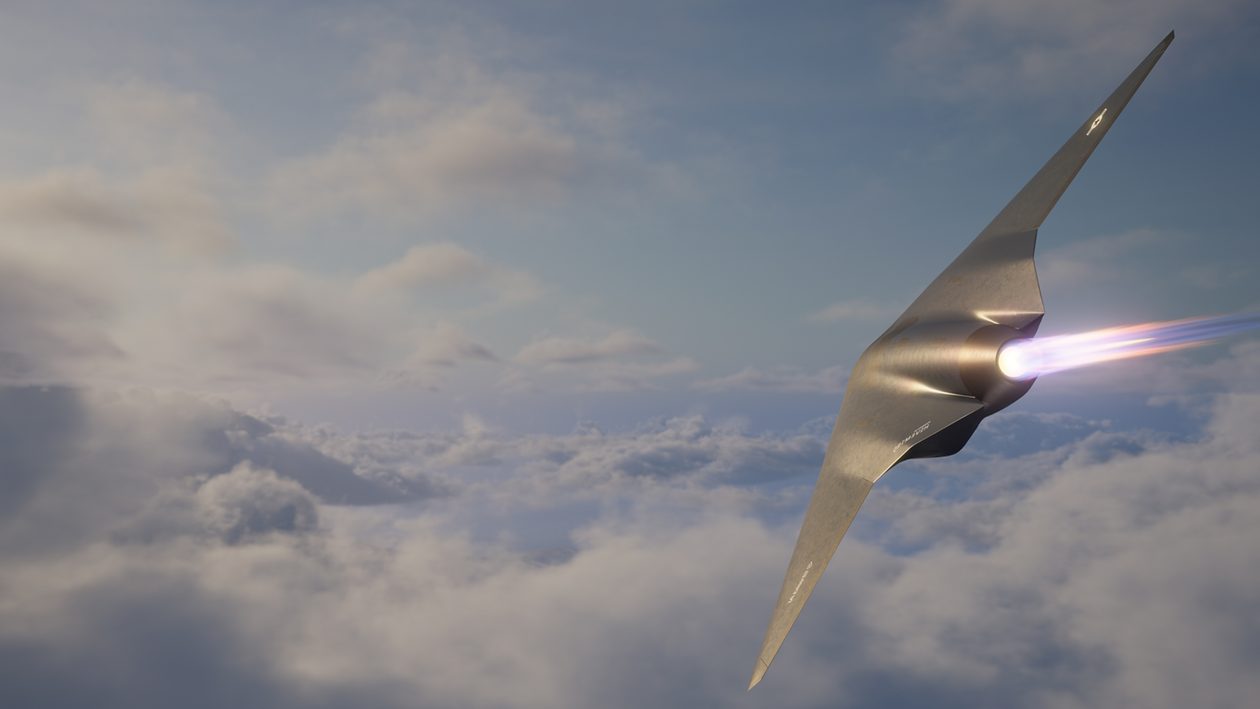
DES MOINES, Wash. — Defense tech powerhouse Shield AI is establishing a massive advanced manufacturing hub in Washington state, tapping the Seattle region’s deep aerospace and tech roots to build a next-generation autonomous fighter jet called the X-BAT.
The project could transform the regional labor market: Shield AI says it expects to have 4,000 workers in the region by the early 2030s as it ramps up mass production of the AI-piloted, 26-foot long aircraft.
It marks a major expansion of advanced aerospace manufacturing in the Seattle region, bringing autonomous military aviation directly into Boeing’s backyard and cementing the state’s position at the center of the AI-defined defense era.
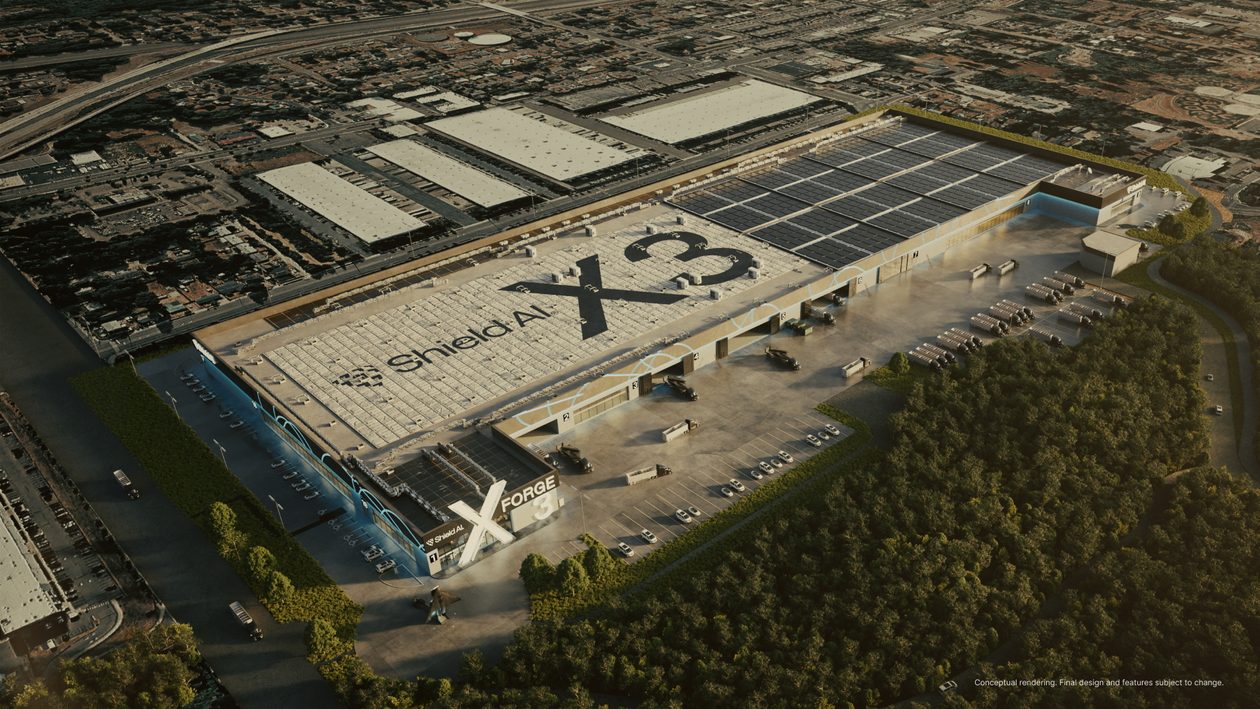
The San Diego-based company, valued at $12.7 billion following a $2 billion venture capital round earlier this year, is looking to complete construction on a 420,000-square-foot facility in Des Moines, Wash., just south of Seattle, next spring.
That physical footprint is expected to grow quickly. Armor Harris, senior vice president of aircraft at Shield AI, told GeekWire that the company is actively looking to add another 1 million square feet in the region to support its long-term manufacturing push.
Named X-Forge 3, the initial facility will serve as the primary manufacturing and engineering center for the X-BAT. It’s now under construction about 15 minutes south of Sea-Tac airport in the Des Moines Creek Business Park West, at 1800 S 216th St.
Developed by Panattoni, the site was selected by Shield AI midway through construction. The company is now taking it to completion, with Harris noting that they are “putting the roof on right now.”
Unveiled last year, the X-BAT is an AI-piloted strike fighter that takes off and lands vertically, carries up to 2,000-pound class weapons in internal bays, and is designed for a 1,000-nautical-mile combat radius — which, when it takes flight, would top the estimated 590 nautical mile combat radius of the Lockheed Martin F-35A.
An economic analysis released by the company estimates Shield AI’s X-BAT program will inject roughly $73 billion into Washington state’s economy over the next two decades as production scales toward full capacity. Projections provided by the company say up to 27,000 direct and indirect jobs — including suppliers — will be generated by the expansion by 2046.
“This is a large program,” said Harris in an interview with GeekWire. “Building a next generation fighter jet is no small endeavor, and with the amount of interest that we’ve seen, both from our U.S. government customers and from international customers, we could be looking at building these at rates greater than fighter jets have been built in a really long time.”
Harris said he expects the first X-BAT aircraft to roll off the line in Des Moines in 2028, with full production ramping up to about 150 aircraft per year by the early 2030s.
The company evaluated more than a dozen sites for the facility, and chose the Seattle area for a simple reason: talent.
Harris cited the region’s robust aerospace legacy, as well as technology giants like Amazon and Microsoft and a burgeoning space and satellite industry which has taken shape in recent years. A number of fast-growing and heavily funded defense tech companies — including Anduril, Armada and Nominal — have also established beachheads in the region in recent years.
He described the X-BAT as a “modern sixth-generation fighter jet” that’s essentially a “flying sensor suite,” ingesting information in real time in order to make lightning-fast decisions.
Deep aviation and technology roots
Building that type of aircraft takes a very specialized workforce, one that Harris said is rooted across technology, aerospace, artificial intelligence, materials science and advanced manufacturing. Those are major strengths of the Seattle area workforce.
“We’re able to tap into that existing lineage and not have to necessarily train a workforce from the ground up, which would be hard to do on the timelines we’re trying to execute,” said Harris, who is planning to relocate to Washington state from Dallas.
To support its ambitious production schedule, Shield AI is actively recruiting across both software engineering and specialized aerospace roles. The initial hiring push for the Des Moines facility spans autonomy developers, flight-control software engineers, composite technicians, and shop-floor assembly specialists.
In one job listing for an engineering manager to lead the X-BAT hardware test software team, the company notes that the ideal candidate “has personally built or led the development of automated hardware test systems used in production, manufacturing, qualification, or other high-consequence environments.”
In another Seattle area job listing for a staff fuel engineer, the company says it is looking for a someone with “strong thermofluid fundamentals, engineering judgment, and the ability to understand fuel system behavior across demanding aircraft operating conditions while serving as the focal point between propulsion, vehicle teams, suppliers, and flight operations.”
Pay across those engineering roles ranges from $169,000 to $300,000 annually, according to the company job postings.
The company currently lists more than 110 open roles in the Seattle area, including a dozen or more in categories such as avionics and electrical; mechanical and thermal; software and networks; and aerostructures.
Choosing Washington also allowed Shield AI to buck a pervasive defense industry trend: separating engineering teams from physical factory floors to shave down labor costs.
While shifting assembly lines to lower-cost regions can cut costs, Harris said that remote manufacturing introduces hidden operational friction when building complex, software-defined aircraft like the X-BAT.
“We fundamentally believe in the colocation of engineering and production is the fastest way to bring capability to our customers,” said Harris, adding that combining engineering and production in a common facility is “one of the secret sauces of Shield.”
In a statement, U.S. Rep. Adam Smith (D-Wash.) — whose district includes Des Moines — welcomed Shield AI and the X-BAT manufacturing facility to King County.
“This hub will create high-quality jobs, strengthen Puget Sound’s expanding technology and aerospace sectors, and further diversify our local economy,” Smith said. “Reimagining aviation will have a rightful home here in Washington’s Ninth District.”
Katherine Caffrey, the city manager for City of Des Moines, welcomed the new jobs and economic investment in the community.
“Des Moines sits at the heart of the Puget Sound aerospace industry, and these jobs and this investment reflects exactly what we want Des Moines to be, a place where families can build strong careers close to home,” Caffrey said.
The ‘holy grail of deterrence’
Shield AI officially introduced the X-BAT program to the public at an October 2025 event in Washington, D.C., unveiling the aircraft before an audience of military leaders, elected officials and defense industry partners.
At the time, Shield AI co-founder and president Brandon Tseng, a former Navy SEAL, called X-BAT a “transformative, runway-independent aircraft” and noted that “airpower without runways is the holy grail of deterrence.”
That vision quickly gained momentum.
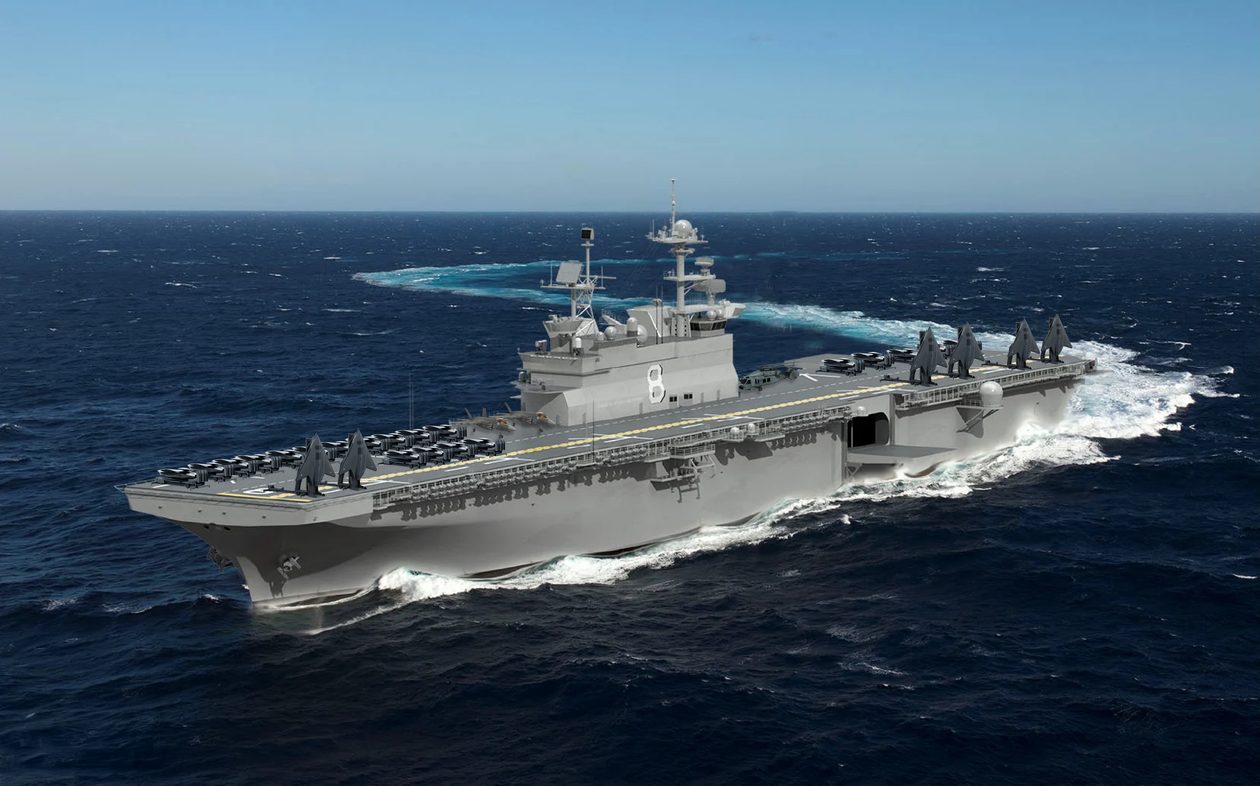
Last month, the U.S. Navy backed the program through an initial $50 million development contract, envisioning the autonomous fighter jets operating directly from destroyers, amphibious assault ships and converted cargo vessels to project long-range airpower without relying on traditional aircraft carriers.
That momentum grew internationally earlier this month, when Shield AI signed a five-year letter of intent with Polish defense companies PGZ and WZL-2. Under the framework, the companies are exploring plans to help build, supply, and repair the X-BAT, a partnership that could give NATO allies a fighter jet capable of operating even if local airfields and runways are destroyed or non-existent.
The X-BAT launches and lands vertically using a specialized Launch and Recovery Vehicle —a mobile trailer that erects the jet vertically, allowing it to be towed on interstate highways or loaded onto cargo ships to set up a field launch pad in minutes.
Harris noted that while a final site selection for manufacturing the LRV trailers has not been made, expanding production into the Puget Sound region remains on the table given the area’s deep manufacturing base.
In addition to the mammoth manufacturing facility in Des Moines, Shield AI announced that it is expanding its presence in both Texas and Kansas.
In Frisco, Texas, the company operates its X-Forge 1 site to handle core prototyping, software integration, and initial engineering for the autonomous fighter. Meanwhile, at X-Forge 2 in Newton, Kansas, Shield AI has expanded its airport footprint to serve as the program’s dedicated flight test, customer acceptance and maintenance hub.
Shield AI expects its X-Forge 2 site in Kansas to support approximately 1,800 regional jobs by the early 2030s, growing to 2,900 positions by 2046 with a projected $5 billion in regional economic impact over that period.
Addressing the cross-country logistics of moving completed aircraft from the Puget Sound assembly line to Kansas for flight testing, Harris explained that the X-BAT can be easily moved via the existing transportation corridors.
“The X-BAT is designed to be road transportable,” he said. “So we’re taking advantage of that.”
Beyond the immediate manufacturing logistics, Harris views the multi-billion-dollar expansion as a major long-term validation of the region’s industrial relevance.
“There’s been a strong narrative of like, ‘Hey, all the jobs are migrating elsewhere,’ and I think this is a big win for the region to capture a major program from a rapidly growing company like this,” Harris said. “This can be the backbone for years of growth in the future.”
That’s a message that Gov. Bob Ferguson is getting behind, saying Washington state is a place where “big ideas take flight.”
“Shield AI’s decision to build its new X-BAT manufacturing facility here is another sign that the future of aerospace is being built in Washington,” Ferguson said in a statement. “We welcome Shield AI and the thousands of good-paying jobs this investment will bring.”