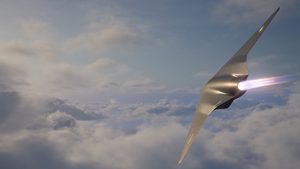
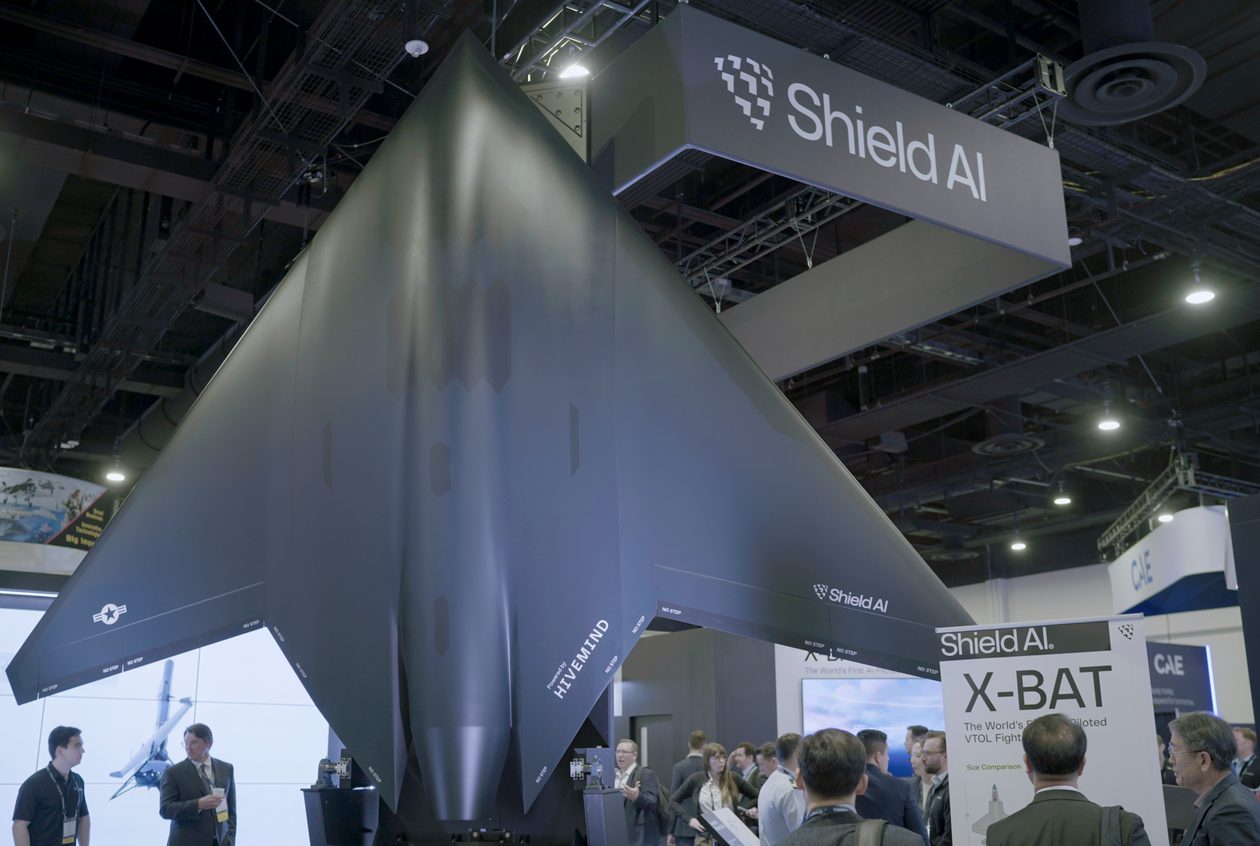
Defense technology startup Shield AI has secured a $150 million contract from the U.S. Navy to advance development of its X-BAT autonomous fighter jet — providing fresh federal backing for the program as the company establishes its first major manufacturing footprint south of Seattle.
Last week, GeekWire reported on Shield AI’s plans to open a 420,000-square-foot engineering and production facility in Des Moines, Wash., dubbed “X-Forge 3.” The company, which is looking to add an additional one million square feet of space in the region, said it expects to employ about 4,000 workers in the Seattle area by the early 2030s.
The new $150 million contract with the Navy adds funding from the Office of the Under Secretary of Defense for Acquisition and Sustainment through its Defense Exportability Features program. The agreement supports efforts to design security and export capabilities directly into the X-BAT, a process that enables advanced U.S. military hardware to eventually be sold to international allies without exposing sensitive domestic technologies.
San Diego-based Shield AI, which raised a $2 billion venture capital round at a $12.7 billion valuation earlier this year, is matching the award with $150 million of its own capital.
Combined with a prior $100 million joint investment finalized in August under the Navy and Defense Innovation Unit’s (DIU) expeditionary strike effort, cumulative commitments behind the X-BAT now stand at $400 million.
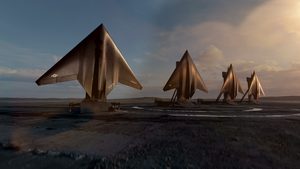
Designed to take off and land vertically, the X-BAT is built to operate from amphibious assault ships, destroyers, commercial cargo decks, and highway strips without relying on traditional concrete runways or aircraft carrier catapults. It launches from a specialized Launch and Recovery Vehicle — a mobile trailer that erects the jet vertically, allowing it to be towed on interstate highways or loaded onto ships.
At the time of its introduction last year, Shield AI co-founder and president Brandon Tseng, a former Navy SEAL, called X-BAT a “transformative, runway-independent aircraft” and noted that “airpower without runways is the holy grail of deterrence.”
The urgency behind runway-independent airpower was underscored last weekend when the U.S. Air Force withdrew strategic B-1 bombers from R.A.F. Fairford in Britain following reports of potential drone threats targeting the air base.
Shield AI expects to begin producing aircraft in Des Moines in 2028, scaling to a target production rate of roughly 150 jets per year by the early 2030s. While prototyping is based in Frisco, Texas, and flight testing will take place at Newton City-County Airport in Kansas, the Des Moines plant will house the core production line and engineering teams.
In an interview with GeekWire, Shield AI executives emphasized the speed at which it hopes to roll out the AI-piloted aircraft in Des Moines.
“This is a large program,” Armor Harris, senior vice president of aircraft at Shield AI, told GeekWire. “Building a next generation fighter jet is no small endeavor, and with the amount of interest that we’ve seen, both from our U.S. government customers and from international customers, we could be looking at building these at rates greater than fighter jets have been built in a really long time.”
Harris noted that keeping development and manufacturing closely linked allows the company to move significantly faster than traditional defense procurement cycles.
“We are testing early and often while working on the aircraft, mission systems, ship suitability and production in parallel,” Harris said in Thursday’s press release. “That approach helps us identify and resolve issues earlier, reduce development risk and move more quickly toward flight testing.”
An engineering team of roughly 500 across Shield AI and key suppliers — including GE Aerospace — is currently building flight-test aircraft.
While the X-BAT has yet to make its maiden flight, the program cleared major hardware milestones in mid-2026. Engineers completed ground engine light-off and thrust-vectoring nozzle integration using GE Aerospace’s F110 engine, alongside wind-tunnel testing to validate internal weapons bay aerodynamics at both low and high speeds.
The aircraft is powered by Shield AI’s Hivemind autonomy software, an AI pilot designed to execute tactical strike missions in contested environments where GPS and satellite communications are jammed.
The jet features a 1,000-nautical-mile combat radius and a 2,000-nautical-mile total range, topping the estimated 590-nautical-mile combat radius of the conventional Lockheed Martin F-35A.
Initial flight tests are scheduled for late 2026 in Kansas, with first production aircraft deliveries targeted for late 2028.
“X-BAT is being built to enhance the lethality, survivability and combat power of U.S. Naval Aviation,” said J.J. “Yank” Cummings, Shield AI’s head of mission solutions for the U.S. Navy and former commanding officer of the aircraft carrier USS Gerald R. Ford. “Its runway-independent design and small deck footprint can increase sortie generation and extend long-range air combat power.”