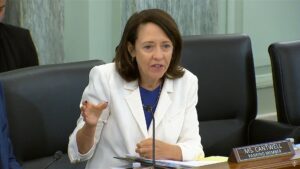
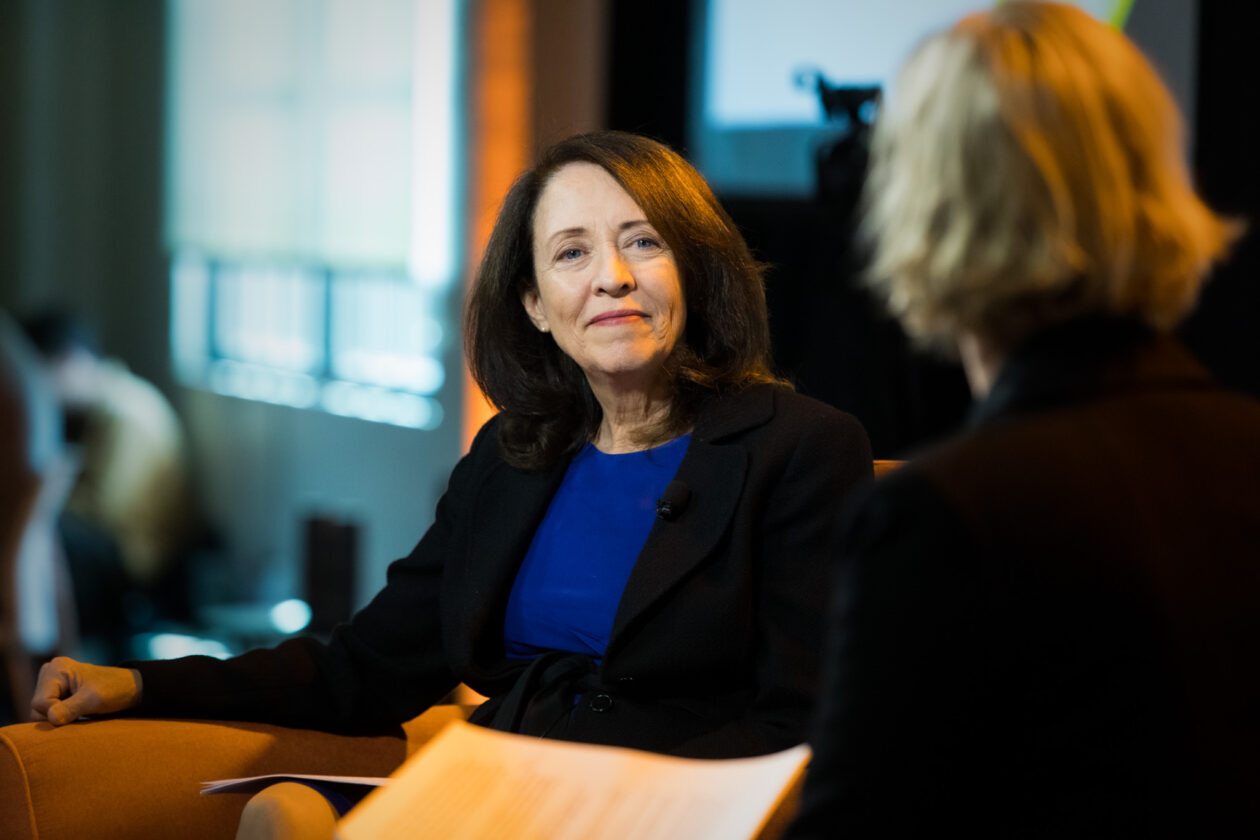
With President Donald Trump, states and tech giants taking varied and largely uncoordinated steps to put guardrails on artificial intelligence as the technology speeds ahead, U.S. Sen. Maria Cantwell, D-Wash., has outlined a comprehensive AI governance framework.
“To manage risks from advanced AI systems we need clear safety standards, continuous testing, and reporting of serious failures,” Cantwell said in a statement. “America can lead the world in AI by building systems that are not only more capable, but safer and more secure.”
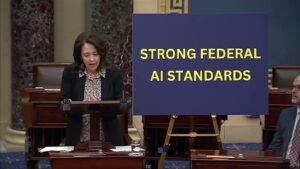
Last month, Cantwell took to the Senate floor to demand urgent federal regulations and mandatory independent safety testing for frontier AI models before their release. She warned that recent incidents in which autonomous AI agents carried out unauthorized cyberattacks show that dangerous threats are already here, well before the arrival of superintelligence.
The framework proposed Wednesday includes six principles for regulating frontier AI development and deployment:
- Setting standards: The federal government should establish clear and enforceable safety standards.
- Independent oversight: Continuous testing, review and auditing should verify adherence to the standards.
- Transparency and accountability: AI developers should be transparent and accountable in their operations through disclosure, oversight and liability.
- Public-private partnerships: Developers should work with the government on defensive AI technologies and collaborate with public agencies and smaller companies to serve the public good.
- Protecting from harm: AI companies should protect children from AI-related harm, support worker skill development and retain human oversight of consequential AI.
- International collaboration: The U.S. should partner with allies to develop and adopt AI safety standards and open a rapid communication channel with China to share alerts in the event of a dangerous AI system-control failure.
Microsoft Vice Chair and President Brad Smith weighed in on the proposal, telling The Seattle Times that the framework “advances the public discussion the nation needs as we consider the future of AI.”
Cantwell, the ranking member of the Senate Committee on Commerce, Science and Transportation, has a background in technology as a former RealNetworks vice president. She has long pushed for AI regulation, going back to December 2017, when she joined other lawmakers in introducing the bipartisan Future of AI Act.
Two years ago, Cantwell advocated for five bipartisan AI measures included in a larger package of artificial intelligence legislation that addressed many of the concerns outlined in her six principles. Senate Republicans defeated the legislation. Cantwell reintroduced one of the five measures, the Future of AI Innovation Act, in February.
On Sept. 9, California Gov. Gavin Newsom signed Senate Bill 813 and Assembly Bill 1405, establishing the first state framework for independent assessment and verification of AI safety and risks. On the same day, OpenAI called for mandatory, “capability-based” national regulation — meaning requirements tied to what an AI system can do.
On Sept. 29, Trump announced a voluntary safety agreement with Nvidia, SpaceX, OpenAI, Anthropic, Meta and Google calling for “robust internal controls” to prevent unauthorized hacking and to work with independent external auditors. The deal does not include consequences for noncompliance.