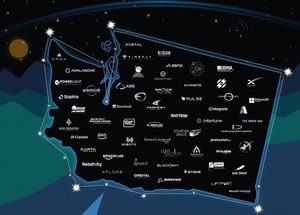
How high can Washington state’s space industry rise?
Preliminary findings suggest that the economic impact of the state’s space sector more than doubled between 2018 and 2022, and nearly doubled again between 2022 and now. But at the same time, some leaders of the space community are questioning whether the Pacific Northwest can keep pace with other regional clusters in, say, Florida, Texas and Colorado.
That good news, bad news situation made headlines this week when Stoke Space CEO Andy Lapsa questioned whether he’d pick the Seattle area as his home base if he had to do it over — just before taking the stage as a member of Gov. Bob Ferguson’s Washington Space Council.
Ferguson isn’t the only elected official trying to make sure the Seattle area keeps up on the space frontier. Dana Ralph, the mayor of Kent, Wash., where Stoke is headquartered, made that clear in her remarks during the kickoff for Seattle Space Week at the Museum of Flight.
“We don’t take you for granted,” said Ralph, addressing a gathering of CEOs, investors and other VIPs. “I want you to hear that out loud: We don’t take you for granted.”
Seattle Space Week — highlighted by Tuesday’s Space Northwest Symposium in Federal Way — provided plenty of opportunities for discussing the challenges facing Washington state’s space ventures. Here are four problems to face, and four prospects to look forward to.
‘We have a problem’
The launch crisis: The availability of launch opportunities has shrunk dramatically. “It’s just crazy how there’s this mismatch between supply and demand right now in the industry,” said Tim Beard, Stoke Space’s chief financial officer. “It’s becoming a crisis.”
One factor is the increased demand for deploying satellite constellations for broadband data services (such as Starlink and Amazon Leo) and for future AI data processing (such as Starcloud, SpaceX’s Starmind and Google’s Project Suncatcher).
Another factor is reduced supply: Blue Origin and United Launch Alliance are dealing with setbacks in their next-generation rocket programs. Meanwhile, SpaceX is talking about phasing out its workhorse Falcon 9 rocket as it makes the transition to Starship. The resulting launch crunch is an industry-wide problem, but it hits Seattle’s satellite ventures especially hard.
The workforce challenge: There’s also a limited supply of skilled technicians and engineers. Bill Bruner, CEO of New Frontier Aerospace, ranks that as his No. 1 challenge. “It’s finding skilled, trained people to do, not just the hard engineering work, but the Grade 13, Grade 14 graduate technical work,” he said. “We need a national solution to that problem.”
Ralph said Kent and other Seattle-area municipalities need to partner with state government and commercial ventures to address the challenge. “We should be able to make it easier for employers to invest in apprenticeship, credentials and on-the-job training,” she said. “We need to build a workforce system that moves with industry, not several years behind it.”
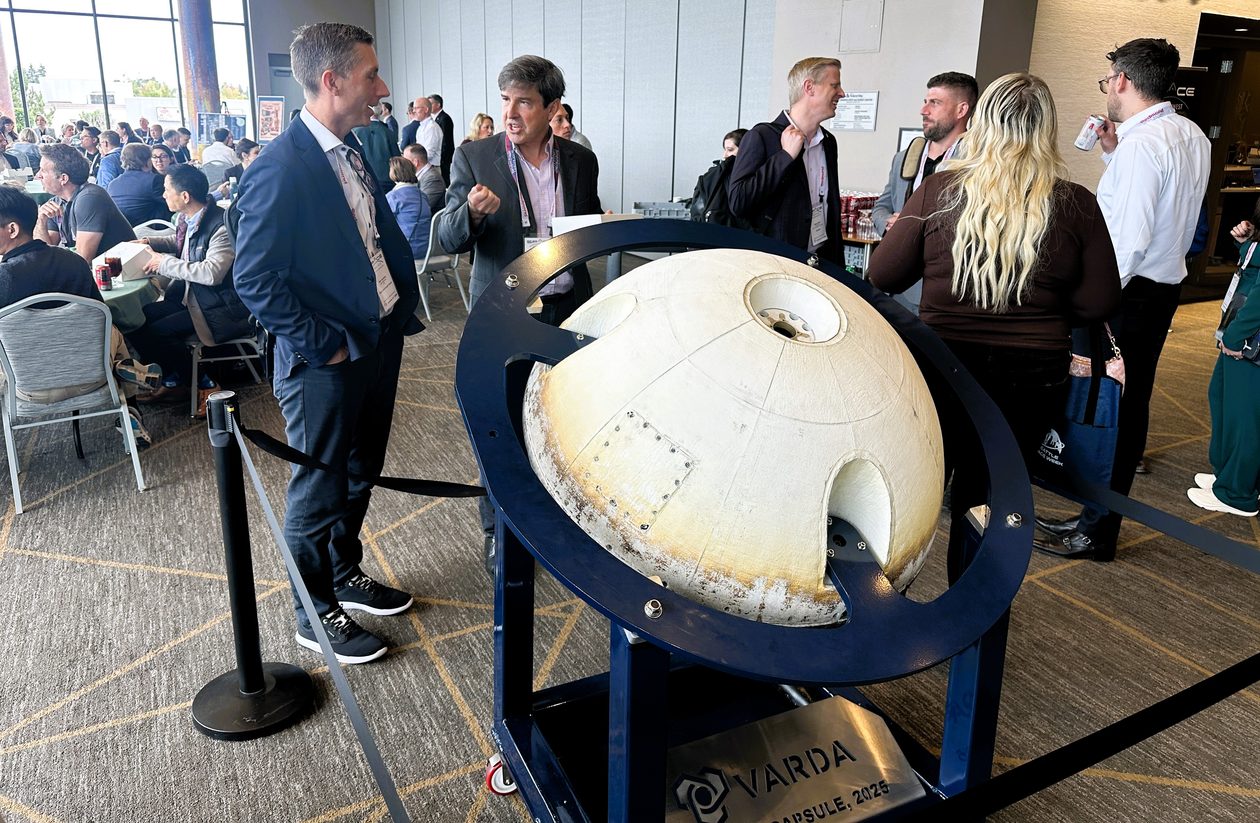
Funding from faraway: Much of the funding that fuels Seattle’s space ventures comes from elsewhere. “There are a lot of VCs in Seattle, but they’re not necessarily space VCs,” said Mike Reilly, chief strategy officer for Varda Space Industries. “I feel like a lot of the space money comes out of L.A. and San Francisco.”
Brian Monnin, co-founder and chief commercial officer at Sophia Space, said midsize space ventures need to find ways to fill their funding gaps. “Debt financing is one way,” he said. “But I think there should be more public-private combinations of firms, traditional banks working alongside debt financiers, working alongside the public for us to fill that vast middle.”
Regional rivalries: Several executives said other states are much more aggressive than Washington when it comes to attracting space ventures. “The incentives just aren’t here,” Monnin said. “We’re looking at where we build our Factory One for Sophia Space tiles, and you have to look at the incentives from sovereign funds in New Mexico, Louisiana and others. They’re far more attractive than they are in this state currently.”
The inter-regional competition was one of the challenges cited by Stoke Space CEO Andy Lapsa — and by his CFO as well. “I need to be pretty direct in that we’re being actively courted by any number of states: Colorado, Texas, Florida,” Beard said. “They want us to move there, but Washington state is the right place for Stoke. … I hope our policymakers in Olympia, throughout the state, our senators hear this. We want to stay in Washington state. Help us do that.”
‘Light this candle’
Public-private partnerships: The newly announced Washington Space Council isn’t likely to set up a multibillion-dollar fund for space ventures anytime soon, but it could serve as a forum for business executives and government officials to work out realistic ways to foster the state’s space industry.
Will the work of the council go beyond virtue-signaling? Last year, the Governor’s Economic Development Strategic Reserve Fund awarded $350,000 to support Portal Space Systems’ expansion into a 50,000-square-foot satellite manufacturing facility in Bothell, Wash. Such grants may serve as a model for future financial incentives.
Satellite offices: Space ventures don’t need to be headquartered in Washington to benefit the state’s space industry. Cowboy Space, for example, is based in California but recently announced the opening of a 291,035-square-foot spacecraft design and manufacturing facility in Kent. BlackSky is based in Virginia, but its satellites are built in a 22,000-square-foot factory in Tukwila, Wash. SpaceX may have moved its corporate headquarters from California to Texas, but it still makes more than half of the world’s satellites at its facilities in Redmond and Woodinville, Wash.
Just as Google and Meta maintain engineering hubs in the Seattle area, out-of-state satellite ventures are likely to establish Seattle-area outposts. “The fundamentals that made this region are still here: talent, a deep supply chain, industrial capacity, a culture of making things, and generations of knowledge that you simply cannot re-create overnight,” Ralph said.
Coming attractions: The silver lining to the launch crisis is that Stoke Space and other commercial space ventures plan to fill the gap. And when SpaceX’s Starship enters service, that could dramatically change the parameters of the launch market. Ron Faith, CEO of RBC Signals, said this week’s first orbital Starship flight was “a pretty big milestone event.”
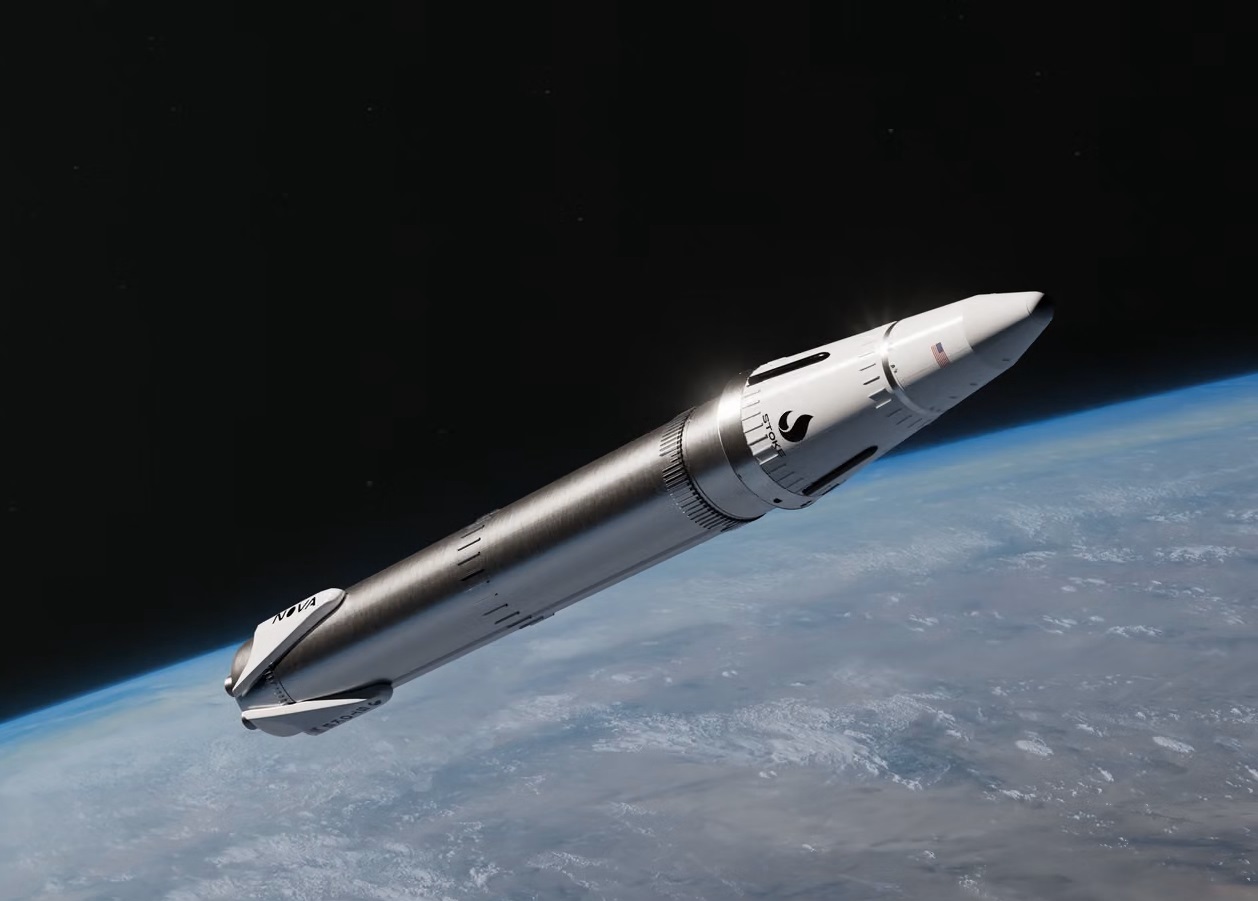
“Having Starship go into orbit and deploy real satellites … that’s a significant increase in capacity for launch,” he said. “But with that said, we’re also seeing many, many more launchers come online.” The list includes Blue Origin’s New Glenn, United Launch Alliance’s Vulcan, Rocket Lab’s Neutron, Firefly Aerospace’s Alpha, Relativity Space’s Terran R — and yes, Stoke Space’s Nova.
A pad of our own: When it comes to space facilities, the Seattle area lacks two big items: a nearby NASA center and an orbital launch pad.
During a recent visit to Redmond, NASA Administrator Jared Isaacman didn’t offer much encouragement for the space agency’s fans in the Pacific Northwest. “I think it’s unlikely we’re going to be adding any additional centers right now,” he told me.
But at the Museum of Flight, Ferguson said the Washington Space Council “will look for ways we might be able to develop Washington-based commercial launch capabilities.”
At the Space Northwest Symposium, Monnin wondered why the Seattle area’s space ventures haven’t forged closer ties with the region’s military installations. “It’s a shame that over the last few decades we haven’t seen the affinity toward Fort Lewis-McChord or the naval base in Bremerton as innovation centers … because from an orbital compute standpoint, the biggest need is defense- or security-related,” he said. “How we haven’t tapped into that as a state, I think, is a miss.”
The Pacific Northwest’s geography would make it difficult to put a launch pad in a place that avoids posing a significant risk to populated areas. That’s why Blue Origin and Stoke Space have their orbital launch pads in Florida instead of Washington. But when Beard was asked about the prospect of using a pad closer to home, he wasn’t dismissive.
“Launching from the Washington coast would be fantastic,” he said. “Also, my geography is not great, but I think it’s slightly closer to ship a rocket to the Washington coast than it is all the way down to Cape Canaveral. So, that’s one advantage as well. We’d love to see launch here, and I think that we’d be good partners to do that with.”
Check out the Space Northwest website for the Seattle Space Week event calendar.