Making the entrepreneurial leap is hard enough, let alone launching a company into orbit. Andy Lapsa gave up a well-paying job, spent his family’s nest egg and went 15 months before paying himself half his old salary to get Stoke Space off the ground.
He said Stoke chose Washington state for its world-class talent in software, aerospace and manufacturing, and for a virtuous cycle in which iconic global companies bring talent and suppliers to the region, and their alumni go on to start companies of their own.
But if Lapsa and co-founder Tom Feldman were starting the Kent, Wash.-based rocket company today, he told a Seattle audience Monday, he’s not sure they’d do it here.
Lapsa cited factors including a political climate that vilifies successful companies and their founders; a state that does less than others to court promising startups; Seattle’s public schools, which he described as a failed institution; and the push for a wealth tax on unrealized gains, which he said would put startups out of reach for anyone who isn’t already wealthy.
“What will it take to ensure the next Stoke builds here, too? If Stoke were starting today, I’ll be straight honest with you: I’m not sure we’d make the same decision,” he said.
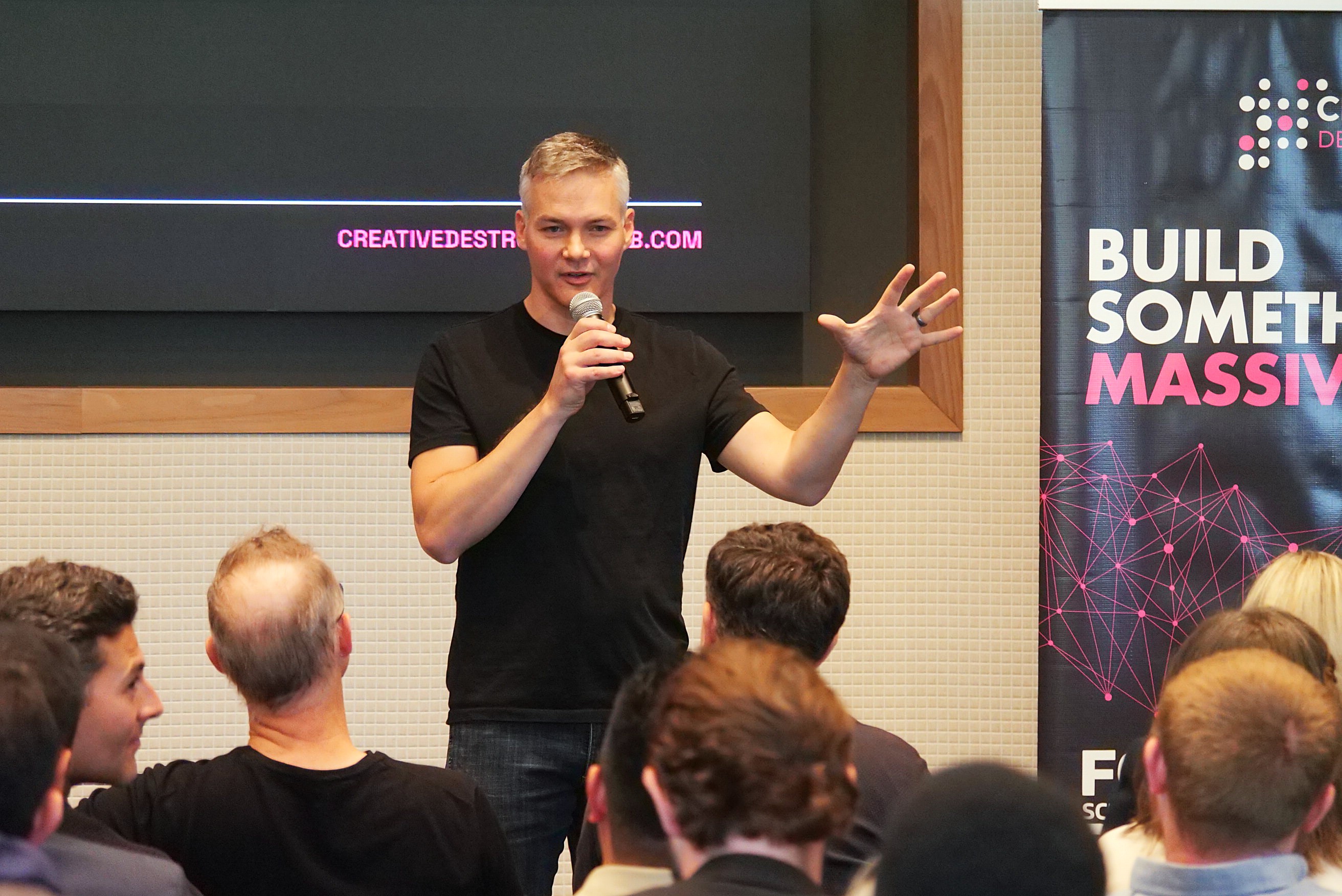
Lapsa delivered the keynote at “Manufacturing the Future in the PNW: Space, Defense & Robotics,” a Seattle Space Week event hosted by Creative Destruction Lab-Seattle.
The speech, which he read from multiple sheets of printed paper, drew on his family’s story and at one point left him choked up. The crowd gave him a standing ovation at the end. The talk was the buzz of the afternoon and the Space Week kickoff at the Museum of Flight in the evening.
Echoes of Schultz: Lapsa’s remarks tracked closely with a July op-ed in the Wall Street Journal by former Starbucks CEO Howard Schultz, who singled out Stoke as a test for the state.
“We should all be watching Stoke Space,” Schultz wrote, to see whether it and other companies “decide that Washington is the best place for them to grow.”
Schultz, who moved to Miami earlier this year, came up in Lapsa’s speech, too. Lapsa cited him and Jeff Bezos as examples of successful founders the region has vilified, and he pointed to Boeing’s headquarters move and Amazon’s HQ2 as part of the same pattern.
Other states calling: Lapsa said South Carolina, Texas, Florida, Ohio, Idaho and Illinois had all emailed him in the past week or two trying to get Stoke to open up shop there.
“I’ve never received the same in Washington state,” he said.
To be clear, in questioning whether he would make the same decision today, Lapsa was speaking hypothetically about founders starting new companies, and didn’t suggest that Stoke plans to leave Washington, where the company has been expanding its operations.
Hours later, Lapsa was among the 23 members of Gov. Bob Ferguson’s new Washington Space Council, introduced at the Space Week kickoff event, as GeekWire reported.
Speaking there, Lapsa struck a similar tone, stressing the need for the state to move quickly.
“States like Florida and Texas and Colorado want this industry, and they want it bad,” he said. “They compete for it every day. Washington has every advantage it needs to lead them all, and the window to use those advantages is open right now.”
A rocket ship: Lapsa’s comments carry additional weight because of Stoke’s trajectory.
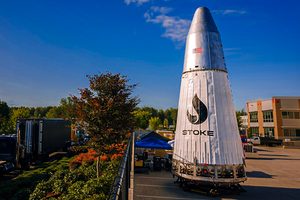
Stoke is developing Nova, a rocket designed so that both of its stages can return and fly again, with the goal of making access to space cheaper and more frequent. It’s only the second company to pursue full reusability, after SpaceX, which reuses the first stage of its Falcon 9 but hasn’t yet achieved full reuse with its much larger Starship.
The company announced a roughly $1 billion Series E round this month, bringing its total funding to about $2.3 billion. It has more than 350 employees in Washington state, a 168,000-square-foot factory in Kent, and a test site in Moses Lake that it’s expanding from 75 to 550 acres.
The first Nova launch is scheduled for early 2027 from Cape Canaveral.
The personal stakes: Lapsa made his case against a wealth tax by telling a personal story that he said he had never told before.
His father grew up in a post-war refugee camp and waited 12 years to immigrate to the U.S., arriving without speaking English. He became a university researcher, but Lapsa’s mother still worked a minimum-wage job to help put Lapsa and his two siblings through college. Lapsa and his wife graduated from college about $200,000 in debt and spent about a decade paying it off.
When he left Blue Origin to start Stoke in 2019, he gave himself nine months to get on track to earn a living wage. Small-business grants and a few angel investors kept the company going.
That’s why a tax on unrealized gains worries him. When a startup raises money, its founders become wealthy on paper overnight, he said, without a dime of cash to pay the resulting tax bill.
“It makes it so that the only people who can afford to start a company are the people who are already rich,” he said.
A note of optimism: Lapsa closed by urging the audience to look past the headlines in their feeds and think critically about the consequences of the policies being proposed. He warned that political extremism harms the country and benefits its adversaries, and that both sides of the aisle are feeding a dangerous cycle of rhetoric.
Americans have more in common than their differences, he said. The freedoms they share, including the ability to change public policy when it isn’t working, are what made the U.S. the greatest country in history, he added.
“These are the reasons I stubbornly cling to the hope that Washington state will come around,” he concluded, “and the next Stoke Space decides here is their place.”