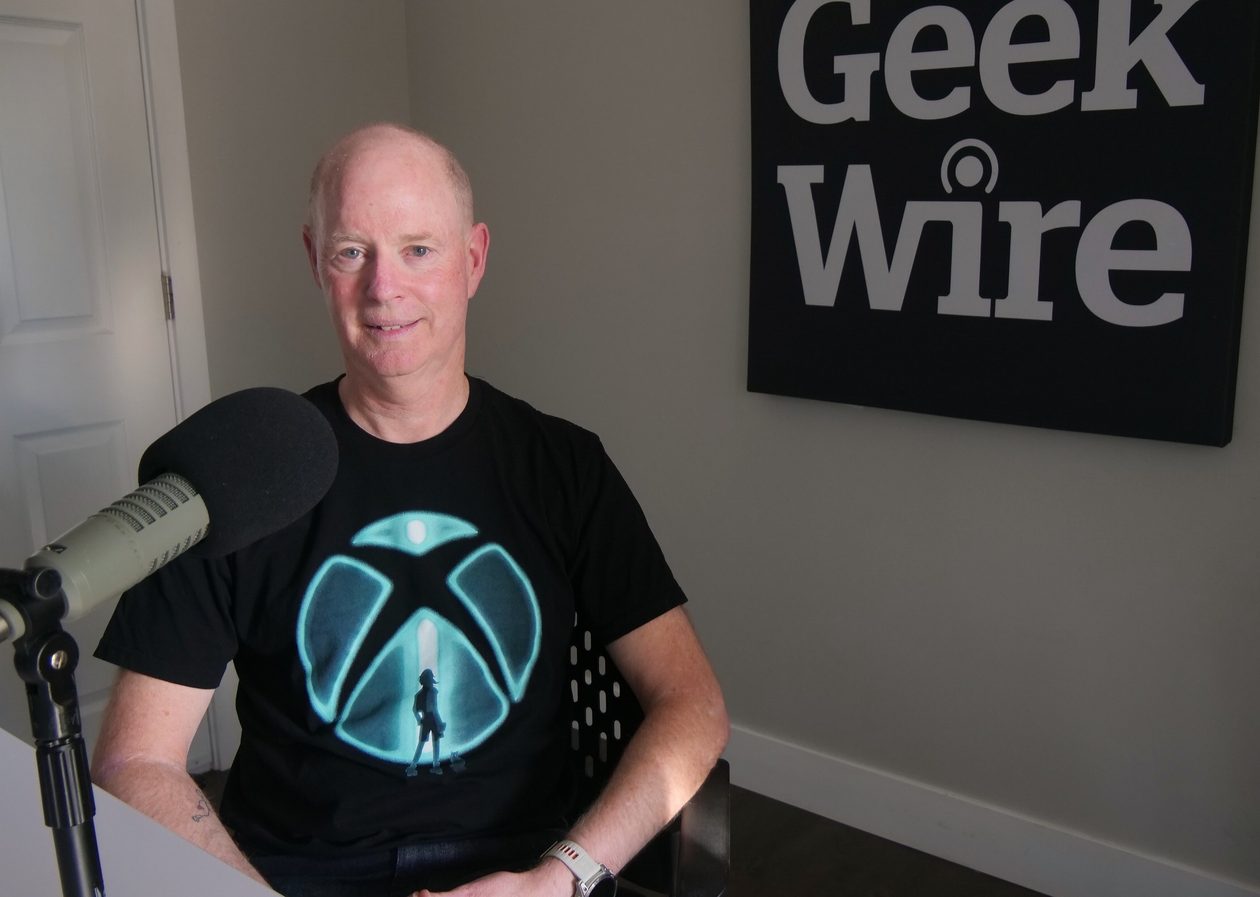
The name Frank X. Shaw isn’t as well known outside the company as those of Microsoft’s other senior leaders, and that’s the nature of the job. But behind the scenes, the company’s longtime communications chief has shaped its public image for nearly three decades, working for all three of its CEOs and handling its biggest stories along the way, from antitrust to AI.
Shaw announced in September that he’s leaving Microsoft at the end of the year. On this week’s GeekWire Podcast, he sits down for what amounts to an exit interview. We’re joined in the conversation by longtime Microsoft beat reporter Mary Jo Foley, editor in chief of Directions on Microsoft and a GeekWire contributing writer.
Shaw talks candidly about working for Bill Gates, Steve Ballmer and Satya Nadella, and about the situations he’d handle differently. He describes his behind-the-scenes dealings with some of the top reporters in tech, from an executive’s objection to a single word to the heated argument that changed how he saw his job.
He also reflects on how communications and media are changing in the AI era, and explains why trust still comes down to a belief in the person telling the story.
Listen below, and continue reading for highlights.
On Microsoft’s three CEOs: Shaw says intensity is what the three have in common, expressed differently: “Steve was outwardly intense. Satya is quietly intense, and Bill is cuttingly intense.”
Ballmer was the hardest to explain to the public, he says, because the loud-salesman caricature hid a thoughtful, detail-oriented leader who often played the boisterous public role because Microsoft’s sales force needed it.
On the clarity of hindsight: Big decisions look obvious once they work out, Shaw says. His example is the board’s choice of Satya Nadella as CEO. It’s seen as a no-brainer now, but at the time there was a lot of debate, there were other candidates, and it was a hard, complicated decision.
“When you get a decision right, it always looks easy afterwards,” he says. “If you get it wrong, you were just an idiot all along.”
On speaking up: A communications leader should weigh in when a decision could damage the brand, Shaw says, and he learned that the hard way.
When Mary Jo asks how he decides when to push back on executives, she raises the Kin as an example. Shaw says he thought the phone would fail. It was late to market, and it would cost more than people expected because it required a data plan. Engineers he talked to had their doubts, too.
But when Ballmer went around the table asking whether to launch it, Shaw stayed quiet, unsure a communications executive had standing to weigh in. Microsoft pulled it within weeks.
In hindsight, he says, framing it as a brand risk would have given him standing to speak: if the Kin failed, it would cause significant brand damage and hurt Microsoft with the younger audience it was trying to reach. He doubts speaking up would have changed the decision, but says he would have felt better about it.
On underestimating a story: A story that doesn’t get much initial attention can still define a company for years. Shaw’s example: Vanity Fair’s 2012 “lost decade” story.
As he recounts it, reporter Kurt Eichenwald told him, “If you don’t give me Steve and Bill, I’m just going to write a hit piece,” and then did. Shaw says he should have escalated to Vanity Fair sooner, and he underestimated how a story that got little immediate pickup would shape how reporters described Microsoft for the next four years.
On narratives: Continuing on that theme, Shaw says facts can be disputed but “narratives are sticky,” and a company can only change one by changing its own behavior. In the 2000s, he says, every story described Microsoft as “a convicted monopolist,” and ending stack ranking was part of how the company moved past the lost-decade image.
On what makes a good story: Shaw recalls having a shouting match with Rob Guth, then a Wall Street Journal reporter, over an article Shaw no longer remembers. It got heated enough that Shaw pulled his car over in Madison Park to keep arguing. (Guth now works as a writer and researcher for Bill Gates.)
Guth told him he was bad at his job because he thought the job was getting positive stories. What Shaw should want, Guth said, were interesting stories that showed something real about the company. Some would be less flattering, but they would be more memorable.
Shaw told him he was wrong. But after thinking it over, he concluded Guth was exactly right. A story about a product built perfectly that everyone loves is boring, he says. “That’s like the plane landed safely. Nobody cares.” The coverage worth hoping for illuminates part of the company in a memorable way, and that always comes with tension.
On taking risks with reporters: Cooperating on a story you can’t control is a risk worth taking when the result shows something real about the company, Shaw says. Asked by Mary Jo for an example, he points to The New Yorker’s long piece on Microsoft’s relationship with OpenAI, featuring Kevin Scott, the Microsoft chief technology officer.
Microsoft agreed to it knowing that the writer, Charles Duhigg, would talk to many people and test a thesis along the way, so there was no telling what would come out. Then Sam Altman’s brief ouster from OpenAI happened right before the story went to press. It was a risky story, Shaw says, but it captured the company at a revealing moment.
On corrections: Shaw’s test is whether something is “irritating” or “damaging.” Only factual errors that matter are worth pursuing, he says.
His example is a Bloomberg story by Dina Bass that described an executive as having “wooed” customers. The executive hated the word and wanted it changed, so Shaw made what he calls the run up the hill, pressing Bass on the exec’s behalf and asking her to check with her editors.
She pointed out that she hadn’t quoted the executive using the word, and the editors left it alone. The executive didn’t like it, Shaw says, but it wasn’t wrong.
On speaking with one voice: Shaw says a big part of his job was trying to ensure that a company of Microsoft’s size made sense to the world.
He recalls a Seattle Times reporter who got 26 pitches from Microsoft in one week and asked him which ones Microsoft thought were important. Sending pitches indiscriminately was a mistake, he says. The company needed to decide what three or four things mattered most and focus its messaging on those.
On building in public: Asked about recent internal memos pointing Microsoft toward more voices and less central messaging as he departs, Shaw says the company already has many employees talking about its products on LinkedIn, X and Reddit, and that’s a good thing.
Someone from Microsoft answering questions in a Reddit Excel thread doesn’t need to be babysat by the communications team, he says. He sees it as a continuation of what Microsoft did with Channel 9 and thousands of MSDN blogs.
At the same time, he says, there are moments, such as a big event or a major launch, when the company needs to break through.
“Every once in a while you want the world to know Microsoft had something to say today,” he says. That’s hard, it takes real effort, and it can’t happen every week or even every month, so the company has to pick those moments and do them right.
On AI and the media: AI can help spokespeople prepare, Shaw says, but asking it what Mary Jo will ask, for example, produces “generic Mary Jo questions.” The best interviewers, he says, deliberately avoid the predictable question.
On reporters’ styles: Preparing a spokesperson means knowing how a particular reporter works, Shaw says, and that comes from people who have sat through many of their interviews. His example is Steven Levy, the veteran tech journalist and Wired editor at large, who Shaw says can lull you with 10 minutes of easygoing conversation, then hit you with one sharp question after another.
Other reporters always sound negative in interviews but write straightforward stories, he says, and an executive who reads too much into the tone risks getting knocked off their game.
Asked to name the toughest reporter he has dealt with, Shaw pushes back on the label. Good reporters are tricky to work with because their job is to find things out and surprise you with what they know, he says. That doesn’t make them tough. What makes a situation difficult is usually a story with real conflict and tension, not the reporter.
On Microsoft in the AI era: Shaw sees AI in a transitional moment, moving away from a constant focus on the models themselves. Right now, he says, every new model release or manifesto makes everyone stop and look.
He hopes the attention will shift from new models to whether AI is actually useful, and he says that’s where Microsoft has historically been strongest.
Acknowledging that he’s still on the payroll and rooting for the company, he offers an analogy that will resonate with anyone who learned to drive a stick shift. The AI model companies want to drop a bigger, more powerful engine into businesses, and the result is often a lot of grinding of gears.
“We’re the clutch,” he says. Microsoft’s infrastructure, in his telling, lets companies absorb that power and get moving without the disruption of a new engine and a demand to go 110 miles per hour.
On journalism: “People trust what they hear because they trust the people,” Shaw says. Deep knowledge of a beat becomes more valuable as the world gets more transactional, he says, even as the business behind it becomes less sustainable.
On what’s next: Shaw plans to take some time off and isn’t making any big decisions. People have suggested consulting, another big communications job or board seats, he says, but he doesn’t want to rush into anything.
Mary Jo has a suggestion: run PR for OpenAI, “because man, they need somebody to help.” Shaw’s characteristically dry reply: “That would be such a low-stress job.”
Related links
- Microsoft comms chief Frank Shaw to exit after nearly three decades shaping the company’s message
- Internal memos: Microsoft shakes up communications as Nadella makes a push to build in public
- Microsoft’s ‘lost decade’: Vanity Fair piece accurate but incomplete
- Frank X. Shaw: Things I’m Thinking About
- Mary Jo Foley’s GeekWire stories
Edited and produced by Curt Milton; Music by Daniel L.K. Caldwell.