Tech remade Seattle and San Francisco over the past three decades, bringing jobs and wealth along with soaring housing costs and a political backlash. Now the AI boom is hitting both cities, before either has resolved the tensions that have repeatedly divided their communities.
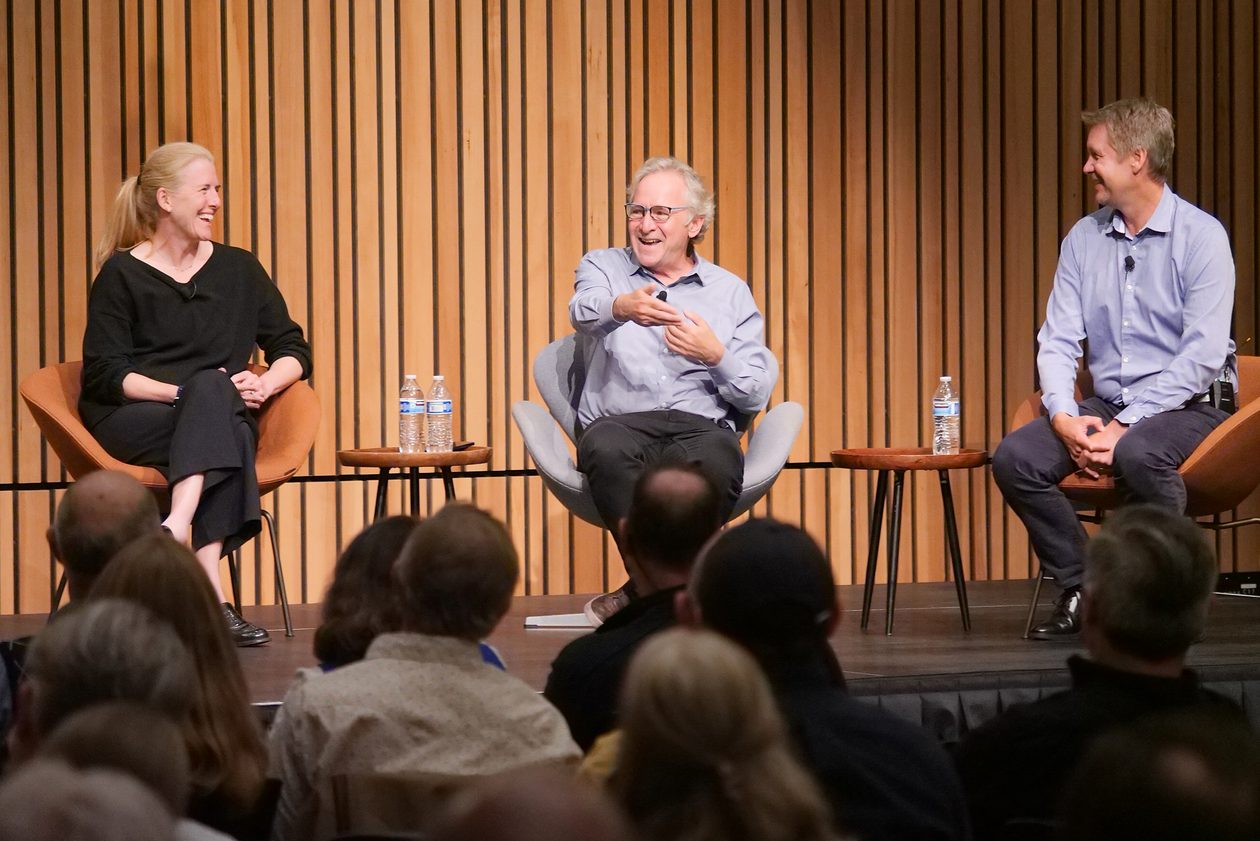
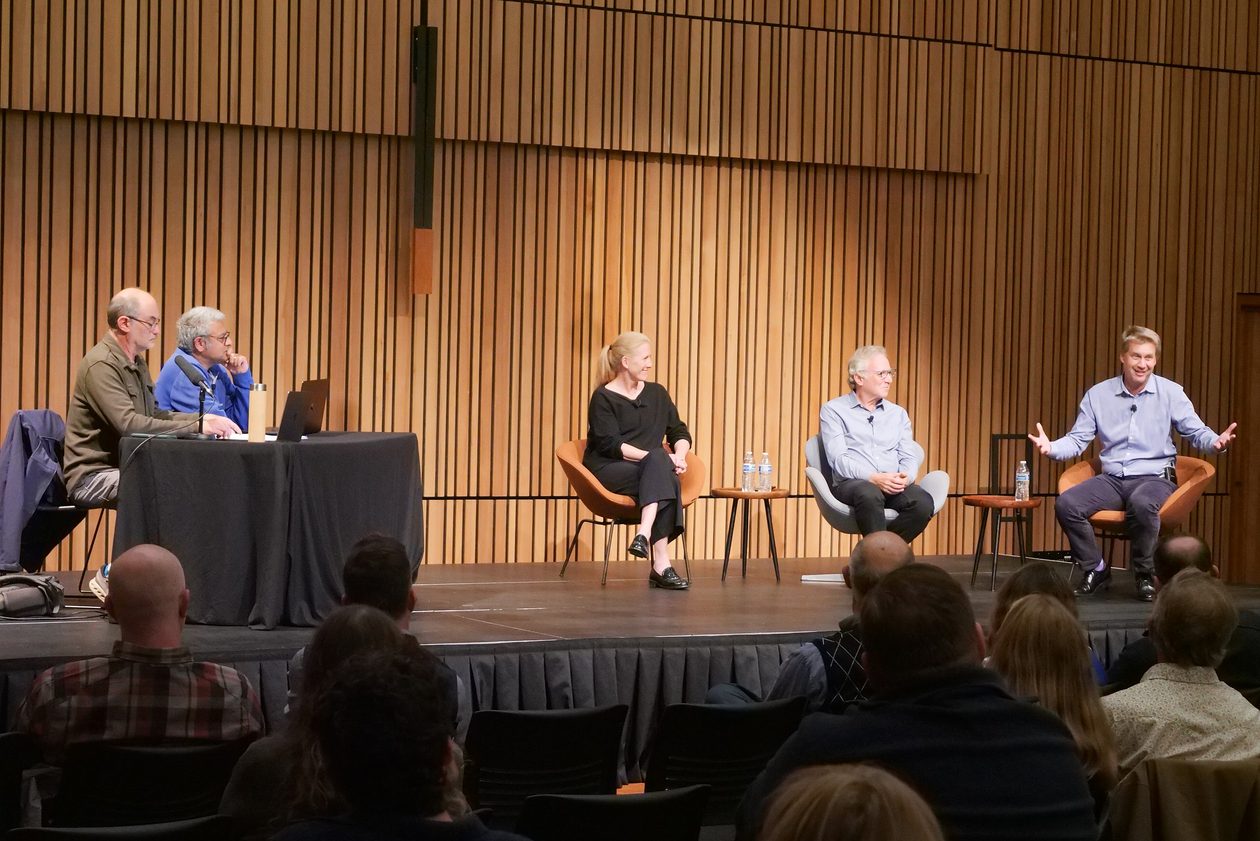
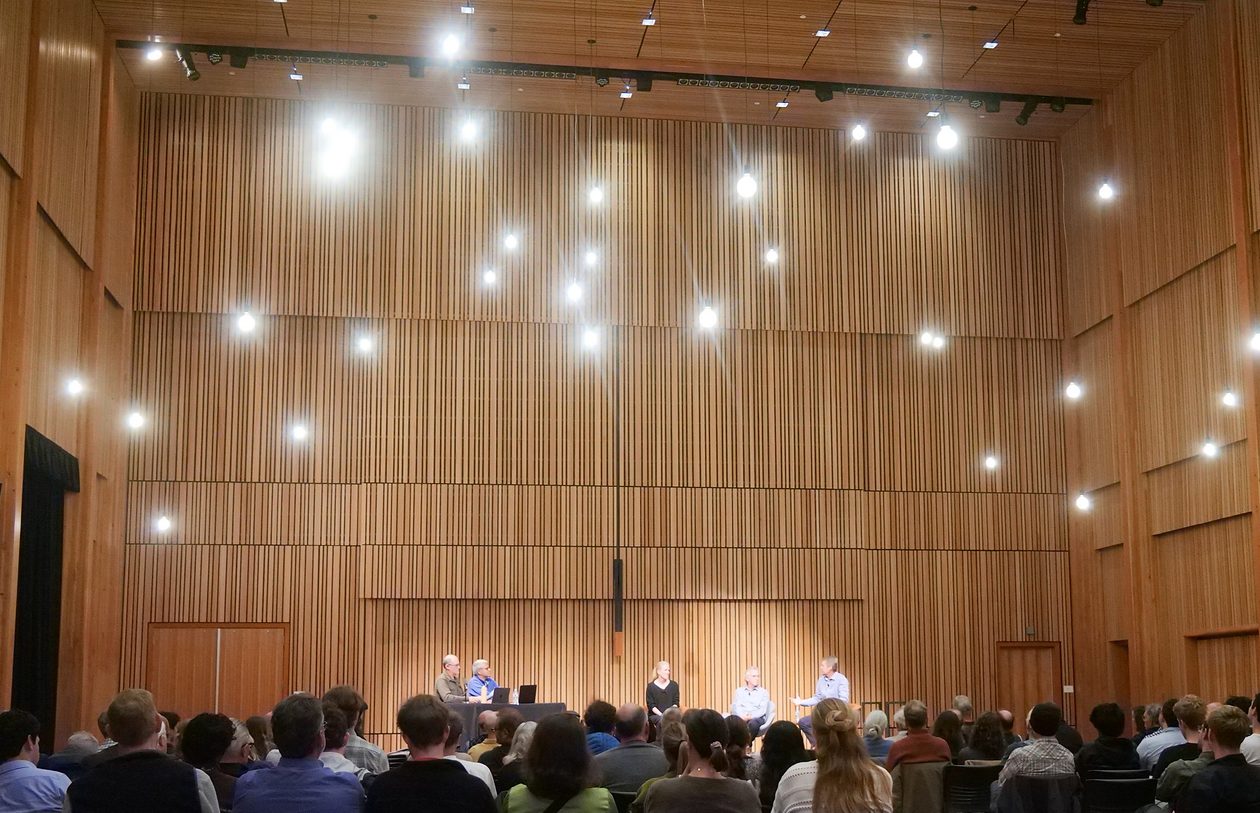
That’s the subject of this week’s GeekWire Podcast, a live joint taping with the Blue City Blues podcast at the National Nordic Museum in Seattle. GeekWire co-founder John Cook joins historian Margaret O’Mara, author of “The Code,” and San Francisco journalist Jonathan Weber, author of “City on the Edge,” with Blue City Blues hosts David Hyde and Sandeep Kaushik.
Here are some of the key takeaways from the conversation.
The tech industry’s conflicts in Seattle and San Francisco began when the industry moved out of the suburbs and into the middle of both cities.
Silicon Valley grew up 30 to 40 miles south of San Francisco, and Microsoft built a suburban campus in Redmond that O’Mara called “its own kind of bubble far away from the city.”
When Weber arrived in San Francisco in 1990 to cover Silicon Valley for the Los Angeles Times, he said, “there was essentially no tech in the city at all.” That changed with the dot-com boom, which brought the first backlash in San Francisco’s Mission District in the late 1990s.
In Seattle, a similar shift happened with Amazon’s move to South Lake Union, starting in 2010. John said Amazon was “most perfectly positioned” at its earlier headquarters on Beacon Hill, southeast of downtown Seattle, “completely isolated from the rest of the city.”
“When things really shifted for Amazon is when they decided to plant themselves in the middle of the city,” John said. “Then things accelerate, and then these problems start to come in, and Amazon starts to get blamed.”
The tech industry grew up in an era of low taxes and light regulation, and that’s baked into its business model.
O’Mara pointed to 1978, when California voters passed Proposition 13, which capped property taxes and “essentially starved localities of revenue,” she said. Personal computers and video games were taking off in that same era. “Silicon Valley’s kind of grown up in that world,” she said.
In Seattle, John said, Amazon’s view was that it was doing enough by bringing jobs to the city, while the city’s progressive leaders wanted more as prices rose. “Those two philosophies just collided in Seattle in real time,” he said.
Cities have limited leverage, Weber said. “A company can move two miles and avoid whatever taxes the city wants to impose.”
Seattle’s tech and business leaders, unhappy with the city’s political leadership, are organizing to fill the gap themselves.
Asked whether tech leaders think they’ve been getting good leadership from Seattle’s mayors, John said, “Short answer: No.” Businesses feel they’re paying a growing list of new taxes, he said, without seeing results on basics like potholes and clean streets.
In recent months, business figures including Microsoft’s Brad Smith, former Gov. Chris Gregoire and Joe Nguyen of the Seattle Metropolitan Chamber of Commerce have started forming coalitions and pooling their resources. “They’re going on offense,” John said. “They feel there’s a vacuum and a gap here based on this lack of political leadership.”
John said one of a mayor’s big jobs is to be “the chief cheerleader of the region and the city,” and Seattle’s recent mayors haven’t done it.
Weber said San Francisco Mayor Daniel Lurie has made that role a big part of his success: “Even though he’s a billionaire, he comes across as kind of a regular San Francisco guy.”
“That’s kind of a regular San Francisco guy these days,” O’Mara quipped.
San Francisco is the center of the AI boom, but Seattle and the Bay Area have always depended on each other more than they’ve competed.
Weber called San Francisco the undisputed capital of AI, as the home of OpenAI and Anthropic. The boom has brought so much wealth to the city, he said, that “there’s a mansion shortage.”
John said the gap between the two regions in venture funding for AI is “an astronomical difference.” But OpenAI and Anthropic have both opened engineering centers in the Seattle area, he said, hiring people who don’t want to leave.
Microsoft and Amazon both raised early money from Bay Area venture capitalists, O’Mara said.
John cited the longtime advice for Seattle founders: “Start your company and build your company in Seattle, raise your money in the Bay Area.” But Seattle has always run second to the Bay Area, John said, and that’s OK. “Who cares?” he said. “They are their own thing. We’re our own thing.”
The Gilded Age offers a precedent for putting guardrails on AI.
O’Mara compared the moment to the era of Carnegie and Rockefeller, when fast-growing industries overwhelmed a small U.S. government, and the regulation that followed still left room to make a lot of money.
Overemphasizing the novelty of AI, she said, “becomes a very convenient excuse not to regulate it.”
Weber said the AI debate is hard to read because most of the people in it are “talking their book,” with a business interest in the positions they take. The issue is arising, he said, at a time when “we essentially don’t have any national political leadership that’s able to deal with it.”
“So many things are indeed new,” O’Mara said, “but it doesn’t mean that nothing can be done.”
Both cities need to protect their quality of place, and tech itself can undermine it.
O’Mara said building a tech hub comes down to three things: capital, institutions such as research universities, and quality of place. Asked what Seattle and San Francisco should do differently over the next decade, she picked the third.
“This is not just making things nice for Amazon engineers getting paid $300,000 a year,” O’Mara said. “It is making the city safe, vital and fun.”
Weber said tech threatens that sense of place, because people who can shop, meet and find entertainment online don’t need the city in the same way. In San Francisco’s traditional nightlife districts, he said, there’s little going on after 9 p.m., while the city’s caterers and party planners are busy. “A lot of social life has moved indoors into private spaces,” he said.
To which John joked, “I just want to enjoy San Francisco in the metaverse.”
Subscribe to GeekWire in Apple Podcasts, Spotify, or wherever you listen.