
The marketing team had no idea anything was wrong. Their rankings were holding. The site still ranked on the first page for the keywords they’d fought over for years, and the dashboards were green. Yet quarter over quarter, traffic was thinning, not collapsing, just quietly draining, with no single number to blame.
Then someone did something simple. They opened an AI assistant and asked it the question their customers ask: what’s the best option for our category? The assistant gave a confident answer and named three companies. Theirs wasn’t one of them. It wasn’t ranked low or buried on a second page. It simply wasn’t there. For a growing share of their customers, the company had effectively stopped existing, and nothing in their analytics had warned them.
This is the quiet shift reshaping marketing in 2026. As customers increasingly ask AI assistants to recommend, compare, and decide, a new discovery surface has formed alongside search, one where brands are either part of the answer or absent from it. And being absent here is different from ranking poorly. There is no second page to scroll to. You are named, or you are left out of a conversation you never knew was happening.
The Shift Isn’t New, But Its Stakes Are
Marketers have been told for decades to move from push to pull: from interrupting people to being found by them. The idea isn’t new. Seth Godin made the case in Permission Marketing in 1999, and “inbound” has been industry orthodoxy since the late 2000s.
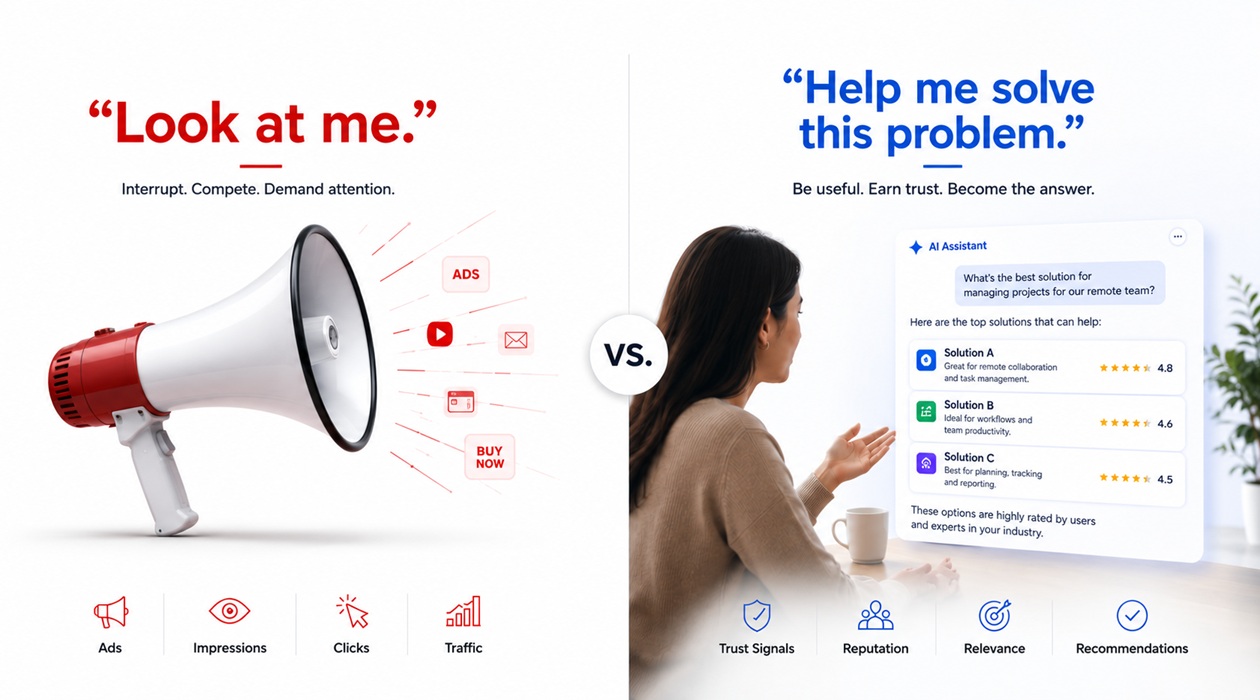
What’s changed is where being found now happens. When a customer asks an AI assistant rather than scanning a results page, interruption-based marketing has little to grab onto, you can’t insert an ad into a synthesized recommendation. Push tactics haven’t stopped working everywhere, but they have become significantly less effective at the exact moment of decision, because that moment increasingly takes place inside a conversation the brand isn’t part of.
This does not mean search engine optimization is dead, and any claim that it is should be treated skeptically. Search still drives enormous volume, and the same signals that earn search authority often help with AI visibility too. The more accurate framing is additive: AI-mediated discovery doesn’t replace SEO so much as open a second surface where brands must separately earn the right to be surfaced. The company in the story didn’t fail at search. It succeeded at search, and never realized a second scoreboard had appeared.
What Actually Determines Whether You’re Surfaced
The temptation is to treat this as a new technical game, an “LLM optimization” playbook to replace the SEO one. That instinct misreads the shift. For executives, the useful lens isn’t how language models retrieve information; it’s what they reward. Three business realities matter far more than any mechanic.
Third-party validation now outweighs self-promotion. AI assistants lean heavily on what credible, independent sources say about a category, reviews, reputable publications, expert roundups, and the places where real customers compare options. A brand discussed across many trusted third-party sources becomes part of how the category is understood. A brand that exists mainly in its own marketing copy often doesn’t. The uncomfortable inversion: the marketing you control matters less than the conversation you don’t.
Clear category association beats aspirational branding. Assistants connect problems to solutions. A brand consistently described in the context of a specific need, “best for tight spaces,” “the option that scales,” “the one that’s easy to set up”, becomes the answer to that need. Vague, aspirational language (“redefining performance,” “engineered for greatness”) gives the model nothing concrete to attach to a real question. Being unmistakably the answer to a specific problem matters more than being broadly impressive.
Structured, genuinely useful information wins. Clear specifications, honest comparisons, and direct answers to the questions customers actually ask are what get surfaced, because resolving the customer’s problem is precisely what the assistant is trying to do.
Notice what’s missing from that list: ad spend, retargeting, attention-grabbing creative. None of it reaches the assistant. You can’t buy your way into a recommendation the way you bought your way up a results page.
“In an AI-mediated market, a brand that isn’t surfaced doesn’t exist. “
What Leaders Should Do Now
The work is less about gaming a system and more about becoming genuinely worth recommending. In practice, that means a few priorities.
Earn real third-party presence where your category is discussed, authentic reviews, comparisons, and expert coverage rather than manufactured mentions. Describe what you do in terms of the specific problems you solve, in language a customer would actually use, not in marketing abstraction. Build information designed to resolve a question completely, because the brand that most clearly solves the problem gives the assistant every reason to name it. And treat AI visibility as a metric in its own right: periodically ask the assistants your customers use the questions your customers ask, and see whether you appear.
None of this is a trick, and that’s the point. “I want your attention” was always slightly adversarial, a request to take something from the customer. “I want to help you solve a problem” is the opposite, and the systems now mediating discovery happen to reward exactly that. The specific mechanics will keep shifting; the principle won’t. Be the genuine answer to a real problem, and you remain part of the conversation. Settle for demanding attention, and you risk ranking first on a dashboard fewer people are looking at, present in search, yet absent from the moment the decision is actually made.
