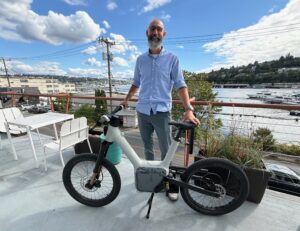
I pulled a classic Seattle move while test riding an e-bike from Rivian spinout Also last week. It was straight out of the sketch comedy series “Almost Live” and the Ballard Driving Academy: I left my turn signal on.
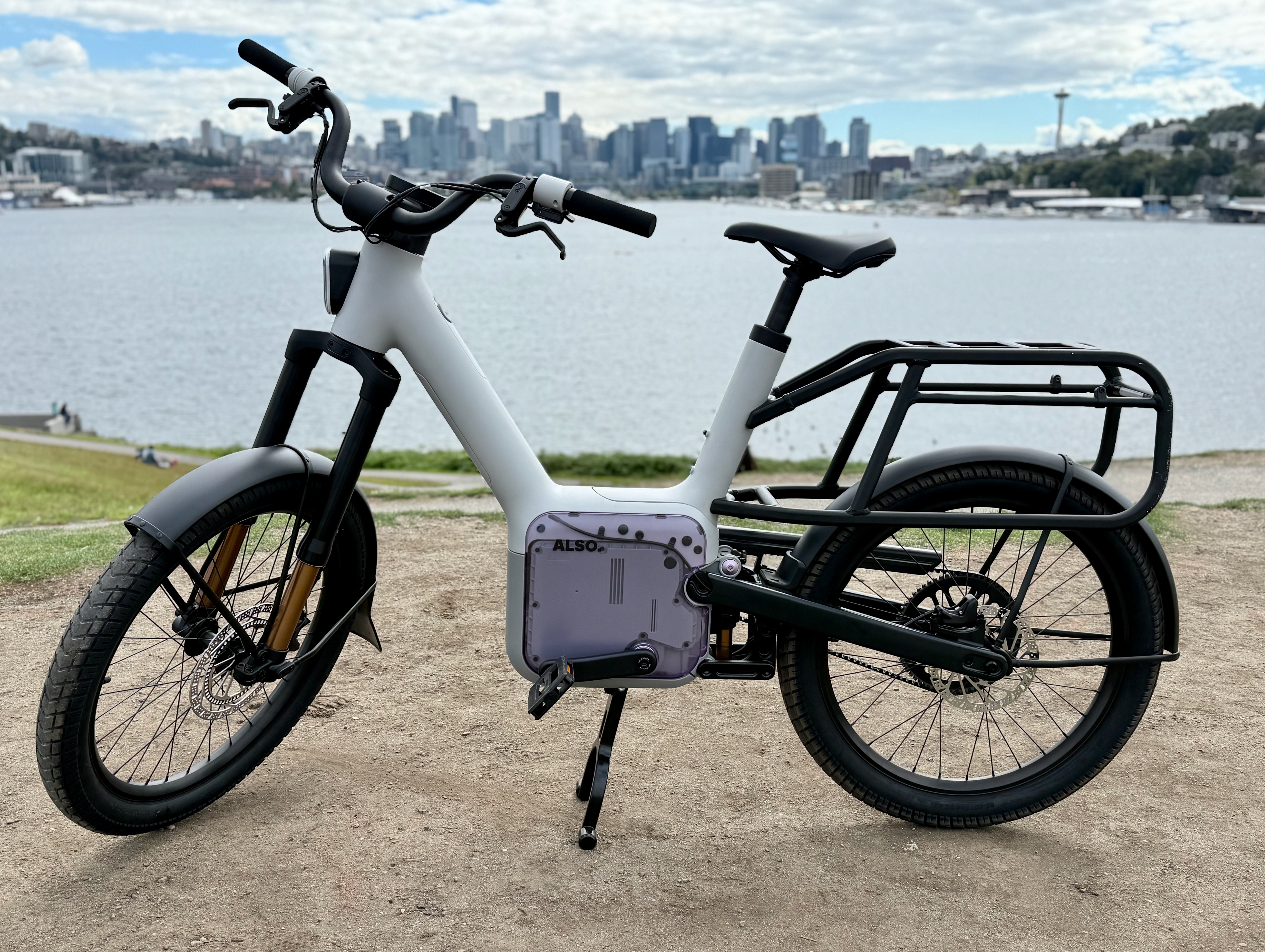
A turn signal is about the lowest tech feature on the TM-B e-bike (Transcendent Mobility Bike), a Class 3 software-defined machine built around what Also calls its “Dream Ride” system.
The bike feels more like an EV than any two-wheeled commuter I’ve ever ridden. From the digital control portal to the immediate acceleration and regenerative braking, the TM-B is designed to treat hardware as software — relying on a pedal-by-wire powertrain.
While an enclosed belt drive delivers power from the central electric motor to the rear wheel, there is no mechanical chain or physical link connecting your pedals to the drivetrain. Instead, your pedaling acts as a digital controller, telling the motor software how much power to send to the back wheel while generating synthetic gear resistance under your feet.
Also is running a pop-up station at outdoor retailer Evo’s flagship store in Wallingford, where riders can book test spins through the end of the year. Seattle is one of 10 initial launch markets nationwide, giving commuters a chance to put the bike through its paces.
The local pop-up isn’t just a coincidence; it sits directly across from Also’s new office location on Northlake Way. The Palo Alto, Calif.-based company, spun out of EV maker Rivian with a $1 billion valuation, is tapping into Seattle tech and retail talent with a commercial outpost and future retail hub run by REI vet Ben Steele.
Amy Hattemer, Also’s Seattle market manager, walked me through how the TM-B works and what powers it before I set off on a ride through the neighborhood and along the Burke-Gilman Trail.
Here’s a quick look at the core specs for the high-tech bike:
- Starting price: $3,500 for the standard model; $4,500 for performance.
- Modular “top frame”: Swappable top frames (solo, bench, or utility cargo) pop off in three seconds with an eject button to adapt for different riders or use cases.
- Motor and drive: 180 Nm of rear-wheel torque powered by a zero-maintenance belt drive rated for 10,000 miles.
- Speed and throttle: Pedal assist up to 28 mph; thumb throttle boosts up to 20 mph for quick acceleration off the line.
- Battery and range: Removable 48V battery built with Rivian-grade cells offering up to 60 miles of range on standard models and up to 100 miles on performance packages. Features two-way USB-C charging to double as a power bank.
- Weight: 80 lbs total; removing the battery and top frame sheds about 25 lbs for easier vehicle rack transport.
- Tech and cockpit: Full-color touchscreen display (“portal”) with proximity locking, over-the-air software updates, hydraulic disc brakes with integrated regenerative braking, and index-finger turn signals.
Beyond performance, security is where the bike’s EV heritage really shines through software. The TM-B is built around an integrated digital locking system that disables the entire vehicle at the push of a button — locking down the motor drivetrain, top frame release, and battery compartment, while electronically immobilizing the rear wheel to prevent someone from rolling it away.
When the accompanying mobile app launches, riders will be able to unlock the bike hands-free via smartphone proximity Bluetooth, program custom PIN codes, or use NFC cards. The app will also enable full GPS location tracking, real-time tamper alerts, and digital family key sharing — turning what would normally be a target for bike thieves into a bricked, trackable piece of hardware if left unattended on a city street.
For my ride, I left Evo and took off into Wallingford headed for the University District. The off-the-line power is immediately noticeable and practically dumped me off the seat when I first engaged the thumb throttle.
Thanks to 180 Nm of torque available instantly at the rear wheel — roughly double the pulling power of top-tier cargo bikes — pressing the throttle gets you moving quickly without pedaling. Hattemer called this capability a key safety feature for clearing intersections ahead of right-turning cars.
“It is very powerful,” Hattemer said. “It’s kind of like Mario Kart real life hitting a mushroom, which is pretty great.”
I put the motor to the test by taking the steepest routes I could find, powering up hills in Wallingford before cutting over toward Gas Works Park to zip to the top of the grassy mound. Hattemer noted that in high assist modes, the software flattens out steep inclines so “it will just feel like you were still flat,” and the TM-B delivered on that promise.
Cruising downhill with a combination of pedal assist and throttle, I topped out at 28 mph of exhilarating speed. The regen braking did a nice job of slowing everything down.
Beyond the speed and torque, what sets the TM-B apart from other e-bikes is how tightly controlled that power is through software. Unlike older e-bikes where riders could clip a wire or dig into settings menus to bypass factory governors, Also’s Class 3 limit of 28 mph is hard-coded into the vehicle’s firmware. The company is also planning over-the-air updates that will introduce parental control modes — allowing owners to cap top speeds at 15 mph for younger family members or trail riding.
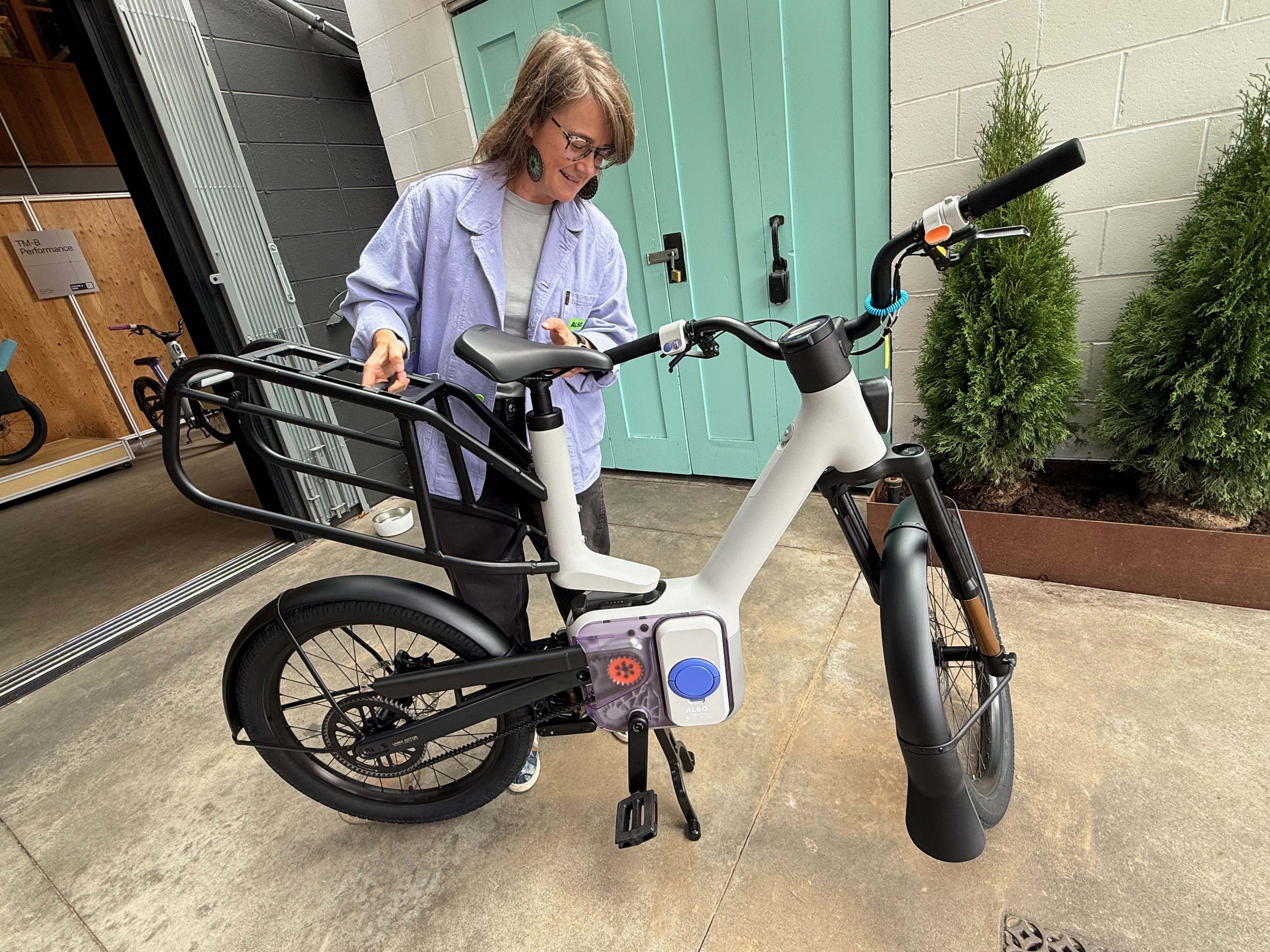
Back at the test station, Hattemer demonstrated how the bike’s modularity works off the road. Pushing a single eject button releases the top frame, allowing riders to swap between a solo commuter setup, a bench seat, or a heavy-duty cargo rack in about three seconds. Because each frame is digitally serialized to the owner’s account, a single bike body can easily be shared across family members of vastly different heights by swapping top frames and adjusting the seat post.
“I am barely 5-foot-4, and my husband is 6-foot-2, and so we can actually share a bike,” Hattemer said. “So I could have a small top frame, and you could have a large one. So multiple people can use this bike.”
Stripping off the top frame and battery also sheds roughly 25 pounds from the 80-pound bike — a huge practical touch for anyone trying to hoist a heavy commuter onto a standard car rack.
For a city built on steep hills and unpredictable weather, the TM-B makes a compelling case for the future of urban commuting. It isn’t just a high-end e-bike; it’s a fully software-defined vehicle platform — and a sign that Rivian’s automotive DNA has successfully made the jump to two wheels.