The preliminary results of a study commissioned by Space Northwest, an association focused on regional space ventures, suggest that Washington state’s space economy contributes $8.1 billion in direct economic output annually.
The newly reported figures show that the space industry’s economic impact in the Evergreen State has nearly doubled since a similar study in 2022. That earlier report also documented a doubling effect over the course of four years, from $1.8 billion in 2018 to $4.6 billion in 2022.
Kelly Maloney, Space Northwest’s co-founder and the chair of the association’s board of directors, shared the latest figures today at the Space Northwest Symposium in Federal Way, Wash. She said the preliminary findings, developed by BERK Consulting and Alliance Velocity, reinforce the view that space is not just a niche industry in Washington.
“We are effectively the Space Tech State,” Maloney said.
She said the state’s space sector directly supports about 12,300 jobs and $2.3 billion in labor income. When indirect and induced impacts are included, the figures rise to about 34,200 jobs, $12.4 billion in statewide economic output and $3.9 billion in labor income.
“For every direct space job in Washington, another 1.8 jobs are supported elsewhere in the economy,” Maloney said.
She noted that the space sector’s direct labor income averages about $188,000 per worker.
“That is twice the statewide average,” Maloney said. “So, this is not just a growing industry in terms of employment. It is an industry generating significant economic value and exceptionally strong labor income here in Washington.”
Maloney added that 94% of the state’s direct space sector jobs are concentrated in three highly technical areas. “Nearly 6,500 people work in space vehicle and propulsion manufacturing; more than 3,000 in research, engineering and computing; and just over 2,000 in space electronics and hardware,” she said.
Washington’s space workers play a central role in the satellite industry. More than 68% of all active satellites in Earth orbit were built in the state, according to the analysis. Most of those made-in-Washington satellites were produced at SpaceX’s Starlink operation in Redmond.
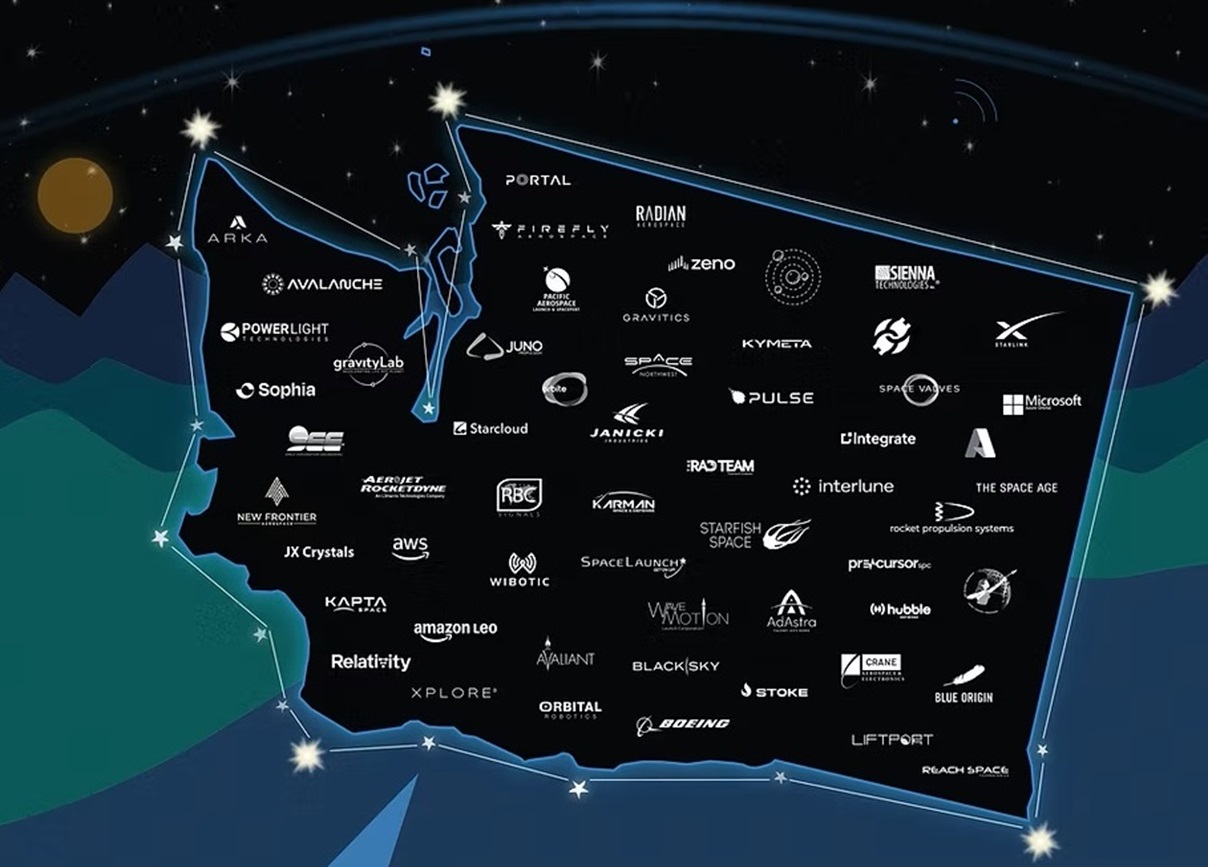
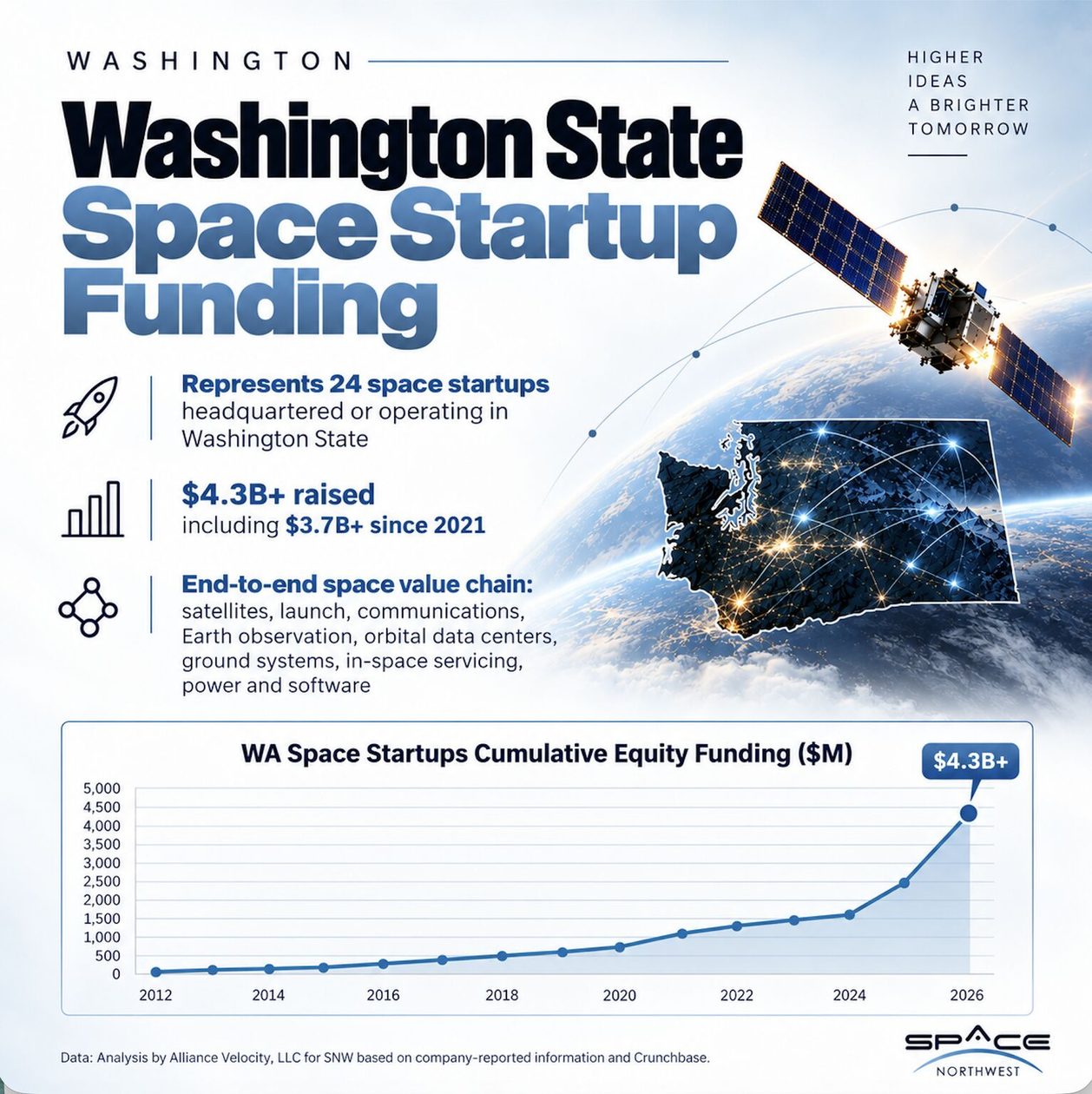
The study also found that 24 space startups headquartered or operating in the state have collectively raised more than $4.3 billion, including more than $3.7 billion since 2021.
Space Northwest is lending support to eight space startups through a new program called the Space Technology Accelerator for Growing Entrepreneurship, or STAGE. The selected startups will participate in a 12-week program, with each startup receiving three hours of personalized coaching alongside specialized workshops.
STAGE’s first cohort includes:
- Beyonders: “We’re opening the door to the wonder of cosmic discovery by creating your own spacecraft … gram-scale picosatellites,” said founder Mike Antares.
- Godel Space: Founded by Vikash Kodati and named after famed mathematician Kurt Gödel, this startup is building autonomous AI agents for satellite payloads.
- Kynthos: Co-founders Selvan Viswanathan and Priya Srinavasa are working on software that maintains continuous custody of high-value assets and non-cooperative space objects.
- Luthien Space: “We are in the business of making lunar landings and missions safe with a decision-grade intelligence tool that is physics-validated,” said founder Tammy Payne.
- Ora Biomedical: “What Ora Biomedical is focused on is creating the therapies that enable longer, safer spaceflight and crewed missions,” said co-founder and CEO Ben Blue.
- Signal Sights: This venture is developing systems that convert radio frequency signals into intuitive visual information to improve situational awareness and decision making.
- SQK: This three-year-old startup provides guided computational AI to reconstruct and validate complex scientific data from noisy, incomplete or low-signal measurements.
- Wave Motion: “What we want to do is turn the rocket equation on its head. … We essentially take the rocket fuel and beam it to the rocket as it’s needed,” said co-founder James Penna.
The preliminary findings reported by Space Northwest were produced by BERK Consulting and Alliance Velocity. Additional data sources include company-reported information, Crunchbase, and satellite data from Jonathan McDowell. The full report is still pending.
Check Space Northwest’s website for a schedule of Seattle Space Week events.