

Microsoft’s Imagine Cup, a competition for student developers since 2003, is expanding for the first time to early-stage startups whose founders aren’t in school, with $250,000 in cash and $1 million in cloud credits awarded to the winner.
The change, announced Monday, opens the competition to companies founded in the past two years that haven’t raised a Series C round, whether or not their founders are students.
Startups will compete in six industry categories, including cybersecurity, developer tools and healthcare. Students will get a seventh category of their own, with a $25,000 top prize, or they can choose to compete for the main prize in the industry categories.
It’s the latest step in a broader evolution of the Imagine Cup, and the implications go beyond the competition itself. Changes in the rules from 2024 to 2027 show how Microsoft and the tech industry are adjusting, year by year, to the realities of the AI era.
Changing AI requirements: The clearest example is the Imagine Cup rules for AI usage. In 2024, entrants had to build their products with “Microsoft and/or OpenAI” services. In 2025, they had to use at least one Microsoft AI service. In 2026, they had to use at least two Microsoft AI services.
For 2027, they can use any AI they want, as long as they use Microsoft’s Azure cloud.
The shift mirrors a broader change in Microsoft’s AI strategy. The company has added models from Anthropic, xAI, Meta and others to Azure. In April it ended its exclusive cloud arrangement with its longtime AI partner OpenAI, allowing the ChatGPT maker to sell its technology through other platforms such as Amazon Web Services.
Microsoft Foundry, the company’s platform for building AI applications, offers access to more than 11,000 models.

“Imagine Cup 2027 reflects that same approach, giving founders the flexibility to choose the right models and technologies for their solutions while meeting the competition’s Azure and technical requirements,” said Tom Davis, general manager of Microsoft for Startups, in a statement responding to GeekWire’s questions.
Why startups: Addressing the expansion to non-student startups, Davis said AI is letting more founders start companies faster than ever, and the revamped competition is meant to help those young companies win customers and prepare to sell to big businesses.
The judging criteria have changed to match that focus on business customers.
As recently as 2024, student teams couldn’t have raised more than $50,000 in outside funding to compete. Under the new rules, final-round judges, whose scores determine all of the winners, will look for net revenue retention over the previous 12 months, six months of traction data, and a customer reference willing to be contacted.
What’s in it for Microsoft: The change is also a way for Microsoft to bring promising startups onto Azure. For startups in the industry categories, the first-round scoring criteria in 2027 will include “Microsoft and Azure commercial readiness, and expected cloud and AI consumption.”
Azure gets less explicit weight in the final round, whose scores determine the winners. A live production workload on Azure is worth 6 of 100 points there. In 2026, use of Microsoft technology made up 40% of the score in every round.
Participants can also earn Azure credits by using more of Microsoft’s cloud services. The credits start at $1,000 and rise to as much as $150,000 for startups that run at least 10 eligible Azure workloads and spend $3,000 a month on Azure for 60 days.
Amazon and Google run their own credit programs for startups, as the cloud giants compete to win AI companies early, when they’re choosing where to build.
Diversity criteria dropped: The new rules also drop diversity, inclusion and accessibility from the judging criteria, where they had been through 2026. In 2024, inclusion was worth 10% of the score, with judges asked to consider factors such as gender, ethnicity and disability.
Davis said Microsoft “updated the judging framework to reflect the range of industries and customer challenges represented in the competition,” and that inclusion and accessibility remain central to the company’s mission. He added that the competition welcomes startups developing products focused on inclusion and accessibility.
Separately, Microsoft skipped its annual diversity report last year, ending a tradition it started in 2019, as Google, Meta, Amazon and other big tech companies scaled back diversity programs under pressure from the Trump administration.
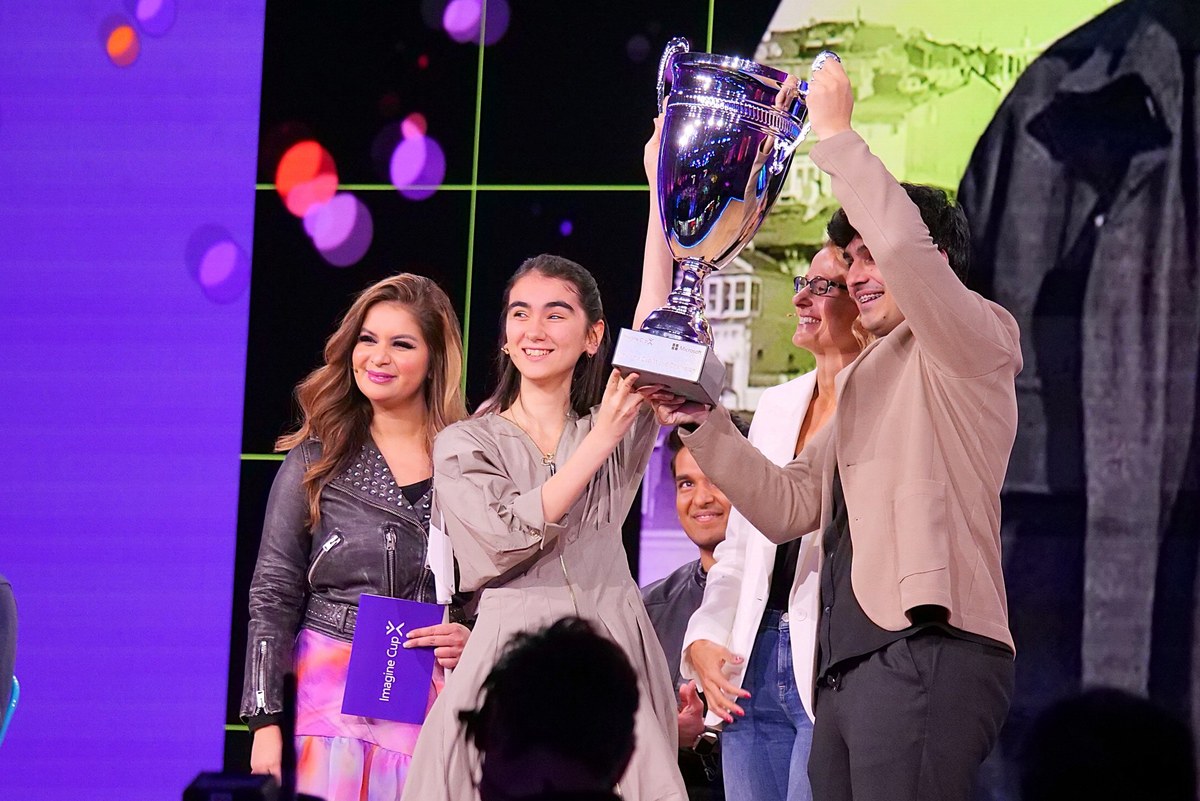
Prizes and timing: Applications are due Feb. 28. The second-place startup will receive $50,000 and $350,000 in credits, and third place gets $25,000 and $350,000 in credits. The 2026 champion, CopyFlag, a U.K. startup that tracks copies of creators’ designs online, won $150,000.
The top startup in the student category will present at the World Championship but isn’t eligible for the top three prizes, according to the official rules. To compete for those top prizes, student startups can enter an industry category instead, going up against companies that may have raised as much as a Series B.
The rules also allow Microsoft to use “automated assistance” to triage, summarize and compare entries, with human review in advancement decisions.
Winners will be selected in April and announced in May or June at a World Championship, with the date and location still to be determined, Davis said. The 2026 finale was at Microsoft’s Build developer conference in San Francisco.


