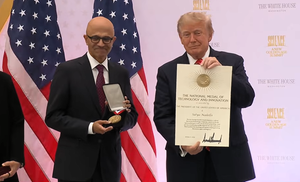
Satya Nadella arrived in the U.S. from India in 1988 to study computer science. Over the next three decades, he went from a temporary work visa to permanent residency to American citizenship, and rose up the ranks at Microsoft to become only the third CEO in its history.
“I don’t think my story would be possible anywhere else,” Nadella wrote in his 2017 book, “Hit Refresh.” “I am proud today to call myself an American citizen.”
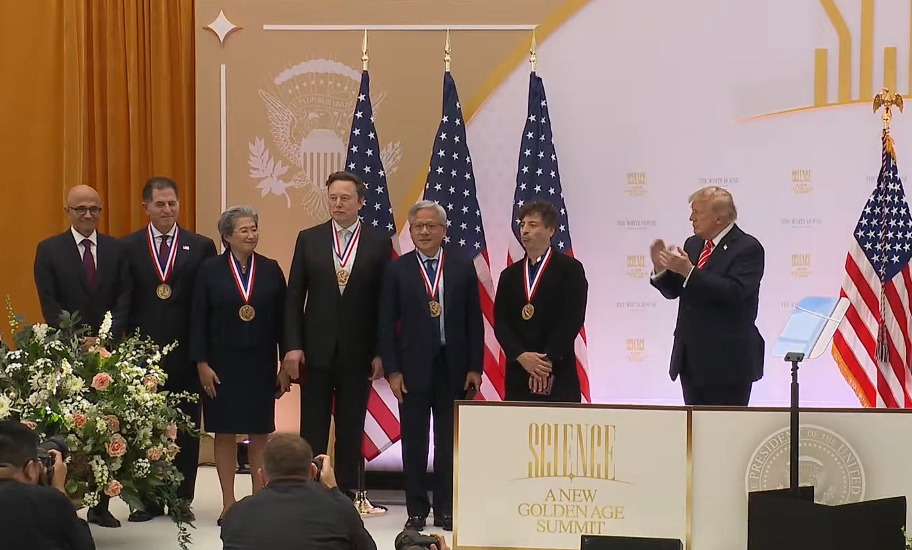
On Thursday, President Trump personally handed the Microsoft CEO the National Medal of Technology and Innovation. The award cited his “transformative leadership of a critical American technology company, which led to its rejuvenation for a new era of cloud computing.”
Nadella thanked Trump on X, writing that he was “humbled to stand alongside so many giants of American innovation.” The other honorees were Dell Technologies CEO Michael Dell, who also received the technology medal; and Elon Musk, Google co-founder Sergey Brin, Nvidia CEO Jensen Huang and AMD CEO Lisa Su, who received the National Medal of Science.
Five of the six were born outside the country.
Hours earlier, the Trump administration had suspended Microsoft from the federal program it uses to help foreign workers take the same path to permanent residency. Vice President JD Vance said the company had abused the system by laying off American workers while hiring foreign workers, and called H-1B workers “foreign indentured servants.”
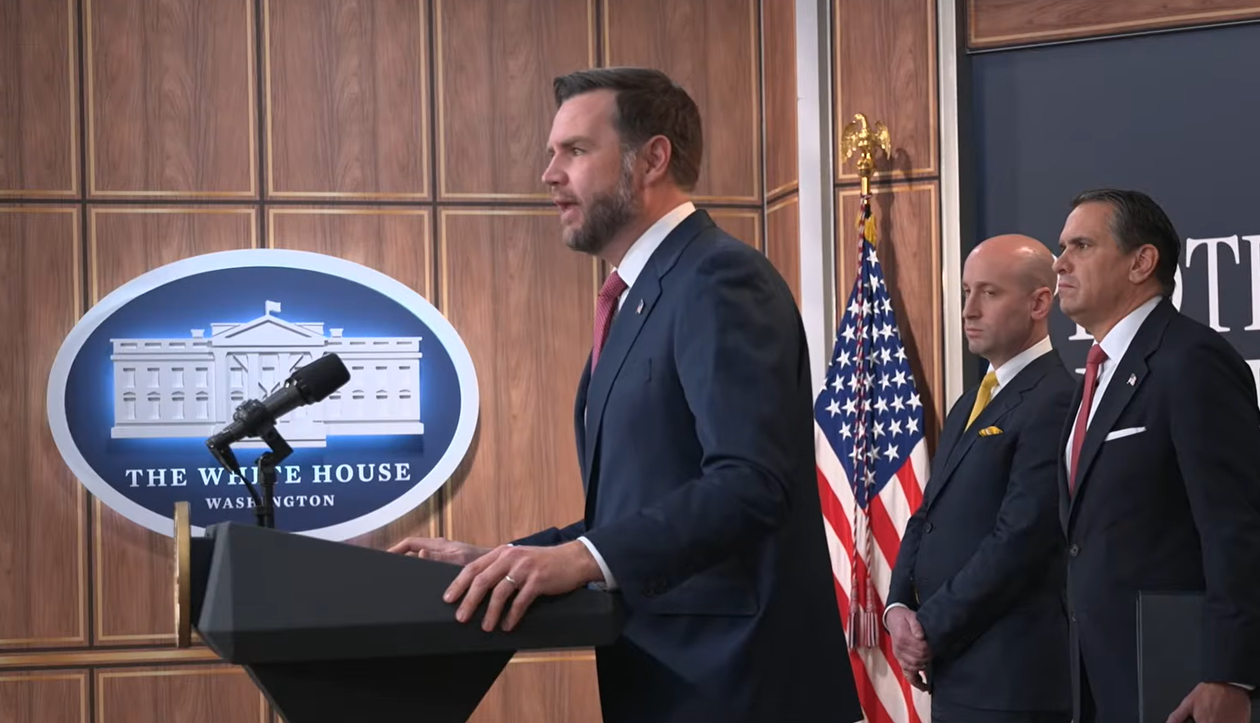
“Our message to Microsoft is you’re a great American company, but you’ve got to hire great American workers,” Vance said at a White House news conference.
Two different programs: The suspension doesn’t stop Microsoft from hiring foreign workers on H-1B visas. Those are temporary work visas, typically granted for three years at a time and generally limited to six years, with some exceptions. They’re overseen by U.S. Citizenship and Immigration Services.
Amazon is the bigger user of H-1B visas. It received more than 19,000 approvals for H-1B petitions in fiscal 2025, about three times Microsoft’s total, according to an analysis of USCIS data by the National Foundation for American Policy. The totals include renewals and extensions, so they don’t represent individual workers.
The program to which Microsoft lost access comes later in the process.
Known as PERM, it’s run by the Labor Department and is usually the first step when a company sponsors an employee to stay in the U.S. permanently. The employer has to advertise the job and show that no qualified, available U.S. worker can fill it. Most applications are for people already working in the U.S. on H-1B visas.
Microsoft is the biggest user of PERM. The Labor Department ruled on 3,161 of its applications in the fiscal year that ended in September 2025, more than for any other employer in the country, according to a GeekWire analysis of the agency’s data. Microsoft also led in the first nine months of fiscal 2026, with 1,683 applications decided through June.
Amazon and Google filed thousands of PERM applications in 2022 and early 2023, then largely stopped. The Labor Department ruled on 39 applications from Amazon and its subsidiaries last fiscal year, including Whole Foods, Audible and Zappos, and three from Google.
The suspension could hit hardest for Microsoft employees already on H-1B visas. Many count on the company to start the permanent residency process in time to extend their visas past the usual six-year limit, and the Labor Department says it won’t process Microsoft’s pending applications either.
Some Microsoft employees on H-1B visas were surprised by the news and unsure whether it would affect them, The Seattle Times reported. The paper noted that the White House hasn’t provided evidence of fraud by Microsoft.
Microsoft’s response: In a statement posted Thursday, Microsoft pushed back on criticism of its hiring and said it looks forward to “providing the Administration with additional information.” The statement focused on H-1B visas and didn’t address the PERM suspension specifically.
The company said about 80% of the roughly 6,000 H-1B applications it filed last fiscal year were to extend or change the status of people who already work at Microsoft. “These were not to hire new people,” it said.
The rest were for new hires already living in the U.S. legally, a group equal to about 1% of Microsoft’s U.S. workforce. “They are not new arrivals to our country,” the company said.
Microsoft also said it files H-1B petitions only for workers who meet “the rigorous standards of this visa category,” pays them “the same as any other employees doing comparable work,” and offers wages “among the highest of all H-1B filings.”
The vast majority of its U.S. employees are Americans, the company said.
Nadella’s own path: Nadella’s route to citizenship wasn’t a straight line, as he described in “Hit Refresh.” He was working at Microsoft when he married his wife, Anu, in India in December 1992. The next summer, her application for a visa to join him in the U.S. was rejected because she was married to a permanent resident.
Spouses of permanent residents faced long waits, and Microsoft’s immigration lawyer told Nadella it could take five years or more to bring her to the U.S.
Nadella considered quitting Microsoft and moving back to India. Then the lawyer suggested a different approach: give up his permanent residency and go back to a temporary H-1B visa, which would let his wife join him right away.
In June 1994, Nadella went to the U.S. embassy in New Delhi, past the long lines of people hoping to get visas, and told a clerk he wanted to give up his permanent residency. The clerk was dumbfounded, Nadella wrote. The plan worked, and Anu joined him in Seattle, where they started a family. Nadella eventually got back on the path to permanent residency and later became a U.S. citizen.
But in the meantime, back in Redmond, Nadella became known around the Microsoft campus as the guy who gave up his green card. Colleagues called him for advice. One, Kunal Bahl, later left Microsoft when his H-1B ran out before his permanent residency came through. He returned to India and founded the e-commerce company Snapdeal.
“Such is the perverse logic of this immigration law,” Nadella wrote.