Microsoft is turning to an old friend and a familiar advantage in search of a new edge in AI.
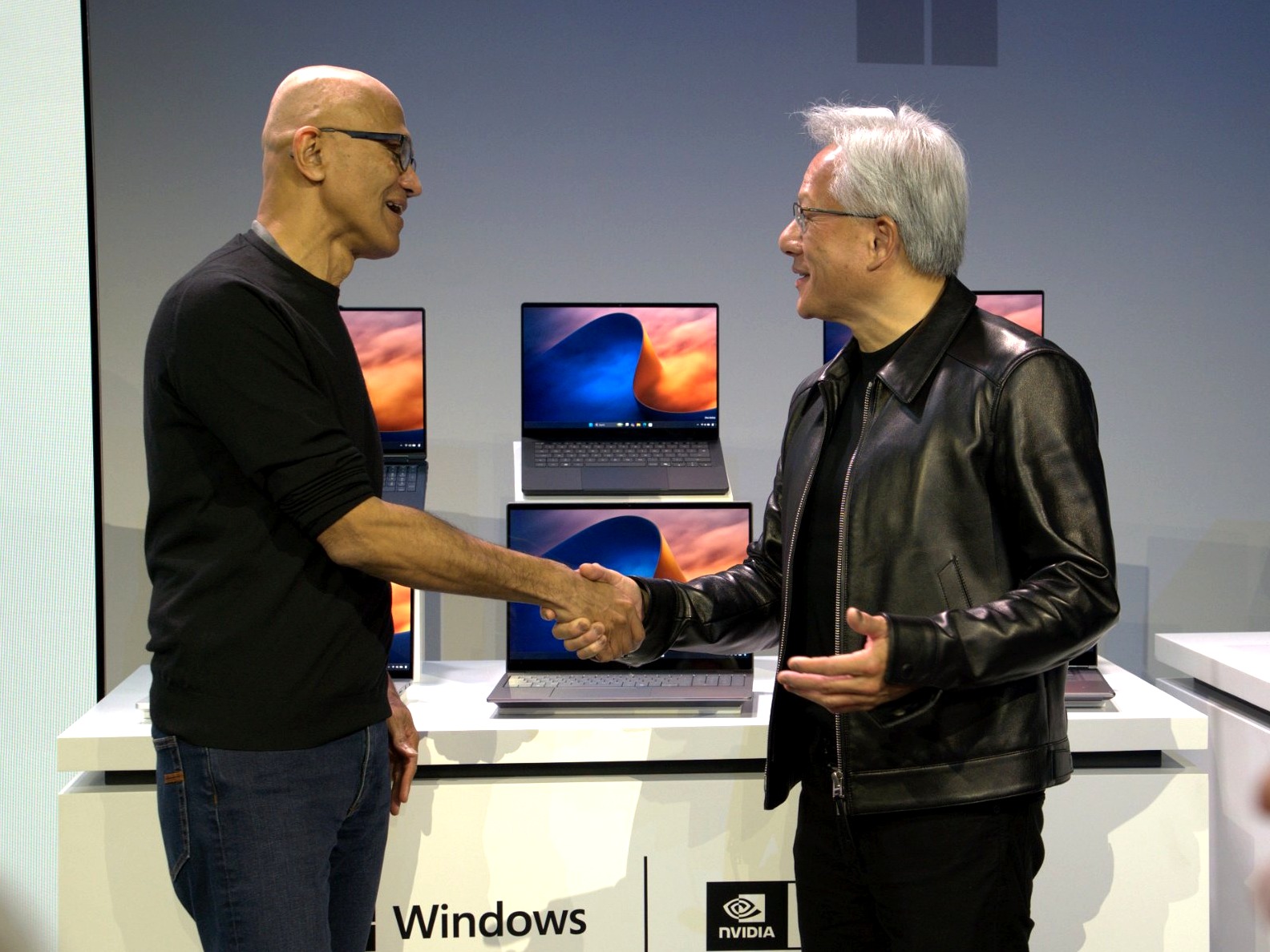
The company and its longtime partner Nvidia on Wednesday started taking orders for a new line of high-end Windows PCs built to run large AI models independent of the cloud.
Microsoft also announced what it calls “Windows Hybrid Intelligence,” a set of features that will let its Copilot assistant read the files on a PC, take actions on the machine and opt to run AI models locally instead of in the cloud when it makes sense.
It’s not a new concept to users of such programs as Anthropic’s Claude, Perplexity and OpenClaw, which already work with the files on a user’s computer. But only Microsoft can build the features into Windows itself, along with security controls that limit what an AI agent can reach on the machine and will keep a separate record of what the agent does.
“I think agents are going to be the largest users of the file system,” Microsoft CEO Satya Nadella said during an on-stage conversation with Nvidia CEO Jensen Huang at an event in San Francisco.
Microsoft got an early jump in AI with its 2019 investment in OpenAI and the 2021 debut of GitHub Copilot, its AI coding assistant. But its Copilot products for consumers and businesses have since been overshadowed by OpenAI’s ChatGPT and Anthropic’s Claude.
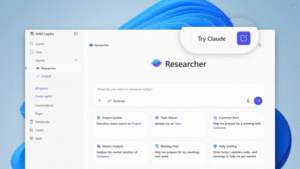
Both rivals also moved quickly on AI agents that write code and carry out other tasks on a user’s computer, the kind of software Microsoft is now building into Windows. Microsoft’s own Copilot Cowork, which it introduced in March, integrates Anthropic’s Claude.
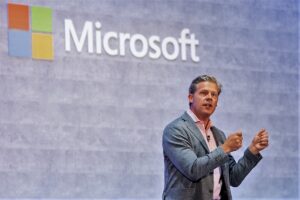
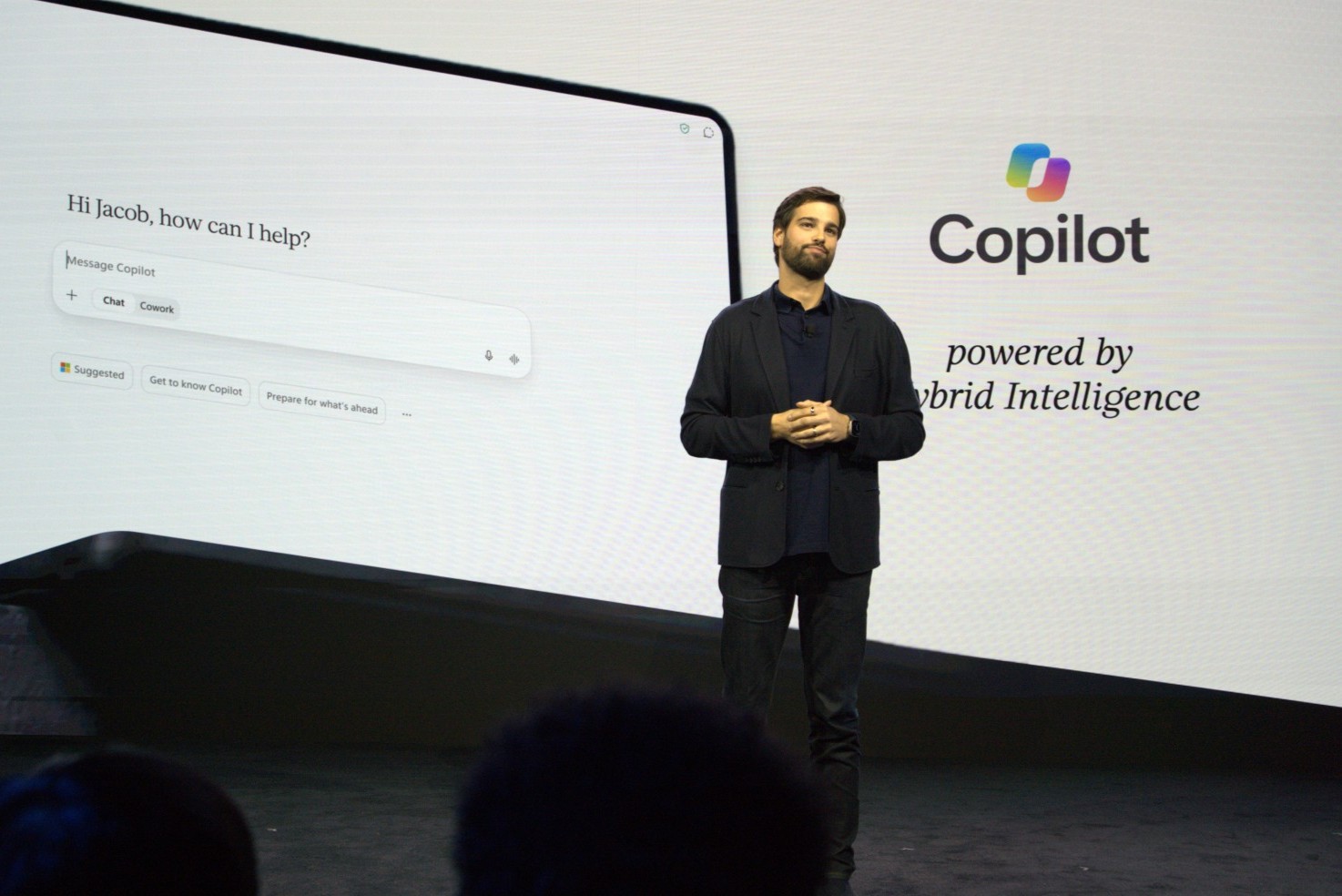
The tech giant has been reworking Copilot to catch up. Earlier this year, it put its Copilot teams for consumers and businesses under Jacob Andreou, now its executive vice president of Copilot. Last month, it released a new version of the app with tools for coding and long-running tasks.
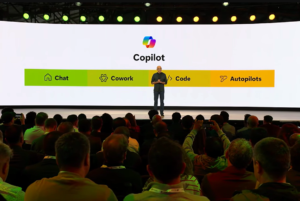
Where Copilot is headed: Windows Hybrid Intelligence gives Copilot three new capabilities, as Andreou described them on stage. The assistant can draw on all the files on a PC, take actions such as moving files and changing settings, and hand tasks to AI models running on the machine “when cost or privacy matter more.”
Copilot will still use the cloud for the hardest tasks, Andreou said, and will act on the PC only with the user’s permission.
Microsoft said the features are expected to begin rolling out in the coming months on Copilot+ PCs, the AI-focused Windows machines it introduced in 2024.
Developers will get a version first. An experimental release coming later this month will let GitHub Copilot automatically send simpler coding tasks to an AI model on the PC and harder ones to the cloud.
In one example depicted on stage, Copilot’s Autopilot agent found an email from Andreou’s accountant, gathered tax documents scattered across his PC, renamed and sorted them into folders, bundled them into a zip file and drafted a reply with it attached, pausing for his approval before sending. The sorting was handled by AI models on the laptop, he said, so the tax details weren’t sent to the cloud.
Running AI models on the PC reduces the usage charges that come with AI in the cloud. Nadella wrote on X that Microsoft is bringing “unmetered intelligence to every desk and every home,” echoing the company’s original mission of “a computer on every desk and in every home.” A slide in the presentation said local models would run tasks on the PC “at no extra cost.”
Microsoft is also adding thousands of quick actions to the search box on the Windows 11 taskbar, such as switching to dark mode, arranging windows or sending a text message. Those start rolling out Wednesday to people in the Windows Insider testing program.
An option to get Copilot answers in the search box will be opt-in and will arrive in select markets later this year, according to the company.
The Recall precedent: Microsoft has run into trouble before with AI that looks at what’s on a PC. Recall, a feature that takes periodic screenshots of a user’s activity to make it searchable, drew objections from security researchers when it was announced in 2024. Microsoft delayed it and made it opt-in before releasing it widely in 2025.
Recall didn’t come up at Wednesday’s event. Microsoft’s blog post says Copilot’s access to local content, which it describes as “files and recent activity,” will require the user’s permission.
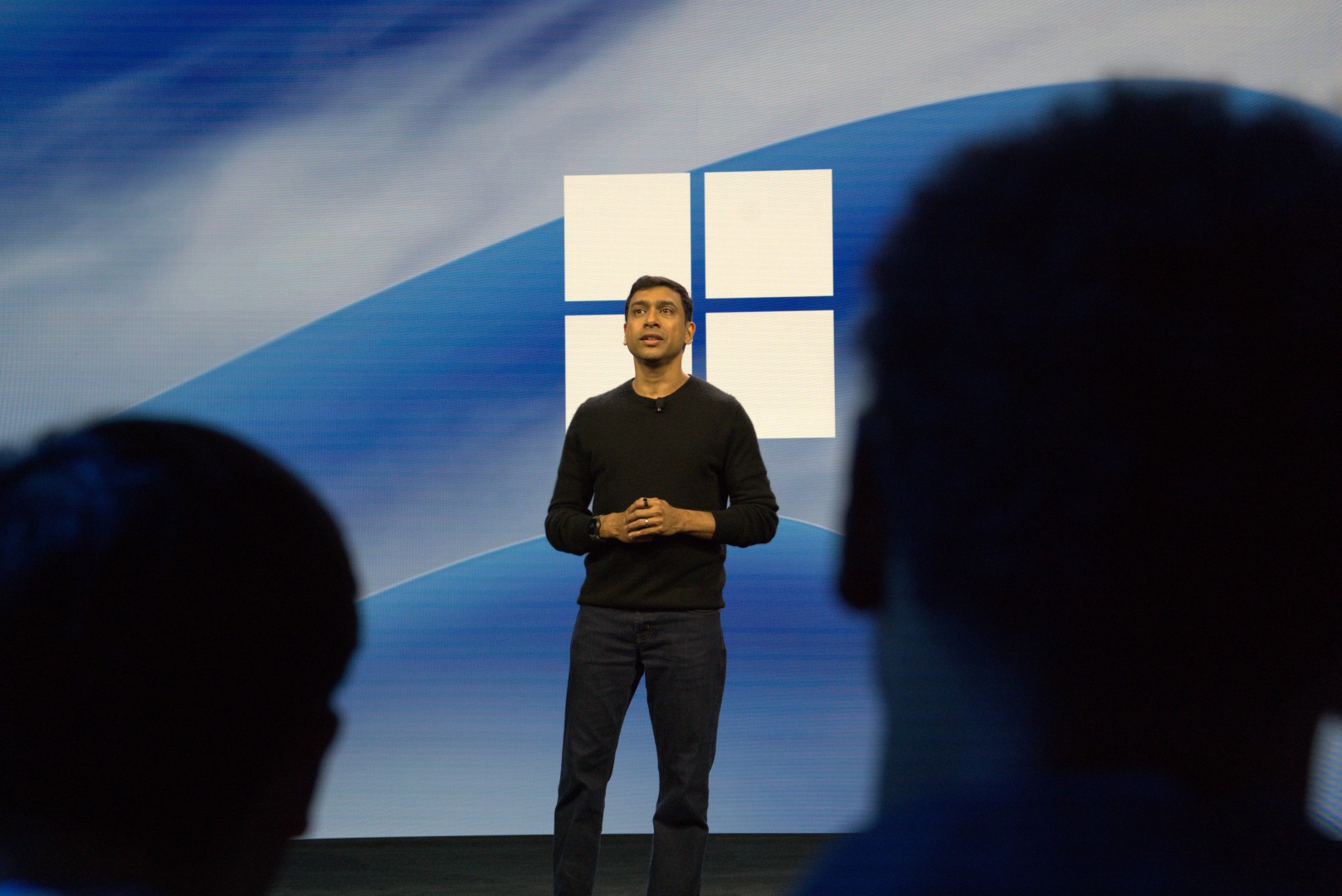
Limits on AI agents: Pavan Davuluri, Microsoft’s executive vice president of Windows and Devices, said the AI agents that run on PCs today are “fundamentally insecure because they have broad system access.”
Microsoft’s answer is a technology called Microsoft Execution Containers, now generally available in Windows 11, which lets an organization set which files and networks an AI agent can reach. Microsoft said OpenAI’s Codex and OpenClaw already support it, and that Anthropic’s Claude Code and Perplexity plan to.
Meta’s Muse agent is coming to Windows as an app that uses the technology, as well.
The new PCs: The machines are built around Nvidia’s RTX Spark chip and aimed at developers and creative professionals who want to run large AI models on their own computers.
Microsoft’s Surface Laptop Ultra, a 15-inch laptop with up to 128GB of memory, starts at $2,599 and will be available Oct. 16, the same day similar laptops from Asus, Dell, HP, Lenovo and MSI begin shipping.
A desktop version for developers, the Surface RTX Spark Dev Box, costs $5,999 and ships in the U.S. in November.
Microsoft is pitching the laptops against Apple. It says machines with the Nvidia chip start producing AI responses up to 2.1 times faster than a 16-inch MacBook Pro with Apple’s M5 Pro chip and generate AI images up to 4.3 times faster, citing tests it commissioned or that Nvidia ran on preproduction machines.
The company is also offering up to $1,000 back to buyers who trade in a MacBook Pro.
Huang said the chip took more than 4,000 engineering years and started with a conversation he had with Nadella four years ago.
Nvidia’s Windows roots: Sriram Krishnan, the venture capitalist and former White House AI advisor who moderated the conversation, asked Huang for a favorite memory of working with Microsoft. Huang said Nvidia owes its existence to Windows.
He recalled a moment in late 1992, when Windows 3.1 was new and he and his co-founders, who had worked mostly on workstations, started imagining a PC with 3D graphics that could run games and design software. They started the company the next year.
“If not for Windows, Nvidia wouldn’t have been founded,” Huang said.
He traced a line from there to the AI boom. Windows brought graphics chips to the PC, he said, which led to Nvidia’s GeForce chips and its CUDA software, which gave AI researchers the computers they needed for deep learning.
Nadella joked that Huang was “now going to do a little transfer of market cap back to me.” Nvidia is the world’s most valuable company, at about $5.8 trillion. Microsoft is worth about $3.9 trillion.
“Windows has been with me for 34 years,” Huang said at the end of the conversation. “Looks like it’s going to be with me for 34 more.”
“There you go,” Nadella added before they walked off the stage.