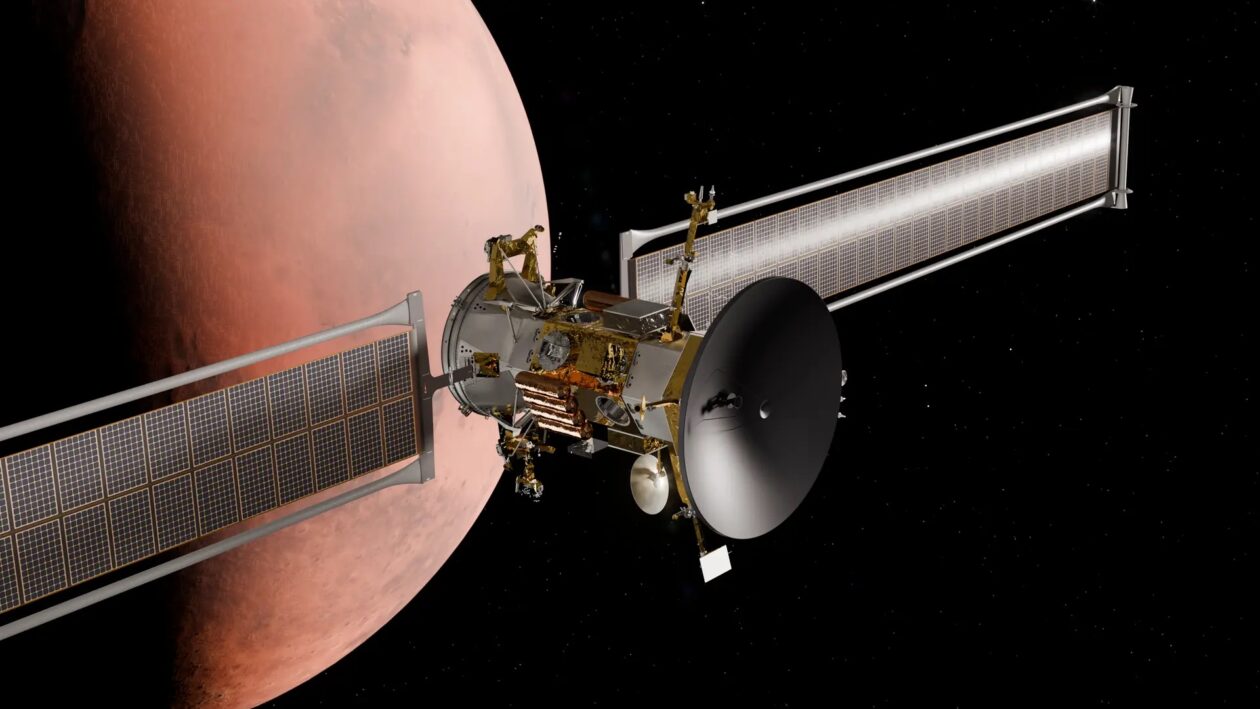
Jeff Bezos’ Blue Origin space venture has won a contract worth up to $700 million to boost NASA’s telecommunications capability in Martian orbit, using a version of the company’s Blue Ring multi-mission space platform.
The contract calls on Blue Origin to deliver a high-performance Mars telecommunications orbiter to NASA by the end of 2028, the space agency said in a news release. Blue Origin would also be charged with operating the Mars telecommunications network as part of NASA’s broader space communications and navigation infrastructure.
Blue Origin CEO Dave Limp said the Blue Ring spacecraft for the mission was already in production in Huntsville, Alabama. “Before the first human steps on Mars, we have to build the road. … MTO will enable science, carry payloads, and help lay the foundation for human exploration,” he said in a post to X.
“MTO is the backbone of America’s Mars exploration program for the next decade and beyond, and will provide the reliable communications capacity that will keep future robotic and human missions connected to each other and to Earth,” Tory Bruno, president of Blue Origin’s National Security Group, said in a news release. “This awarded contract is a testament to the Blue Origin team that has been building Blue Ring with exactly this kind of mission in mind. We’re ready, and so is the hardware.”
NASA’s current telecommunications links to Mars rely on an aging set of orbiters, including Mars Odyssey (launched in 2001) and Mars Reconnaissance Orbiter (launched in 2005). The multinational relay network also makes use of the European Space Agency’s Mars Express and ExoMars Trace Gas Orbiter. In addition to the orbiting relay satellites, NASA’s probes on the Martian surface can communicate directly with Earth to a limited degree.
Plans for a new Mars telecommunications orbiter have been under consideration for more than a decade and a half, but had been repeatedly put on hold due to budget concerns. This May, NASA issued a request for proposals relating to a commercial network for the Red Planet, drawing responses from Blue Origin as well as Rocket Lab.
Blue Origin announced three years ago that it was developing its Blue Ring in-space mobility platform for a wide range of potential applications — and last year, the first flight of the company’s New Glenn rocket included a payload that tested communications and control system for Blue Ring.
NASA said the Mars Telecommunications Network would be managed by the space agency’s Space Communications and Navigation program. The network is expected to be operational at Mars by 2030 to support current and future missions to the Red Planet.
Update for 3:30 p.m. PT Sept. 13: Rocket Lab is challenging the contract award to Blue Origin in a protest filed with the Government Accountability Office.
“NASA’s award decision appears to be inconsistent with the eligibility criteria mandated by Congress. In addition, the agency’s punitive review of Rocket Lab’s technical volume was inconsistent, making incorrect assertions and conclusions,” Rocket Lab said in a post to X.
“Procurement standards exist to ensure fair competition and protect public investment,” the company said. “We are pursuing this review to ensure those standards are upheld for critical infrastructure that will underpin American exploration at Mars for decades to come.”
The GAO is required to issue its final decision on the protest within 100 days.