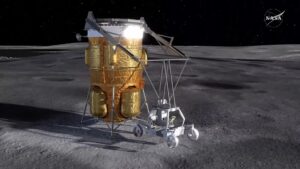
NASA has selected proposals from 37 companies, including several with Seattle-area connections, to further its plans to establish a long-term presence on the moon and enable human exploration of Mars.
The companies applied to partner with NASA under the terms of an Announcement of Collaboration Opportunity, or ACO. The selected proposals aim to develop technologies for space transportation, planetary surface operations and lunar surface infrastructure.
“We are empowering American industry to become active partners in NASA’s missions to the moon, Mars and beyond,” Greg Stover, director of the Advanced Research and Technology Division in NASA’s Research and Technology Mission Directorate, said today in a news release. “By tapping into commercial industry, NASA can rapidly develop key capabilities to support its most ambitious missions while fostering the nation’s robust space economy.”
While the ACO agreements do not involve an exchange of funds, the selected companies can leverage NASA’s specialized facilities, software, hardware and subject-matter experts to mature their technologies for commercial and government use. The performance periods will be negotiated individually, with an expected duration of 12 to 24 months.
Five Seattle-area companies made NASA’s list:
- Aerojet Rocketdyne: The L3Harris-owned operation in Redmond focuses on producing thrusters for spacecraft propulsion systems. The facility’s NASA-supported project is “Advanced Electric Propulsion System Hall Current Thruster Affordability Improvements.”
- Blue Origin: The Kent-based space venture founded by Jeff Bezos is developing crewed and uncrewed lunar landers for NASA’s Artemis moon program, as well as technology to produce solar cells and other components from lunar resources. Blue Origin’s NASA-supported project is “Space-to-Surface Deceleration Capabilities Assessment.”
- Starcloud: This Redmond-based startup aims to launch thousands of satellites to build orbital data center constellations. Starcloud’s NASA-supported project is “Flight Demonstration of High-Performance Computing for In-Orbit Autonomy and Exploration.”
- Stoke Space: This Kent-based venture, founded by veterans of Blue Origin, is building a fully reusable medium-lift rocket known as Nova. Stoke’s NASA-supported project is “Advancing Nova Stage 2 Entry, Descent and Landing.”
- Zeno Power Systems: Operating out of offices in Seattle and Washington, D.C., Zeno is developing a new type of nuclear battery for applications in space as well as on Earth. Zeno’s NASA-supported project is “Irradiation Testing of Sunpower Robust Stirling Converter Organics.”
The other 32 companies are Advanced Cooling Technologies, Advanced Space, Apech Labs, Astrobotic Technology, Axiom Space, Busek, Canopy Aerospace, Chase Supply, Dcubed USA, Elementum 3D, Enduralock, General Galactic Technologies, Hebi Robotics, Hyperion Transport Systems, Kall Morris, Lockheed Martin, Lunar Outpost, Made in Space, Max Space, Mission Space U.S., Moonprint Solutions, Motiv Space Systems, Opterus Research and Development, Orbital Composites, Psionic, Quadrus Corp., Rogue Space Systems, Starpath Robotics, Teledyne Energy Systems, Ten One Aerospace, Varda Space Industries and Venturi Astrolab.
This report has been updated to add details about the Seattle-area space companies’ NASA-supported project proposals.