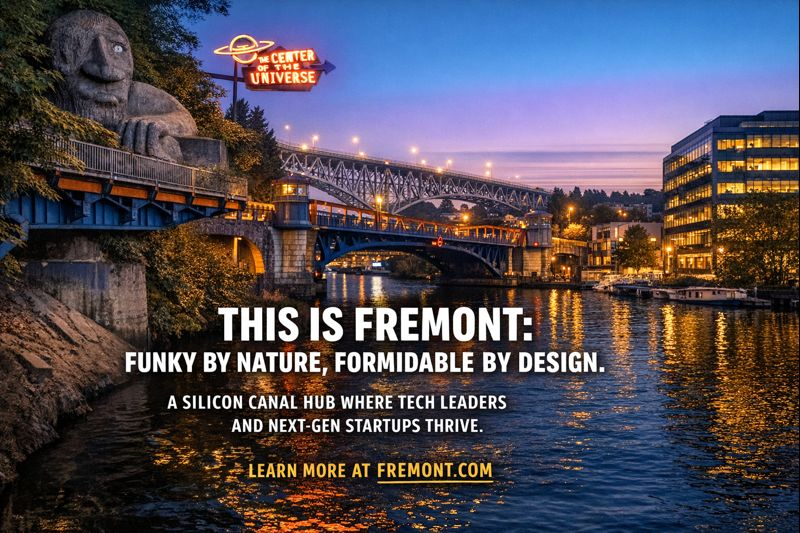
The Fremont neighborhood is just five minutes north of downtown Seattle, yet it feels like a world away.
Renowned for hip restaurants, independent boutiques and free-spirited celebrations like the annual Solstice Parade, Fremont’s fun loving and silly spirit make this quirky area just north of the Lake Washington Ship Canal a destination for creative types of all stripes.
And that creative spirit is helping to drive innovation across a wide-range of industries, from high-end drone manufacturing to groundbreaking breakthroughs in artificial intelligence to world-class games. There’s a reason why office vacancy rates in Fremont sit at 14%, half the rate of downtown Seattle, according to CoStar data.
The diversity of Fremont’s business community — whose lumber mill history has largely faded from view — remains a strength compared to places like Redmond or Seattle’s South Lake Union neighborhood.
“(Technology) is a big part of who we are—but it’s only a part,” says Pete Hanning, Executive Director of the Fremont Chamber of Commerce. “There are boats being built, industrial work still happening along the ship canal, alongside the classic brick-and-mortar retail community and businesses.”
Western Towboat is one such example. Family-owned since 1948, it operates one of the most advanced tugboat fleets in the world.
It’s the combination of businesses like Western Towboat with software companies such as Salesforce that makes Fremont so unique. And it’s one of the reasons why Hanning and others like to call the Fremont area “The Silicon Canal.”
Mark Grey, a principal with Fremont-based commercial real estate firm Stephen C. Grey & Associates, has watched the transformation of Fremont from the front lines. And he points to another factor that makes this slice of Seattle truly unique: There are few national franchise businesses operating in the neighborhood, meaning a strong core of mom-and-pop shops drive the appeal.
When working to fill office space in the DATA 1 building in 2017, Grey made a point of attracting street-level retail made up of independent shops, not cookie-cutter chains.
“In another neighborhood, you might see a Subway or a Bank of America,” Grey says. “But we have Milstead Coffee, Cafe Turko and Tivoli.”
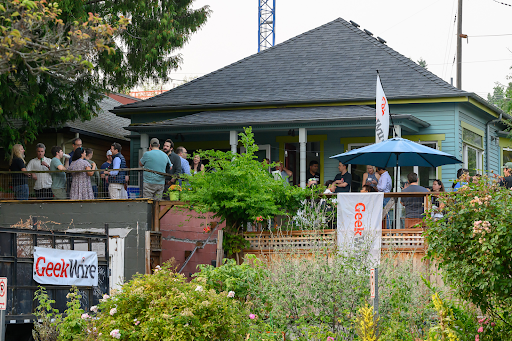
Those independent businesses — beloved by customers from near and far — are having another impact. Fremont’s mix of charming shops, retail and art makes it a place that people want to hang out, which strengthens the call for employees to return to the office.
“Salesforce and Google have shared with me that their (return to office) numbers in their Fremont campus are way higher than their other offices, and are second only to their San Jose headquarters,” says Hanning.
While Google plans to consolidate its Seattle operations at its South Lake Union facilities later this year, other companies are racing to fill the void in Fremont at one of the most spectacular waterfront locations in Seattle.
And there’s another world-class tech bigwig setting up shop on the Ship Canal.
Nvidia, the $4.5 trillion chip maker that’s leading the way into the AI era, just leased 28,000 square feet of office space in The Fremont Lake Union Center building. Technically, this marks Nvidia’s second Fremont lease, if you count its Sept. 2025 acquisition of OctoAI, which already maintained space inside the same building.
While Nvidia is the buzziest new tech company to arrive, Fremont’s tech scene is notably resilient and vibrant, Grey says.
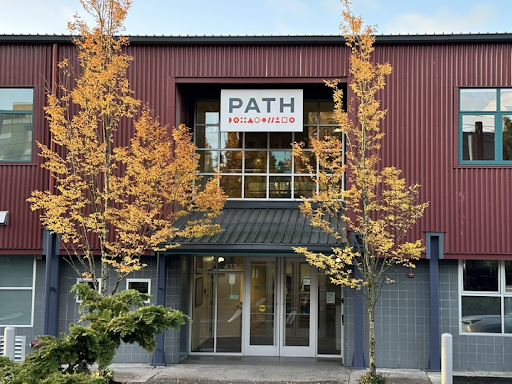
For example, in 2025, the global biotech nonprofit PATH (Program for Appropriate Technology in Health) relocated and took over offices formerly occupied by Tableau in Fremont’s West Dock building.
A growing roster of other innovators — including biotech giant Amgen, Breville, The Trade Desk and The Allen Institute for AI — renewed their Fremont leases last year for long-term occupancy. GeekWire, which has called the Fremont neighborhood home for more than a decade, also recently renewed its lease along the ship canal.
This vibrancy means that Fremont’s compact, tightly packed physical footprint of less than a square mile now overflows toward Gas Works Park in the Northlake area, home to fast-growing autonomous vehicle maker Overland AI.
Companies have also spread throughout the once worn-down, but now-bustling south end of Stone Way, where Brooks Running’s headquarters along the Burke-Gilman trail has more than doubled to 500 staffers in recent years.
According to Mike Peck, the VP of Creative at Brooks, the company moved from its previous Bothell location to Fremont, “intentionally, so we’d be across the street from the Burke.”
Brooks’ employees often take 1-on-1 meetings outside — walking or running.
“We love to say, ‘Let’s go to the dinosaur topiaries!’” says Peck, referencing one of the many public art installations scattered throughout the neighborhood.
Peck also pointed out the interesting mix of companies located in Fremont, and how they come together to form a strong community tied to the natural environment.
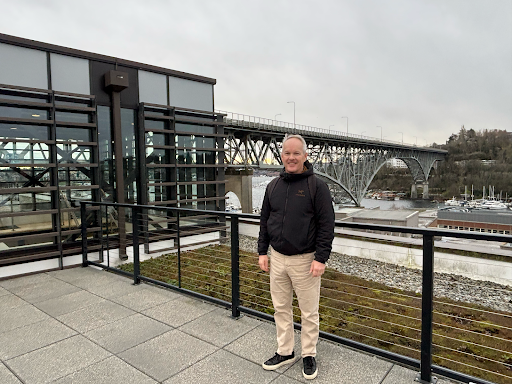
“It’s so interesting to watch from our offices and see the fishermen coming in and out, sailing under the Aurora Bridge — which is such a gorgeous structure,” Peck said. “You’ve got rowers on the water, and runners along the trail, and houseboats, all near each other. It’s simply stunning.”
Hanning, of the Fremont Chamber of Commerce, feels that same buzz when walking the streets and trails of Fremont or spending time on the water.
“The energy here is palpable,” he says. “You can see it, you can feel it, you can engage with it.”