
When X-VPN’s security team recently ran a round of internal testing, they uncovered a signal that looked, at first glance, like a potential data exposure risk. Further investigation, however, pointed to something bigger — an Android platform–level behavior that affects many VPN apps, not just X-VPN.
Rather than a flaw in VPN encryption or tunneling, this finding highlights how operating system configurations can influence network safety in subtle ways — and why transparency matters when it comes to online privacy.
A Closer Look at Blind In/On-Path Risks
The issue X-VPN analyzed relates to what researchers describe as “Blind In-Path” or “On-Path” attacks. These techniques don’t actually decrypt user data. Instead, attackers try to infer or interfere with traffic by observing how systems respond to certain types of network packets.
In classic Man-in-the-Middle scenarios, an attacker can see or modify content. Blind In/On-Path attacks are different — they rely on guessing and probing. It’s a reminder that not all security risks are about broken encryption; sometimes, they come from how the system itself routes and filters network traffic.
What X-VPN Found — and What It Means for Android Users
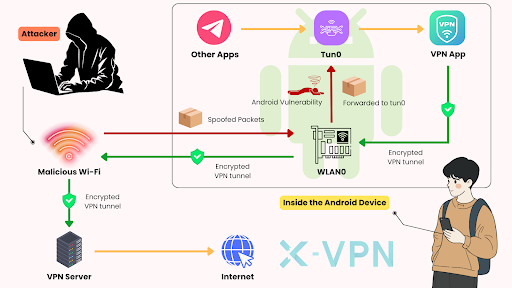
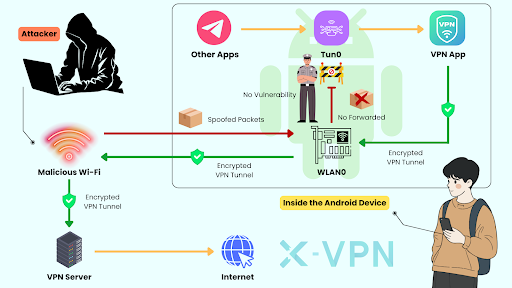
During X-VPN’s review, its engineers detected response patterns when running tests on Android devices. After reproducing the behavior in controlled environments, the team discovered that the cause was Android’s default configuration, specifically how it handles reverse path filtering (rp_filter=1).
Because Android doesn’t strictly enforce this setting, spoofed network packets on unsecured Wi-Fi could be routed to a VPN tunnel interface and trigger system responses — even though the VPN tunnel itself remains encrypted and uncompromised.
Importantly, X-VPN confirmed that no user data, session content, or traffic logs were exposed. The company’s encryption layers, zero-log policy, and kill switch protections functioned as expected.
In short, what looked like a VPN issue was actually a platform-level signal, reproducible across multiple VPN implementations.
A Broader Industry Pattern
To confirm the scope, X-VPN’s researchers replicated the same tests using other well-known VPNs on Android. The results were consistent — the signal wasn’t unique to any specific provider. It stemmed from Android’s network stack, not VPN code or configuration.
On Linux, similar network behavior appeared, but administrators can manually harden the system by adjusting kernel parameters. On Windows, macOS, and iOS, no such responses were observed at all.
That finding aligns with X-VPN’s position: the issue is not about broken encryption, but about how the OS itself interacts with network interfaces.
Responsible Disclosure and Defensive Measures
Following standard disclosure procedures, X-VPN shared its findings, reproduction data, and observations with Google’s Android security team for review. The company also rolled out additional safeguards on its Linux client, dropping potentially spoofed traffic aimed at VPN interfaces.
For Android users, X-VPN recommends a few practical precautions:
- Prefer mobile data or trusted Wi-Fi networks.
- Keep HTTPS enabled whenever possible.
- Turn on the Kill Switch feature in the app settings — available for all Android users.
Why Transparency Matters
Security research often reveals that not every risk originates from the app itself. Sometimes, it’s about how multiple layers — device, OS, and network — interact. X-VPN’s decision to publicly share its review reflects an industry shift toward greater accountability and technical openness.
An independent audit is already underway, covering VPN protocol configurations, client behaviors, and mitigation effectiveness. A public summary will be released once the review is complete via the X-VPN official site.
For users, the takeaway is straightforward: no evidence of exploitation or data leaks has been found, but awareness and layered defenses remain essential.
About X-VPN
X-VPN is a privacy-focused VPN provider trusted by over 100 million users worldwide. Operated by LIGHTNINGLINK NETWORKS PTE. LTD. and headquartered in Singapore, X-VPN offers no-log VPN services across major platforms, combining AES-GCM encryption, RAM-only server infrastructure, and support for multiple tunneling protocols including WireGuard, OpenVPN, and its proprietary Everest protocol.
Media Contact: [email protected]
Source: X-VPN
