
Over the past decade, connected technology has redefined how essential systems operate. Mobile banking replaced branch visits. Telehealth reduced the need for in-person care. Work became untethered from a fixed location. The pattern is clear: when secure, connected technology is placed directly in people’s hands, even longstanding systems become more efficient, accessible, and effective.
Nearly two million people are housed in U.S. correctional facilities, where administrators manage a uniquely demanding environment balancing staffing shortages, safety requirements, aging infrastructure, and a growing need for rehabilitative programming. For correctional leaders, the question isn’t whether technology belongs, but how to implement it responsibly by deploying solutions that are secure, durable, and purpose-built to improve outcomes while preserving the balance facilities work every day to maintain.
Tablets in corrections function as core infrastructure for modern operations. When designed specifically for correctional use, they reduce operational friction and support safer, more stable facilities for both staff and incarcerated individuals. They also create a foundation for delivering education, workforce training, and communication tools at scale, capabilities that have historically been difficult to provide consistently, given staffing and physical constraints.
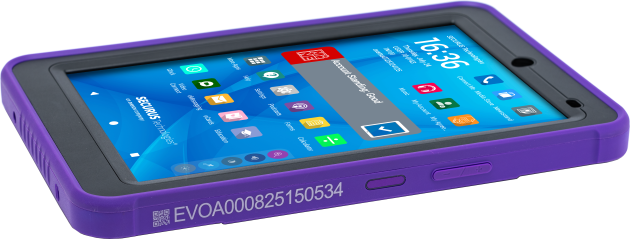
A new generation of corrections-grade tablets reflects this shift. The EVOTABⓇ, a corrections-grade tablet, is built on a familiar foundation: the same Google-certified Android Enterprise platform used by millions of people every day. That choice was intentional. The tools people use to find jobs and stay connected outside of facilities run on platforms like this one. Introducing that same foundation inside facilities helps build digital fluency well before release, supporting successful reentry as a process rather than a moment.
At the same time, familiarity alone is not enough. What distinguishes corrections-grade infrastructure from consumer electronics is not the operating system, but the information architecture, security framework, and governance layered on top of it. In correctional environments, it is not just about controlling devices, but about structuring how information is accessed, shared, and monitored across an entire system. Correctional environments require technology designed for continuous shared use, strict access controls, and real‑time visibility, all while minimizing administrative burden on already stretched staff.
On that familiar platform, EVOTABⓇ layers the security and durability a correctional environment demands. It provides access to education, skill-building, and job training programs. It enables secure communication with family members, a factor research consistently links to safer facility environments and reduced recidivism. The data supports this: Niagara County Jail in New York saw a 22 percent drop in infractions within a year of tablet implementation. Engagement through tablets reduces idleness. Reduced idleness reduces incidents and contributes to stability.
In corrections, security and durability are not optional enhancements. They are baseline requirements. Purpose‑built tablets account for the realities facilities manage every day: constant use, limited opportunities for repair, and the need for immediate response if something goes wrong. When technology is designed with those realities in mind, it becomes a support system rather than a source of added complexity.
But none of this is possible without first solving the security problem, and this is where corrections technology diverges sharply from consumer electronics. Before any device is allowed inside a facility, it must be ironclad. Durability, tamper resistance, and system integrity are not optional features; they are the price of entry. Without these foundations, tablets don’t improve outcomes.
Modern corrections-grade tablets are built for these realities. These controls are not isolated features. They are part of a broader system architecture that governs who can access what information, when, and under what conditions, creating a controlled digital environment rather than an open network. They feature tamper-resistant casings that protect internal components, sealed ports that eliminate pry points, and built-in alerts that notify staff of any attempted interference. Fingerprint authentication, GPS tracking, and a private Google Play Store add further layers of accountability. Dual LTE and Wi-Fi connectivity minimize downtime and simplify infrastructure upgrades in facilities where connectivity has historically been fragile and expensive to maintain.
Importantly, security does not stop at the device itself. Enterprise‑grade corrections technology is managed across its entire lifecycle, from provisioning and monitoring to lockdown and decommissioning, giving facility leaders the ability to contain risk, maintain oversight, and operate with confidence.
This kind of structured environment is what makes modern enterprise systems, including AI-enabled tools, viable in complex settings. Without clear information architecture and governance, even the most advanced technology cannot operate securely or deliver meaningful insight.
The broader opportunity extends well beyond facility walls. Individuals who leave incarceration with digital skills, stronger family connections, and access to reentry resources are better positioned to find employment and reintegrate into their communities. In that sense, corrections technology supports not only public safety inside facilities, but economic stability and workforce readiness outside of them as well.
Realizing that potential requires a shift in mindset. Reentry cannot begin at the point of release; it must start on day one. Infrastructure that supports education, communication, and skill development inside facilities is what makes that possible.
We’ve seen this before. Banking, healthcare, and the workplace were reshaped when secure, user-centered technology was scaled under the right controls. Corrections is on a similar path. With the right infrastructure in place, grounded in secure information architecture and operational control, facilities have an opportunity to evolve how they operate, using purpose-built technology to strengthen both day-to-day performance and long-term outcomes.

Melanie Sankaran is the Chief Information Officer of Aventiv Technologies, where she leads innovation in secure communication and technology solutions for correctional facilities. With over two decades of experience in cybersecurity and IT leadership, she is dedicated to building systems that empower staff, strengthen safety, and support rehabilitation through connection and education.

Kevin Elder is the President of Securus Technologies. With a strategic vision rooted in enterprise architecture, data platforms, and digital transformation, Kevin brings executive leadership and deep technical insight to the forefront of AI and information governance initiatives.
