
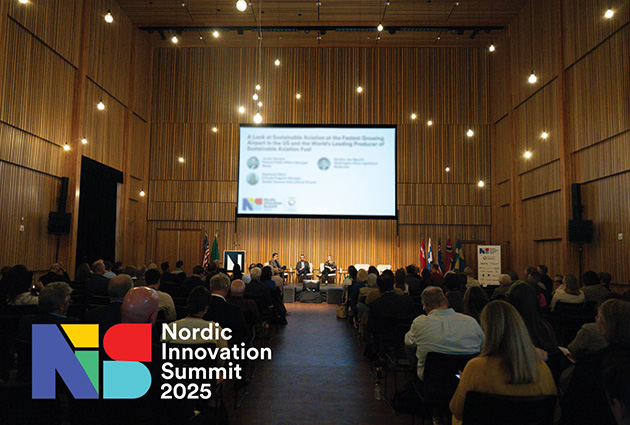
Have you ever wondered why there’s such a strong tie between the Nordic countries (Norway, Sweden, Denmark, Finland, and Iceland) and the Pacific Northwest?
Nordic peoples were the largest group of immigrants to settle this region, including my own Norwegian relatives. Their impact has left an indelible mark on the greater Seattle area and strong ties have persevered through a number of political and societal transitions. Even today Nordic innovators find a warm welcome here. Since 2018, the National Nordic Museum has hosted the Nordic Innovation Summit, connecting thought leaders and innovators from both sides of the Atlantic.
Having studied how innovation happens – at Silicon Valley’s Tech Museum of Innovation, Paul G. Allen’s Living Computers Museum (RIP), and the Museum of the Future in Dubai- a common thread became clear: innovation thrives when government, academia, and private industry work in partnership. This “triple helix” model, widely embraced across the Nordics, provides a proven framework where research, regulation, and entrepreneurship co-evolve. This “triple helix” model—widely embraced across the Nordics—provides a proven framework where research, regulation, and entrepreneurship co-evolve.
In the United States, universities such as Stanford and the University of Washington have long been vital players in this ecosystem. But recent political and budgetary shifts are threatening public investment in both government research and academic institutions. The Nordic Innovation Summit is a rare American forum where all three strands of the helix—plus non-profits and NGOs—come together to shape bold, future-facing ideas.
In a time of polarization and fragmentation, recommitting to this kind of cross-sector collaboration is not just smart—it’s essential.
This year at the National Nordic Museum, we’re hosting the Nordic Innovation Summit on October 21st to 22nd to align with One Ocean Week and the 200th Anniversary of organized Norwegian immigration to America. Some may ask why a museum would be the institution to convene these kinds of conversations. Museums bring together artists and engineers, students and CEOs, policymakers and the public, in spaces designed for curiosity and reflection. In doing so, they bridge the gap between information and imagination, past and future. As the venue for the Nordic Innovation Summit, the National Nordic Museum becomes more than a cultural institution—it becomes an incubator for insight and catalyst for discovery.
During a talk at the museum in August with Danish author and politician Pelle Dragsted, the point was made that the world often looks to the Nordics for inspiration. While the Nordics are leading the innovation indexes and rankings for happiest countries, there’s no better time for these important dialogs.
The 2025 Nordic Innovation Summit will focus on the theme of Resilience. Resilience is a common Nordic trait exemplified by the Finnish concept of “sisu.” Author Joanna Nylund introduces sisu as “stoic determination, hardiness, courage, bravery, willpower, tenacity and resilience.” Whether it is in hearing stories from early immigrants struggling to make a new life in America, Sámi people in the Nordics fighting for indigenous rights, shipwreck survivors, or modern-day astronauts orbiting the poles, sisu is always on display at the museum.
We look forward to hearing about and learning more inspiring examples of sisu at the Nordic Innovation Summit this month.
