
When you operate in an industry as competitive and cost-sensitive as online travel, you need to automate wherever you can. That’s why we decided to experiment with agentic AI.
Since launching as a hotel booking app seven years ago, Engine has grown into a $2 billion travel platform serving more than 1 million travelers. In 2025, we’re aiming to grow another 70% without adding overhead. That means we need a way to quickly scale while continuing to offer the white-glove concierge service our customers expect.
Since Fall of 2024, we’ve been using Salesforce’s Einstein chatbot to answer questions on web and mobile. It was a natural evolution to use Agentforce to build an AI agent that could fulfill customer requests on its own.
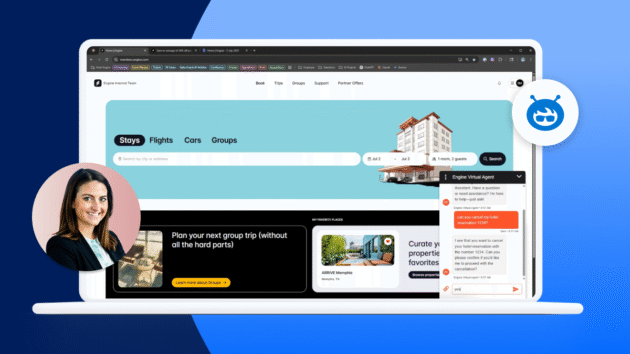
The result was the Engine Virtual Agent (EVA), which launched in November, 2024. It was our first step toward becoming an agentic company, and we’ve already learned several valuable lessons in just a few short months.
Keeping it simple
We began with a long list of tasks we wanted to automate: reservation updates, rental car inquiries, flight changes, and so on. But we quickly realized that when an agent has too many options to choose from, it requires more escalation to human agents, creating more latency and confusion. EVA struggled to route things cleanly; resolution times slowed.
So we stepped back and decided to focus on the broader categories of hotels, flights, and cars. Scaling back EVA’s options greatly improved performance, leading to smoother conversations and fewer errors. For our first public-facing assistant we landed on a clear, high-value use case: automating customers’ ability to cancel hotel reservations.
Before implementing EVA, Engine’s human support representatives were handling more than 300 cancellation requests a day. That meant reading the transcript of each customer’s chat session, calling up their active reservations in our booking platform, contacting the hotel and the customer to confirm the cancellation, and manually updating the customer’s profile in the Salesforce Service Cloud.
Now imagine doing that for a dozen travelers flying in from multiple destinations.
Today, nearly half of all hotel booking cancellations are handled automatically by EVA, which uses natural language processing to understand each request, validates customers’ identities, and uses API integrations to contact the hotel and update the cancellation across all of Engine’s data sources.
Using EVA has enabled us to cut average customer handle time by 15% and improve the productivity of our support reps by 10%, allowing them to spend more time on higher value customer experiences. We estimate using EVA will save $2 million a year, and allow us to scale our business without significantly expanding our 150-person support team.
Key lessons learned
Creating our first virtual agent taught us some key principles about what it means to be an agentic company.
Transparency is crucial. EVA is introduced up front as an AI assistant, and makes it easy to get human intervention when needed. This level of transparency helps to build trust with our customers.
Perfection is not an option. Many organizations struggle because they assume the AI will always work perfectly. But AI chatbots still hallucinate, and sometimes fail to understand what people actually need. We designed EVA with failure in mind – engineering the agent to recognize its own limitations and escalate proactively.
Smart escalation is essential. Knowing when to escalate is important, but so is knowing how to do it. There’s nothing more frustrating than having to repeat the same details when a support representative comes on the line. We are careful to preserve the context of each conversation, so our human agents can understand the customer’s problem and see what steps EVA has already attempted.
Customers don’t mind if the AI can’t solve every problem. They mind when it wastes their time trying.
The agentic future
To do agentic AI well, you need to give the agent the same tools and resources your support team has. Building EVA directly inside Salesforce enabled us to do that. Now that EVA is connected to our knowledge base and products, it can provide a real end-to-end experience for customers – becoming a support agent in the truest sense of the word.
And we’re only just getting started. EVA was designed to be modular and scalable; we plan to have her take on more tasks and begin to collaborate directly with other specialized agents from our partners to event planners.
Our goal was never to build the perfect AI agent. It was to enable a perfect customer experience through intelligent human-AI collaboration. EVA was our first step toward Engine becoming an agentic company, but this won’t be our last.
