Unapologetically oddball public artworks, from sculptures to topiaries to murals, cultivate Fremont’s widely admired reputation for quirkiness.
Block after block, it’s easy to stumble upon creative — some might say zany — landmarks. Both neighborhood organizers and tech company leaders alike cite Fremont’s artiness as a key ingredient in the area’s unmistakably positive vibe.
Here’s a round-up of several of Fremont’s notable outdoor artworks, with commentary from Brandi Gaines, a longtime Adobe employee in their Fremont offices who’s also served as the Fremont Chamber’s board president for the last two terms (six years) and is now the president of the Fremont Creative District.
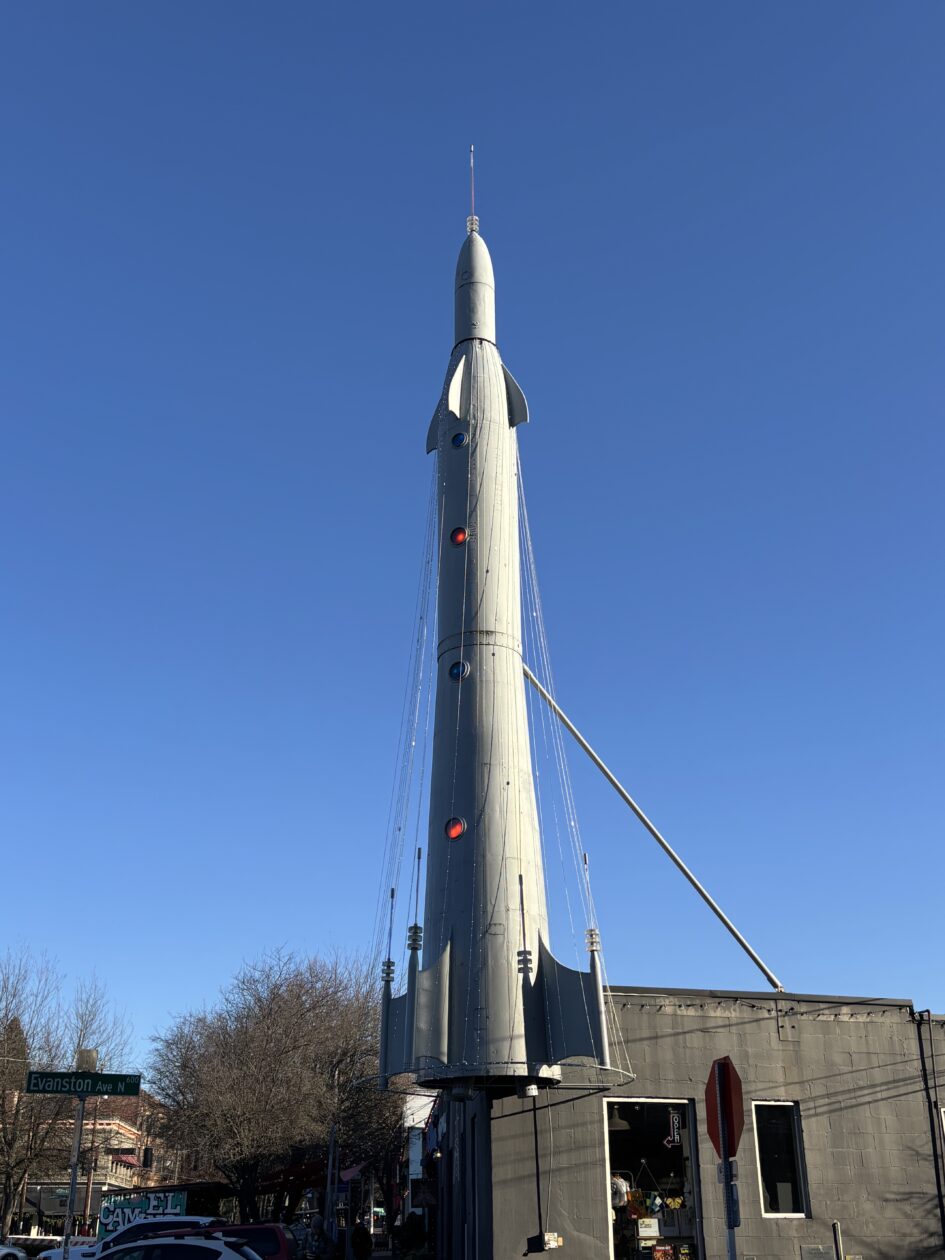
1. The Fremont Rocket
Location: Evanston Ave. N. and N. 35th St.
Here’s a blast from the past, so to speak: in 1991, the Federal Army & Navy Surplus store in Belltown decided to clean house. They enlisted a DJ to ask, “Anybody want a 53-foot-long Cold War-era rocket fuselage?”
Members of the Fremont Chamber of Commerce raised their hands and shelled out $750 for it.
These were the same people responsible for cheekily declaring Fremont “The Center of the Universe.” Planting a rocket in the center of the neighborhood felt like a fitting way to stake their claim and draw attention and visitors to the area.
Logistically, the group struggled with how to install the fuselage, so it wasn’t properly installed until 1994.
But for over 3 decades, it’s attracted gawkers and (more recently) selfie-takers and tourists who take to heart its inscription: “De Libertas Quirkas,” or “The Freedom to Be Peculiar.”
2. The Fremont Troll by Steve Badanes, Will Martin, Donna Walter, and Ross Whitehead
Location: Troll Ave. N and N 36th St.
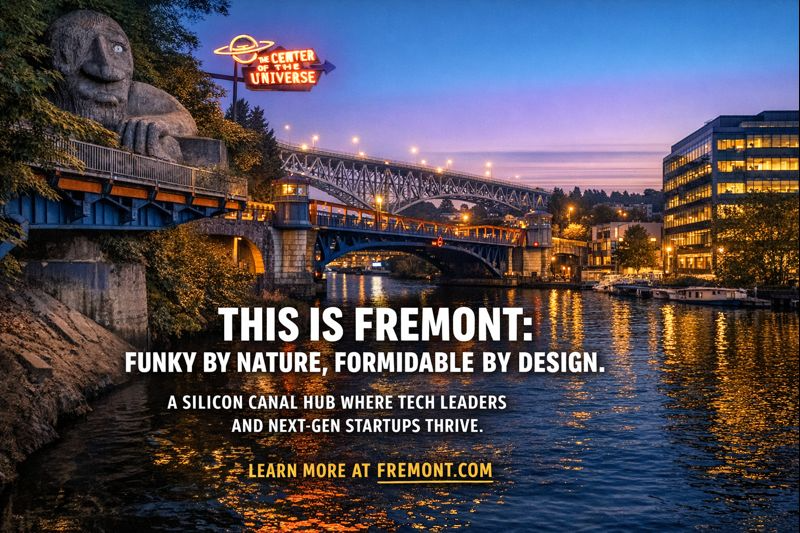
Once an overgrown, garbage-strewn plot, the home of the Fremont Troll is now arguably Seattle’s weirdest public art installation. The 18-foot concrete troll, inspired by “Three Billy Goats Gruff,” seems to lunge out of its cave-like abode under the Aurora Bridge while clutching onto a 1967 Volkswagen Beetle. Its provenance? An arts competition organized by the Fremont Arts Council.
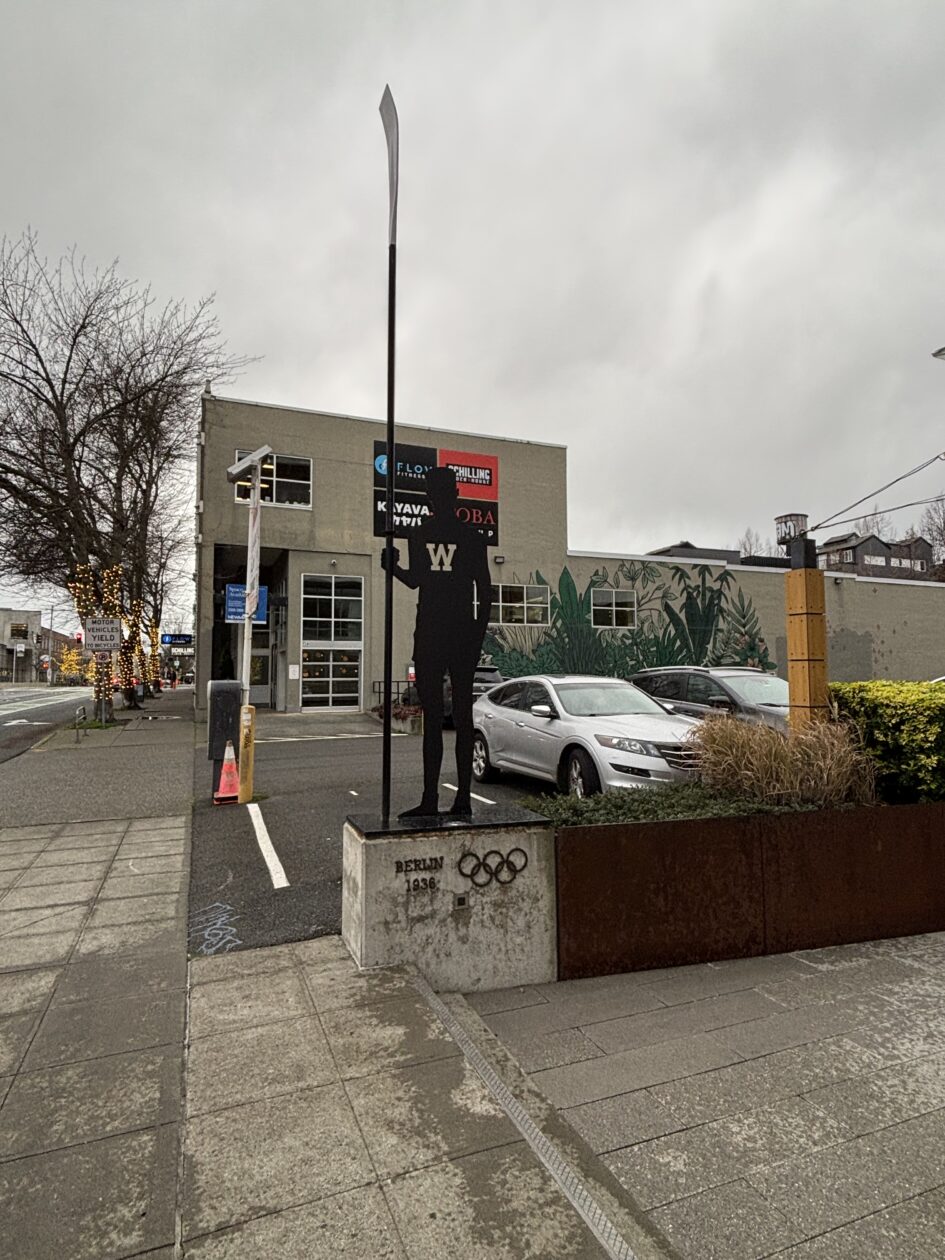
3. “Berlin 1936”
Location: 744 N 34th St., alongside the DATA 1 building
The University of Washington’s scrappy rowing team won gold at the 1936 Berlin Olympics and was featured in the bestselling book and George Clooney-directed movie, “The Boys in the Boat.”
The sculpture is often unofficially referred to as the “Joe Rantz sculpture,” after the rower who overcame being abandoned by his family (played by Callum Turner in the film).
The metal sculpture is notable for its oversized, 14-foot oar. The sculpture was designed by Fremont’s Weber Thompson architects and fabricated by Ballard’s Mach 2 Arts and Fabrication as part of the Data 1 building.
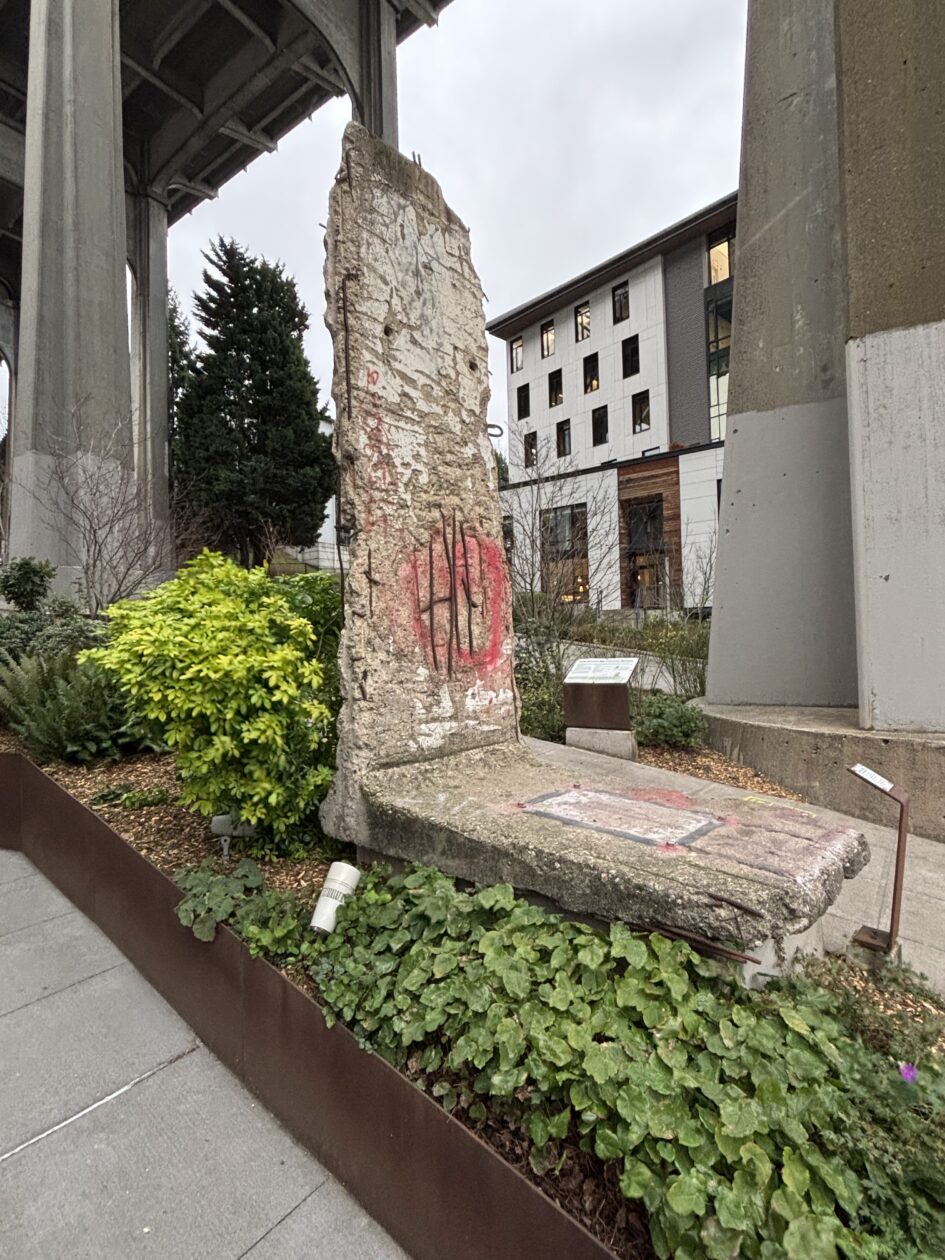
4. Segment from the Berlin Wall
Location: Troll Ave., outside Milstead & Co.
Mere steps from the “Berlin 1936” sculpture, you’ll discover a graffiti-covered chunk of the Berlin Wall. It commemorates Seattle’s and Boeing’s role in the 1948 Berlin Airlift. Some folks in Fremont say this concrete slab itself somewhat resembles a mini-troll, with bolts for its eyes and rebar for teeth.
5. “The Medalist,” designed by Gabe Hajiani and Matt Kappler and created by Larry Tate
Location: N 34th St. and Stone Way N, by the Brooks Trailhead store
To commemorate the company headquarters’ move from Bothell to Fremont, Brooks Running asked customers to donate race medals and share the personal story behind each medal.
Over 1,000 medals were collected, with all 50 states and each major U.S. marathon represented, then bronzed and forged into an 11-foot-tall image of a victorious runner. Running groups use the sculpture as a meeting point. The runners’ stories were collected in a book that’s on display in the store.
6. Topiary dinosaurs
Location: 101 N. Canal Street (intersection of Phinney Ave. N. and N. 34th St.)
Another neighborhood’s unwanted art is Fremont’s gain—again! Back in 1999, the Pacific Science Center no longer wanted the giant mother and baby Apatosaurs, back then filled and covered with fake vegetation.
The Fremont Rotary stepped in, adopting the 66-foot-long creations for the demure price of $1. The dinosaurs’ frames weigh 5 tons, not counting their coverings of 7,000 ivy plants (real-live ones, not plastic, and requiring frequent pruning).
As enormous as these dinos are, they’re sometimes camouflaged among all the greenery along the Burke-Gilman trail.
7. The Lenin Statue
Location: Intersection of Fremont Place N., N. 36th Street, and Evanston Ave. N.
What weighs over 7 tons, is 16 feet tall, and commemorates mocks the legacy of a Bolshevik despot? The bronze statue of Vladimir Lenin, created by Emil Venkov, was toppled in then- Czechoslovakia, during the 1989 Velvet Revolution.
An American veteran and Issaquah native, Lewis Carpenter, discovered the statue in a scrapyard and mortgaged his home to cover the $40,000 cost to bring it to the Seattle area.
Much like “Waiting for the Interurban,” the Lenin statue frequently gets treated to a sartorial makeover, sometimes whimsical to mark holidays like New Year’s or Valentine’s Day, and sometimes political.
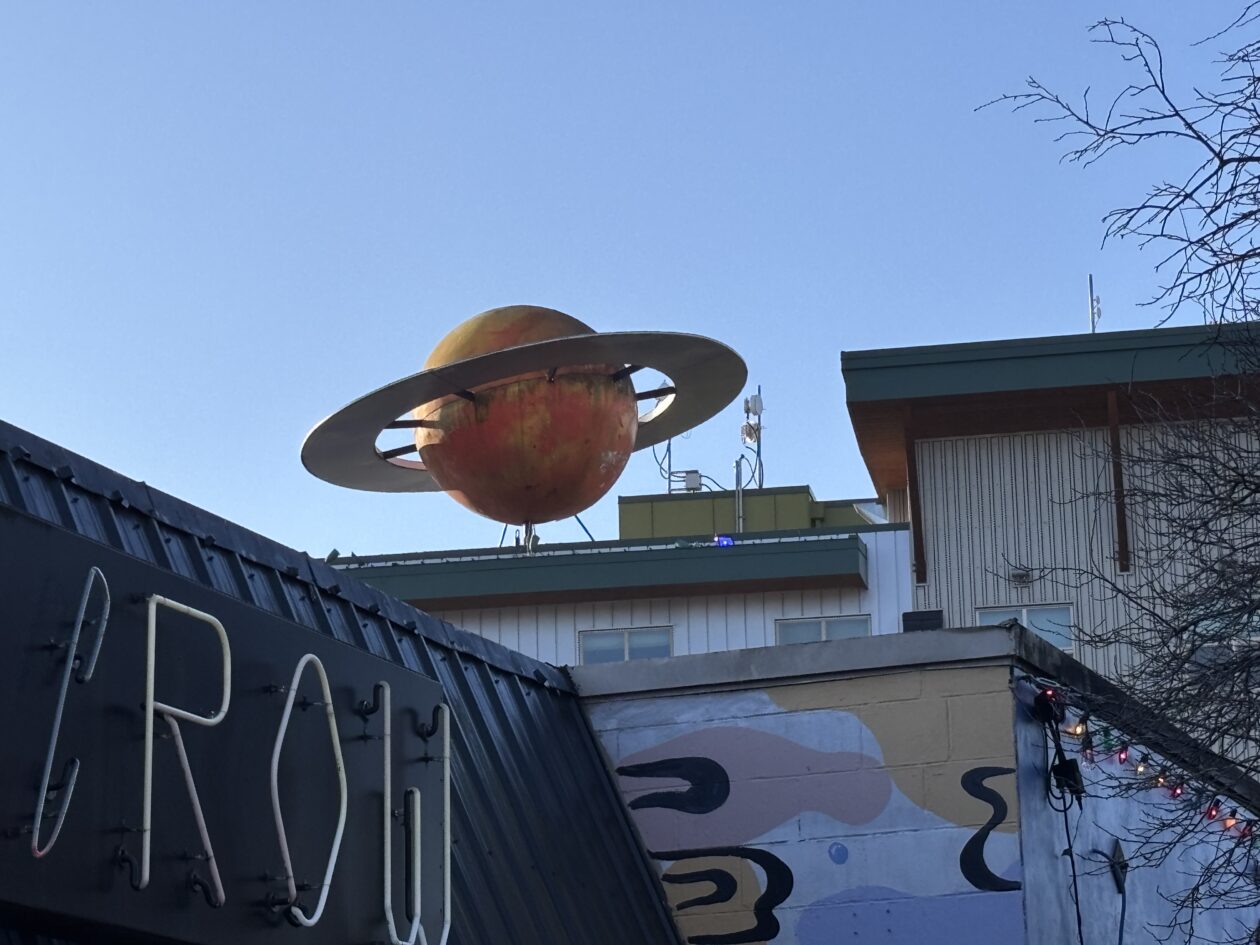
8. The Saturn sculpture by Brian Regan
Location: The Saturn Building (3417 Evanston Ave. N.)
Viewable by: Anyone visiting the Fremont Rocket
What’s that orange glow surrounding the rocket? That would be from the 24-foot-wide Saturn sculpture, plunked on a roof directly across Evanston Avenue in 2013.
The Saturn Building is home primarily to healers of all kinds, including clinical psychologists and massage and bodywork therapists, many focused on holistic approaches like Rolfing and craniosacral therapy.
A smattering of tech companies in the Saturn Building include Living Green Technology, which offers recycling of physical tech like laptops and destruction of e-waste (such as unneeded data).
9. “Rapunzel” and “The Elephant’s Child,” both by Rodman Miller
Location: Inside the Fremont Bridge’s watch towers
With blond wavy hair cascading down, the neon “Rapunzel” sculpture has stood sentinel high in the Fremont Bridge tower since the 1990s. She can survey those who pass by in boat, car, and bicycle–the intersection of Nickerson, Fremont, and Dexter Avenues is one of the busiest intersections in the city for bike traffic.
On the northeast side, “The Elephant’s Child,” a nod to Rudyard Kipling’s story about how a curious elephants got its long trunk, is another neon sculpture looking down over the bridge, which opens to boat traffic an average of 35 times a day.
The tower itself is sometimes home to artists-in-residence, from writers to animation artists, thanks to grants from Seattle’s Office of Arts and Culture (ARTS) and SDOT (Seattle Department of Transportation).
10. “Waiting for the Interurban” by Richard Beyer
Location: Intersection of N. 34th Street and Fremont Ave. N.
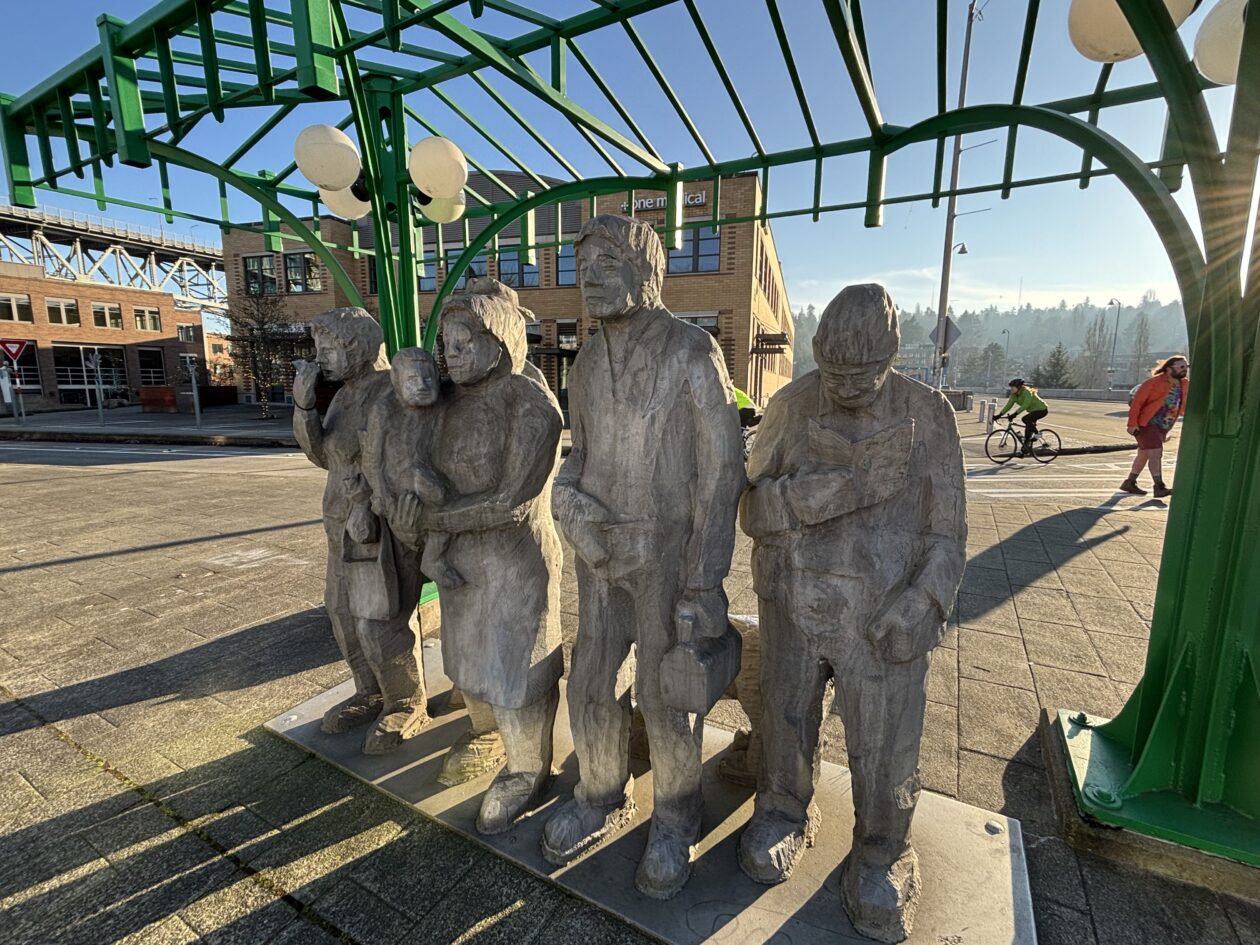
A sculpture of 6 men and women along with a human-faced dog huddle together patiently alongside North 34th Street just north of the Fremont Bridge. A nod to the Interurban trolley line that once rolled through Fremont’s streets, “Waiting for the Interurban” reflects the Fremont spirit as you’ll often see the people and pup dressed up with birthday crowns and balloons tied around their wrists.
Sometimes, it’s Seattle Sounders scarves, or Storm or Seahawks jerseys. When summer rolls around, you’ll see high school graduation gowns and mortarboards and occasionally even wedding attire.
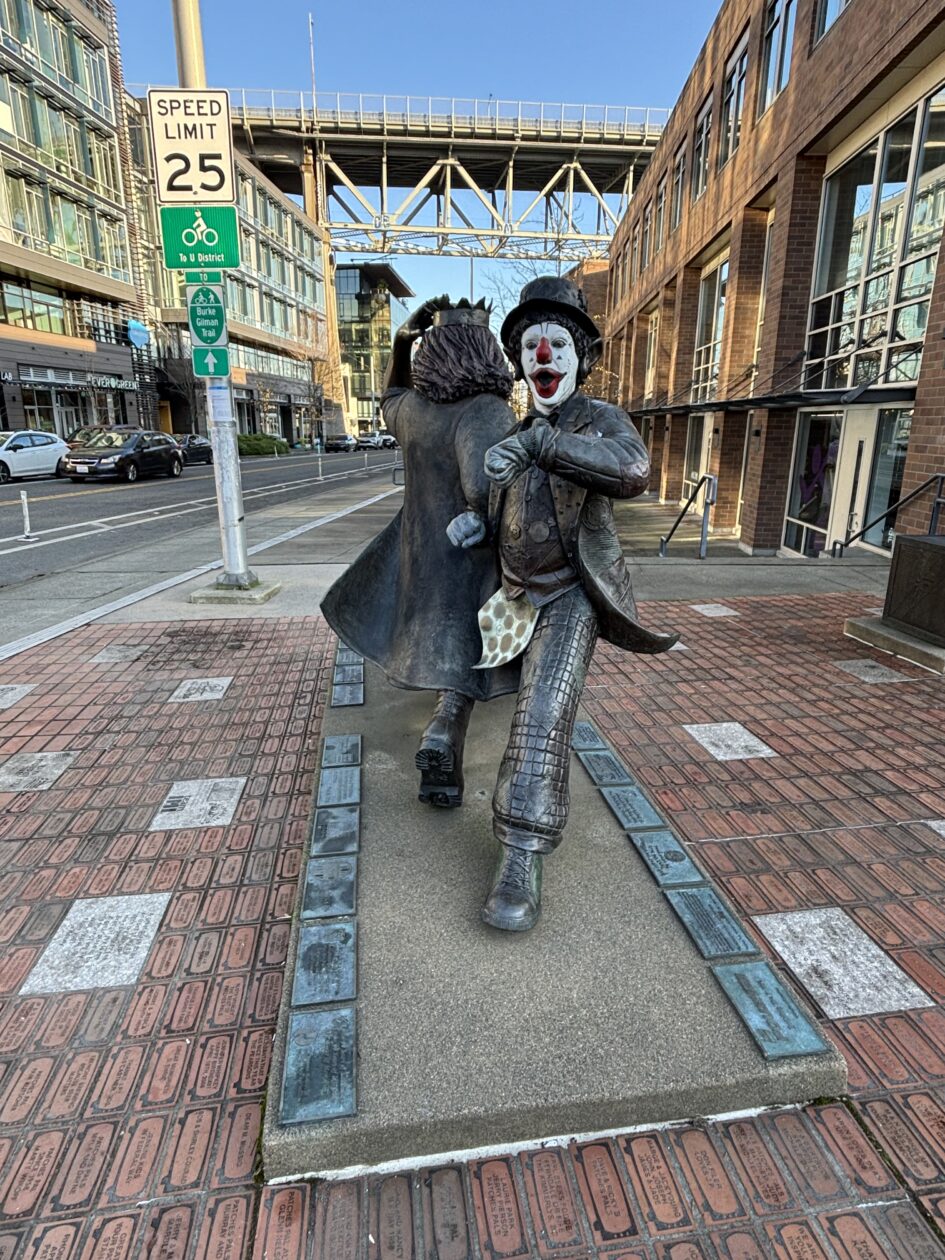
11. “Late for the Interurban” by Kevin Pettelle (also known as the “J.P. Patches and Gertrude” sculpture)
Location: Solstice Plaza, intersection of N 34th St and Fremont Ave. N
The “J.P. Patches Show” was a live, unscripted, and often irreverent kids’ television show that ran on Seattle’s KIRO-TV from 1958 to 1981. Astoundingly, it aired twice daily, before and after school, for over a dozen of those years.
J.P., played by Chris Wedes, and his mop-haired buddy Gertrude (Bob Newman) welcomed special guest stars including Jesse Owens and Jacques Cousteau.
As depicted in the bronze statue, are J.P. and Gertrude jauntily dancing, or are they trying to yank one another in the opposite direction? Well, supposedly, they’re trying to catch the Interurban trolley—a nod to “Waiting for the Interurban” just across the street—but obviously, some shenanigans will be had first.
The legacy of J.P. Patches looms large. Portland, Ore-native and Simpsons creator Matt Groening counts himself among the legion of J.P. fans and gave a nod to Seattle’s favorite clown by giving the name “J.P.” to one of Krusty the Clown’s friends.
With artworks like these found throughout Fremont, tech and business leaders say their employees feel uplifted and inspired. The art adds a joie de vivre to the area that’s unmatched by other neighborhoods and fuels creative thinking and problem solving.