
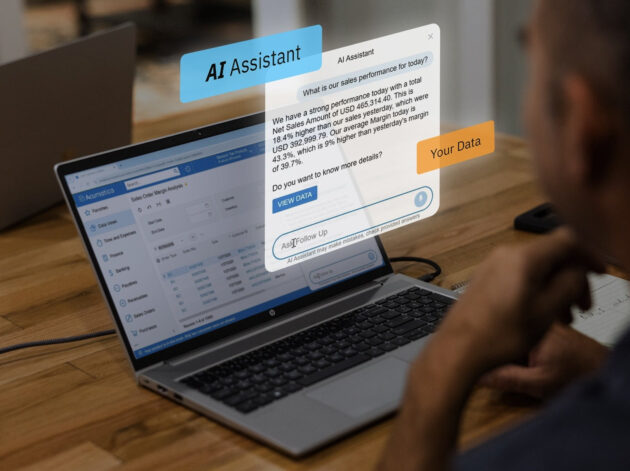
Artificial intelligence (AI) is a transformative technology offering the dramatic potential to revolutionize the way we work.
But, according to Tech.co’s 2024 report, “The Impact of Technology on the Workplace”: “The use of AI is not as widespread as news coverage might suggest: 67% of respondents told us AI is never used (34%) or used to a limited extent (33%) in their businesses.”
With AI’s potential to provide new ways to boost efficiency and evolve decision-making, why are so many companies slow to adopt it?
This hesitancy is rooted in a few areas, including legitimate questions over data security and privacy and a broader confusion over AI hype and which new AI-enabled capabilities truly address business problems. All organizations, particularly small and mid-sized businesses, realize that AI enablement is more than just flipping on a switch. To fully benefit from AI tools, they must be AI-ready. This starts with a strong foundation of data supporting and informing every business move.
Foundation Faults
AI is only as good as the data it uses. To prepare for new AI-enabled capabilities, organizations would be wise to identify and address some common faults in the data they currently use, such as siloed data from multiple teams and systems, data conversion errors from information transfers to new systems, and outdated information.
Any AI tool, trained on and forced to operate with such a compromised data foundation, will produce incomplete, inaccurate, and misleading results. Beyond AI, the impact of poor-quality data includes lost profits, reduced efficiency, missed opportunities, wasted time and money, diminished employee morale, reputational damage, and even fines.
In short, a faulty data foundation not only creates business challenges but also is a complete hindrance to AI readiness.
Foundation Stabilizers
Businesses that are confronted with poor quality data can take steps to fix the faults in their foundation by cleaning their data. Data cleaning is the process of removing the inconsistent, duplicated, inaccurate, or outdated data that hampers current performance and complicates the adoption of future innovations.
The goal of these data-cleaning efforts is to achieve quality data that is:
- Accurate. The data should be correct and error-free.
- Complete. There should be no inexplicable data gaps, and no essential information should be missing.
- Consistent. The data should be in the same format companywide, and the information one department has shouldn’t contradict the information another department has.
- Timely. The data should be up to date. No analytics-skewing old data should be hanging around.
- Valid. The data should fit its intended use cases.
For small to midsized businesses operating with tight profit margins and a staff that is already spread thin on their daily tasks, achieving clean data requires the change management that is needed with modern business technology.
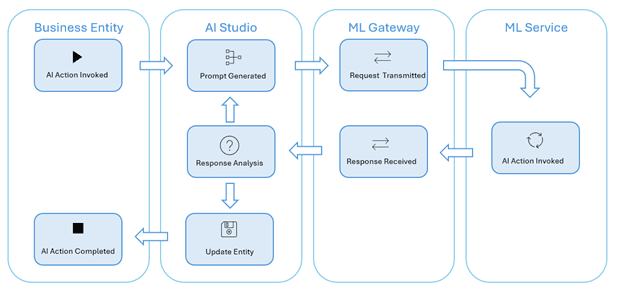
ERP as a Fast Track to AI Readiness
Modern business solutions, such as enterprise resource planning (ERP) software, serve as the central nervous system of your organization.
The process of implementing a new ERP system will not only streamline operations but also initiate the change management steps needed to improve data quality. And businesses don’t have to go on this journey alone. ERP and business process specialists, data and systems architects, industry-specific experts, and more will help them not only implement the system, but also clean and prepare their data for migration to the new software.
By the time the implementation is finished, the business has accurate, complete, consistent, timely, and valid data—making it better positioned to reap the benefits of AI tools. They’re ready for intelligent AI advisors. They’re ready for interactive AI assistants. They’re ready for business process automation.
Building a strong data foundation stabilized by modern business management software ensures that all your operational investments—including future AI capabilities—will pay off with increased efficiency, greater productivity, and, ultimately, business success.
To learn more about Acumatica’s approach to practical, responsible AI, check out our commitment to AI That Works for You and our Principles of Innovation.
