
When people think about digital transformation, they tend to think about hospitals replacing paper charts with electronic health records, banks shifting customers to mobile platforms, or schools adopting online learning models. Few think about jails.
Yet correctional facilities across the United States are undergoing their own technology transformation, driven by many of the same challenges reshaping other industries: operational complexity, rising service expectations, and pressure to deliver better outcomes with limited resources.
In my three decades as a sheriff in the Florida correctional system, facility operations and programming models depended heavily on the availability of staff and physical space. Technology existed, but it was often deployed to solve individual problems with a lens toward a broader operational strategy.
Today, a new generation of secure technology infrastructure is creating connected ecosystems inside correctional facilities, many of which have operated on outdated, siloed systems for decades.
The last time I went to the doctor, my records were already there, history, prescriptions, everything needed to make decisions quickly. When I handle a banking transaction, I can move money or pay a bill instantly, without waiting in line. That kind of connected real-time access is now expected in everyday life. The same capabilities can modernize corrections, bringing visibility, coordination, and continuity into environments that have historically operated without it.
For law enforcement and facility operators, that shows up in practical ways, pulling up an individual’s history in seconds, seeing activity across a housing unit in real time, or sharing updates with another agency without waiting on reports. Instead of piecing together information from different systems, teams can work from a single view, helping them respond faster and manage situations more safely.
For incarcerated individuals, it can be just as straightforward: signing up for a class without waiting for space, staying in touch with family, or starting job training before release. Access to these services is no longer limited by staffing or classroom availability, making it easier to build skills and prepare for life after incarceration, including returning home ready to work and contribute to their local economy.
The shift mirrors what other industries have already experienced, but corrections bring a different level of complexity. Every technology decision has to improve daily operations while maintaining security and supporting public safety. That’s pushed leaders to think beyond standalone tools and focus instead on systems that work together.
It’s not unlike building something layer by layer. Communications, identity, operations, and programming all have to do their job, and they have to connect. When one layer breaks down, the whole system feels it. But when it’s built the right way, everything works together more smoothly.
Instead of separate systems for communication, programming, identity, and operations, those capabilities are starting to connect, so information flows more easily and decisions can be made with more context and less delay. The result is better visibility for leaders, faster workflows for staff, and more consistent access to services inside the facility.
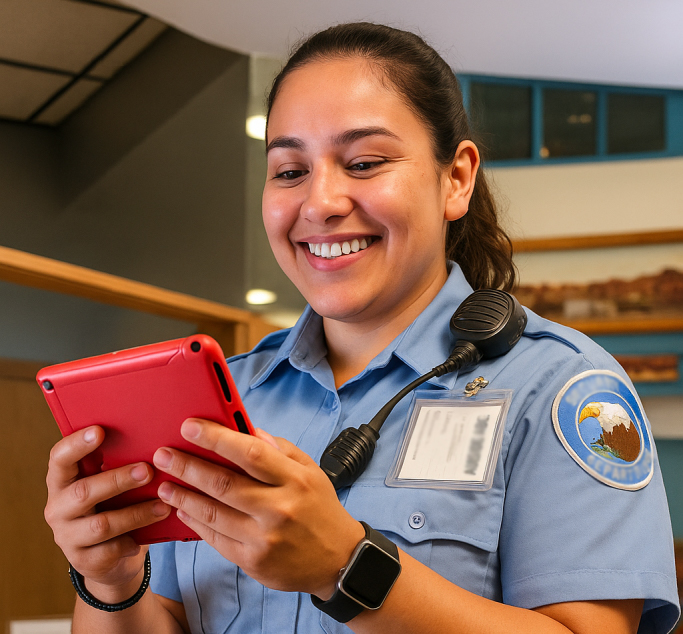
For correctional officers, the impact is immediate. Reports that once took an hour can be completed in minutes. Information that used to require a call or a walk across the facility is available at a glance. That reduces administrative burden and gives officers more time to focus on safety, supervision, and engagement. In a profession where burnout and staffing shortages are ongoing challenges, those gains matter.
At the same time, sheriffs are rethinking how preparation for reentry begins. Each year, roughly nine million people move through local jails, yet access to education and workforce training has traditionally been limited by staffing and physical space. Connected platforms are changing that, making it possible to start a course, work toward a credential, or build skills without waiting for a seat in a classroom.
The National Sheriffs’ Association’s I.G.N.I.T.E. initiative is one example of this shift. Launched in 2021 and now adopted across dozens of counties, it focuses on starting education and workforce preparation at intake, not release. At this year’s National Sheriffs’ Association conference, agencies pointed to how secure technology infrastructure is enabling them to deliver that programming more consistently and at scale.
Early results are encouraging. Research from Harvard, Brown, and the University of Michigan found that even one month of participation was associated with reductions in recidivism and misconduct, along with measurable gains in reading and math.
Those outcomes lead to something bigger. Technology is helping connect what happens inside a facility with what happens after release. Education providers, workforce programs, and community colleges can increasingly operate as part of a continuous system, rather than a series of disconnected efforts. Over time, that continuity helps more individuals return to work, support their families, and contribute to their communities, reducing the long-term costs tied to repeat system involvement.
For a system that has long relied on manual processes, this is a meaningful shift. Digital infrastructure isn’t theoretical; it’s already changing how facilities operate, how staff do their jobs, and how individuals prepare for what comes next.
