

This is a paid advertorial by Reason Cybersecurity
It isn’t just media sensationalism messing with your perception. Cyberattacks are actually getting worse over time.
As internet users, we need to have our guard up. Hackers and their attack methods have become so effective, intrusive and rampant that they now pose a serious threat all of us.
To hackers, everyone’s fair game, and it’s our private information and identities that are at stake. Personal and financial data can fetch a sizable amount on the black market, giving hackers plenty of motivation to intercept these details. The stolen data can also be used to fuel other crimes, such as identity theft and fraud. Some attackers are even snooping into people’s private moments to extort victims in situations where they find incriminating information to leverage.
Conventional approaches to securing our computers and other connected devices are not enough anymore. Antivirus software products that are limited to threat detection and removal can fail to prevent newer attack methods.
Leading antivirus service Reason Cybersecurity, however, has zeroed in on these new threats and offers features that are key to protecting user privacy in 2019.
Privacy Threats in Various Forms
We’ve gone a long way from when cybersecurity threats were mostly pesky viruses that showed some quirky messages on your screen or worms that sent out chain letter emails to your contact list.
Attackers now creatively use various malware to perform intrusive and malicious acts. Malware could easily get into computers by spreading through an infected network or by being downloaded as attachments or links in phishing attempts. If a home network also happens to have lax security, hackers can also remotely implant these on connected computers.
Once inside networks and computers, malware can compromise user security by doing the following:
- Camera and Microphone Hijacking. Attackers can use remote access tools that access communication peripherals like webcams and microphones. They can then intercept feeds or even turn devices on in order to watch, record, or listen in on private acts and conversations. Fortunately, there is a way to remove malware from your camera.
- Cryptojacking malware can secretly take over a computer’s processing power and bandwidth to mine cryptocurrency in the background. All proceeds in the mining activity go to the attacker’s wallet.
- Ransomware encrypts all files on victim’s computer rendering them inaccessible or useless. Victims have to pay the ransom in order to get decryption keys that may enable them to get back their files.
- Data Theft and Credential Snooping. Malware can also be used to scan for documents and even network traffic that contain personal and financial information and remotely send the data to hackers.
- Activity Tracking. Spyware can track users’ browsing activities. The tracking data is often sold to unscrupulous advertisers that can use the information to serve targeted ads and send spam email to their victims.
Extensive Protection Needed
Conventional antiviruses that only scan and remove malware files are not enough to prevent these. This is why Reason Cybersecurity has chosen to focus on these new needs of computer users. Reason Cybersecurity already provides real-time protection and scanning and removal of malicious files and threats that are essential to antivirus software. But aside from these functionalities, it also offers privacy-oriented features such as:
Camera and Microphone Security

Reason Cybersecurity monitors all attempts by any application to use communication peripherals. Depending on the user’s chosen setting, Reason Cybersecurity can send out a notification when an application attempts to access a webcam or microphone or only allow known and trusted applications like Skype and Slack. It can also be configured to allow or block all applications’ access to these devices.
Tracking and Browsing Protection
Reason Cybersecurity can search for and remove cookies and scripts that track your browsing activities. It also has built-in network protection that bars applications from connecting to known malicious networks such as botnets or unauthorized crypto mining pools. Reason Cybersecurity also offers a Chrome browser extension that warns you about malicious links and websites and blocks bad ads from displaying as you browse the internet.
Ransomware Protection
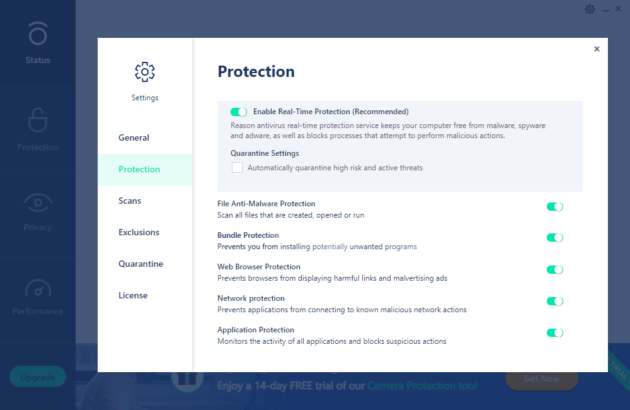
Reason Cybersecurity’s antivirus also watches out for potentially malicious files associated with ransomware and blocks them from executing. Reason Cybersecurity also detects and prevents file encryption to ensure that your files are safe from such attacks.
Unwanted Software Blocker
Some software may bundle unwanted applications, toolbars, and browser extensions and deploy them during the installation process. Unfortunately, many of these payloads tend to spy on your activities. Reason Cybersecurity Unwanted Program Protection can check for unessential applications that may be installed on your computer so that you can remove them. It can also monitor installation wizards and uncheck the option to install other software on your computer.
Better Safe than Sorry
Cyberattacks are an inevitability these days.
A Clark School study revealed that computers connected to the internet gets attacked every 39 seconds on the average. Many of these attempts are performed automatically by scripts and bots. What’s even more worrying is that successful attacks that compromise your privacy can result in much more than a mere inconvenience.
Falling victim to identity theft, fraud, and extortion through the leak of your personal information and files can be difficult to recover from. This is why it’s critical for your security solution to provide comprehensive features that protect your system 24/7. The focus on privacy of a security solution like Reason Cybersecurity makes it a fitting solutions for today’s users.
It would be beneficial for users to be aware of these threats and adopt the necessary solutions and measures to prevent the worst from happening.
