
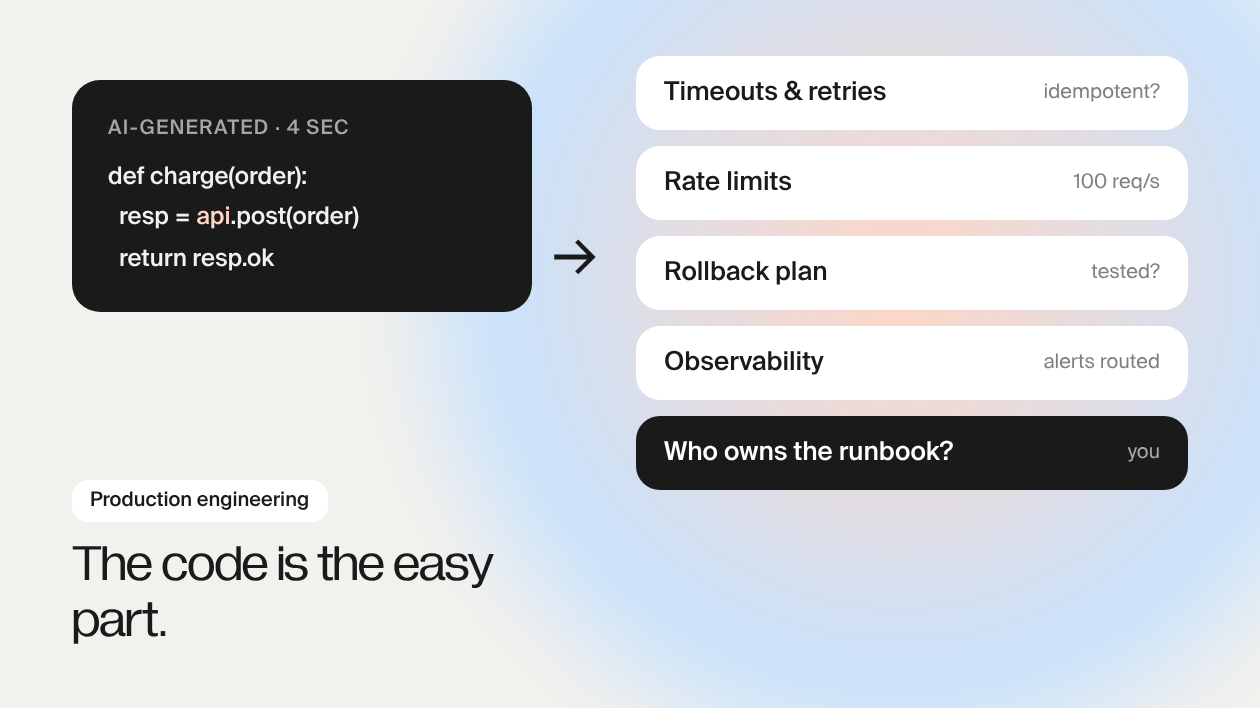
If you’re a junior or mid-level engineer wondering what’s left to master now that AI can write code, the answer is plenty. Code generation keeps getting faster and cheaper. Reliable systems, the kind that survive traffic spikes, 2 a.m. failures, and real customers, still depend on human judgment, architecture, and operational discipline. That gap is where engineering careers are being built right now.
Coding isn’t obsolete. AI makes drafting and iteration faster, but faster code doesn’t remove the need for architecture. Seniority now comes from owning consequences, and consequences live in production.
Why reliable systems are harder than code
Production software fails at the seams, and AI doesn’t see the seams. A function that passes its tests can still take down a service: an API that times out under load, a retry policy that turns one failed payment into three, a deployment that breaks on a Sunday. Each of those failures lives between components, in the integration layer that no single snippet describes.
An AI assistant can generate a clean implementation in seconds. What it doesn’t know is that your payment provider rate-limits at 100 requests a second, that three downstream teams consume your pipeline’s output, or that last quarter’s outage traced back to an unmonitored dependency. Those facts don’t live in the prompt. They live with the engineers who own the system.
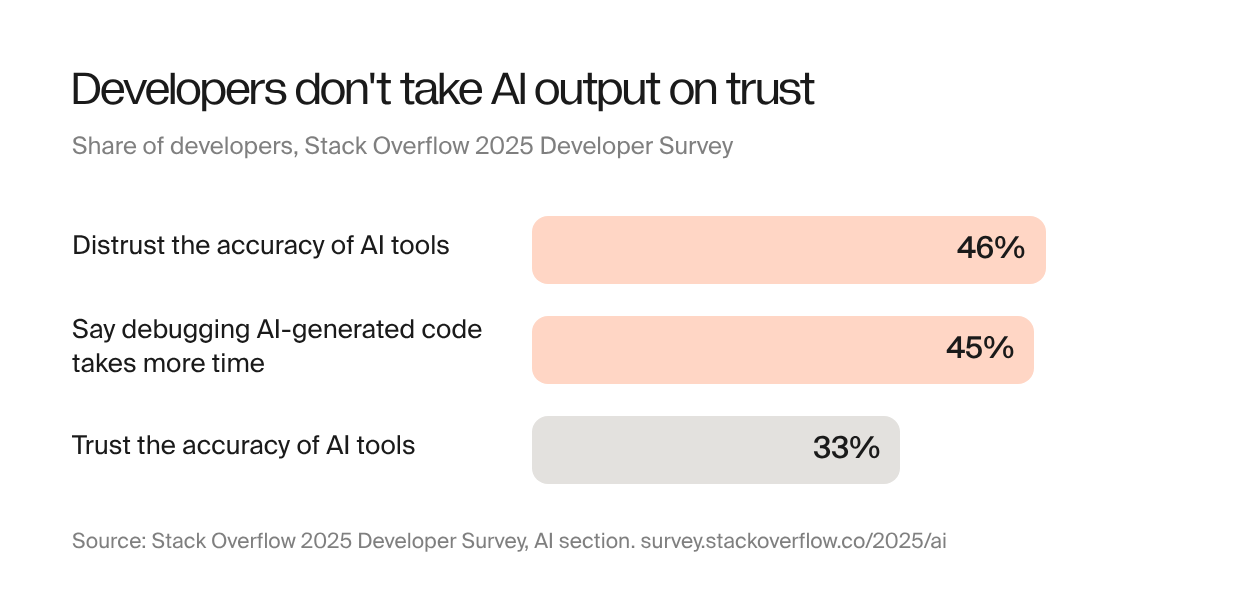
Developers know the limits. In Stack Overflow’s 2025 Developer Survey, 46% of developers said they distrust the accuracy of AI output, compared with 33% who trust it, and 45% said debugging AI-generated code takes more time.
When I review code today, the syntax is rarely the problem. Failures hide in the integration layer: missing timeouts, retries without idempotency, no rollback plan. Anyone can build a service in a weekend with AI. The real question is who’s going to own the runbook.
Why teams need direction, not just AI tools
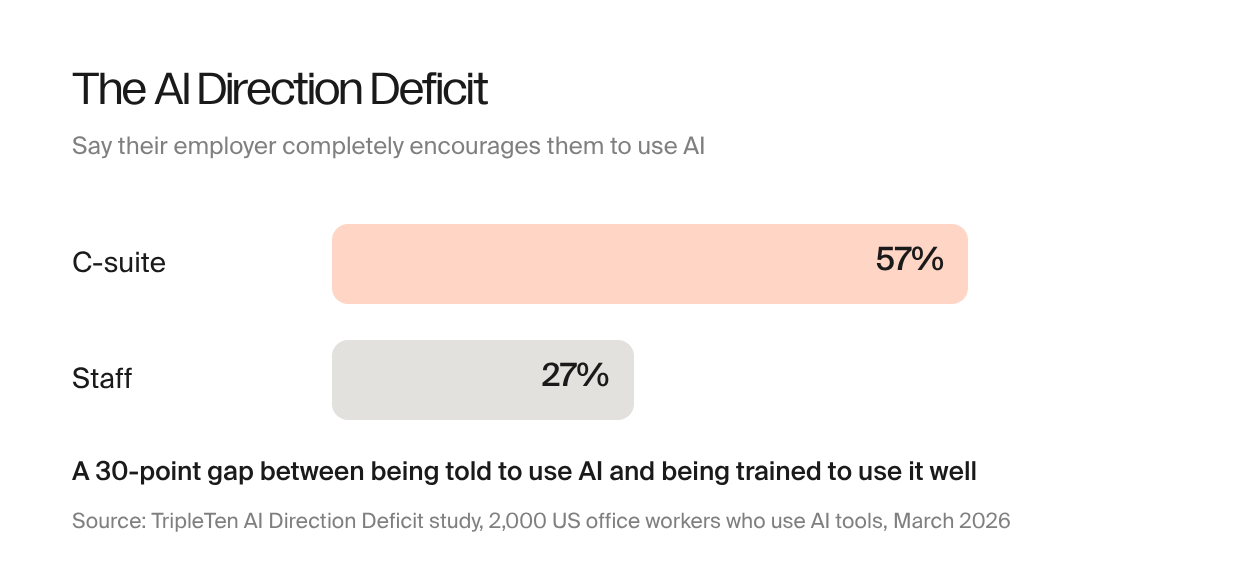
Adopting AI doesn’t make a team more effective on its own. TripleTen’s AI Direction Deficit study, a March 2026 survey of 2,000 US office workers who use AI tools, found that 57% of C-suite respondents said their employer completely encourages them to use AI, compared with 27% of staff. TripleTen calls that 30-point gap the AI Direction Deficit: the distance between being told to use AI and being trained to use it well.
The same gap shows up inside a codebase. Generating work with AI is easy. Integrating it into a dependable system means evaluation pipelines that catch bad model output before customers see it, fallback chains around model calls, and governance that keeps an AI feature from becoming next quarter’s incident report. Engineers who can supply that structure are scarce, and that’s where the career ladder now leads.
What junior and mid-level engineers should learn next
The skills that compound in the AI era sit one level above code generation. If you already ship features, build toward these:
- System design and tradeoffs: scalability, reliability, and when a monolith beats microservices
- APIs and data: service boundaries, versioning, caching, and SQL-versus-NoSQL decisions
- Cloud infrastructure and CI/CD: Kubernetes, Terraform, and GitOps workflows
- Distributed and event-driven systems: queues, Kafka, consistency models, and idempotency
- Security: zero-trust architecture, threat modeling, and secrets management
- Observability and incident response: metrics, alerting, root-cause analysis, and blameless postmortems
- AI systems design: LLM integration, retrieval-augmented generation, fallback chains, and evaluation pipelines
- Architecture documentation: architecture decision records (ADRs) and diagrams that align teams
Junior engineers make code work. Senior engineers make sure the system keeps working when load, failures, dependencies, and business constraints show up.
If you want one place to start, write an ADR. Pick a critical service that doesn’t have one and document why it’s built the way it is. You’ll learn more from that than from adopting another framework.
Where to build these skills
You can learn most of this on the job if your team gives you ownership of a production service. If it doesn’t, structured training can close the gap. At TripleTen, a professional education platform with AI-focused programs for career switchers and tech professionals, I wrote the curriculum for the AI Systems Engineering program for engineers with about two years of production experience. Over 22 weeks, students build five progressive projects, from a production API to a system architecture capstone, and defend their design decisions one-on-one with senior engineers.
AI will keep getting better at writing code. The engineers who keep advancing will be the ones who can design systems, manage tradeoffs, and prove their work holds up in production.
