
It sends a jolt through the crypto space when a big-name exchange, one touted as “the world’s safest exchange,” admits to a security breach. That’s exactly what happened with Coinbase in May 2025.
This wasn’t hackers smashing through complex code to drain crypto directly. No, this was a different beast altogether, a chilling lesson in how easily human weak spots can be turned into open doors for stealing precious user data. It was a heist focused on identities and personal information, not digital coins.
Incidents like this really hammer home why security can’t just be the exchange’s problem. It’s a team effort. As Binance CEO Richard Teng points out, a dual-layer security approach is key. “The first layer is our responsibility—firewalls, detection systems, AI threat modeling. But the second layer is just as critical: users must know how to secure their wallets, use 2FA, and avoid phishing attempts,” Teng said.
Exchanges need their strong security measures, absolutely. But just as vital is that second layer: users who are educated in crypto and vigilant. When the human element is the weak link, like in this Coinbase breach, savvy users can be the firewall that stops data leaks from turning into empty wallets.
Coinbase: The Anatomy of the Security Breach
The news dropped on May 15, 2025: Coinbase had a serious data breach on its hands. But this wasn’t a story of hackers exploiting smart contract vulnerabilities or draining hot wallets. Instead, the attackers took a craftier route, sidestepping the toughest digital locks by targeting people.
Their plan zeroed in on a third-party support vendor working overseas for Coinbase—a company that had some, but not full, VPN access to internal systems. The attackers didn’t bother trying to batter down Coinbase’s main security measures from the outside. They found a more cunning way in: they reportedly bribed a couple of contractors at this vendor.
Once these insiders were on board, they allegedly coughed up their login details and even helped with screen-sharing during live support sessions. This gave the attackers a direct window into certain support tools.
With this inside peek, the thieves went to work, pulling sensitive Know Your Customer info and account balance snapshots. They targeted around 70,000 high-value accounts, which Coinbase mentioned was less than 1% of its active monthly users.
The data stolen was a scammer’s dream: names, email addresses, phone numbers, home addresses, and, for some US users, the last four digits of their SSNs. Some users even worried their uploaded IDs, like passports, were snagged too, though Coinbase didn’t confirm every specific data point for all affected.
The crucial thing here, as internal reports stressed, was that no crypto was directly stolen from the exchange. No hot-wallet keys were exposed, no internal systems for signing off on cryptocurrency transfers were touched. This was purely a heist of identities and personal information. The attackers weren’t trying to empty Coinbase’s coffers immediately; they were building a hit list for highly targeted phishing scams and potential SIM-swap attacks down the line.
The fallout was pretty swift. Coinbase’s stock (COIN) dropped, and the company braced for a hefty bill, estimating the breach could cost between $180 million and $400 million for fixes, user reimbursements for related scams, and lost business. When the attackers demanded a $20 million ransom, Coinbase told them “no deal” and instead put up its own $20 million bounty for info that could lead to the criminals’ arrest.
Adding another layer to this, independent blockchain investigator ZachXBT had actually been raising red flags for months. Starting way back in December 2024, he’d been documenting a pattern of very convincing social engineering scams hitting Coinbase users, suggesting that the data grab in May, or similar efforts, might have been in the works for a while.
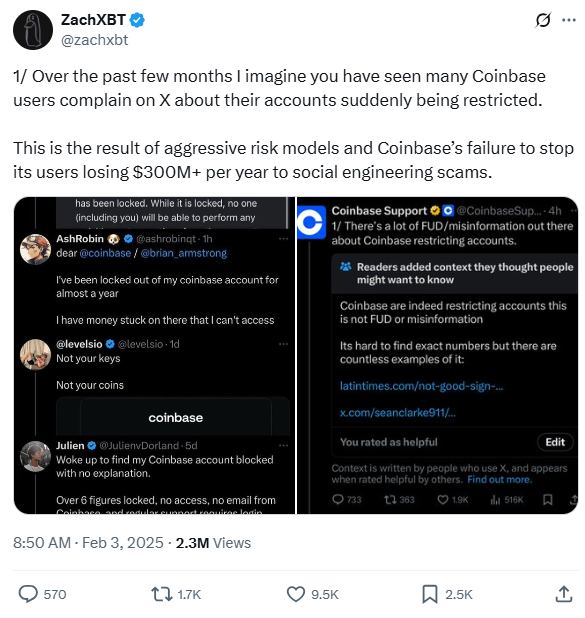
Coinbase, for its part, got in touch with affected users, said it would reimburse losses directly linked to the breach on a case-by-case basis and started rolling out beefed-up security measures. This included more ID checks for large withdrawals and more warnings about scams. The exchange also announced plans for a new support center in the US with tighter security.
A Dual-Layered Approach Against Future Exchange Breaches
The Coinbase incident in May 2025 is a powerful lesson in why you can’t cut corners on security in the crypto space. The weak link wasn’t the blockchain itself or Coinbase’s cryptocurrency wallets; it was a breakdown involving people and an outside vendor. This is exactly why that “dual-layer security” idea, which folks like Binance CEO Richard Teng talk about, is so incredibly important.
That first layer? That’s all on the platform. Exchanges have to build and maintain rock-solid technical defenses—think strong firewalls, smart systems that detect intruders, AI that models threats, and a secure setup overall. They need to be constantly investing in making their systems tougher, especially when it comes to carefully checking and watching any outside companies that get even limited access to their internal workings.
But, as the Coinbase hack clearly showed, even the best tech defenses can be sidestepped if people are the target. That brings us to the second layer, which is just as vital: user security. This comes down to education, staying alert, and using good security habits. Platforms can help here by offering clear, easy-to-understand educational materials covering everything from basic wallet safety to spotting complicated scams.
When users are empowered with knowledge, they’re far less likely to get tricked by the phishing emails and social engineering scams that often pop up after personal data gets leaked. If the folks whose data was exposed in the Coinbase breach really know their stuff—like never sharing private keys or 2FA codes, and how to spot fake messages—it makes it much, much harder for attackers to actually turn that stolen data into lost money.
Disclaimer: GeekWire newsroom and editorial staff were not involved in the creation of this content.
