

For the last decade, launching a telehealth company required building a massive, custom tech stack from scratch. Today, developers and founders are bypassing the gatekeepers entirely, utilizing a single API to deploy digital clinics in 48 hours.
The history of enterprise technology is largely the history of abstraction. Before Amazon Web Services (AWS), launching a tech startup meant buying and racking physical servers. Before Stripe, accepting online payments required months of negotiations with legacy merchant banks. Before Shopify, selling a t-shirt on the internet demanded a custom-built e-commerce database. In every vertical, complex infrastructure eventually gets abstracted away into a single, highly scalable API.
Today, that exact same revolution is quietly arriving for the most heavily gatekept, legally complex industry on earth: healthcare.
The global telehealth market is projected to shatter the $450 billion mark by the end of the decade. But until recently, the barrier to entry was insurmountable for the average tech founder. To launch a direct-to-consumer (D2C) digital clinic, a startup needed millions of dollars in venture capital just to build the foundational plumbing, navigating a labyrinth of state-by-state medical compliance, physician networks, and fragmented pharmacy logistics.
Enter Bask Health.
Often described by industry insiders as the “Shopify for healthcare,” Bask is a white-label telehealth infrastructure platform. But framing it purely as a SaaS tool drastically undersells its market position. Bask operates as the invisible tech stack powering a massive, decentralized wave of digital clinics. By providing the critical “headless” infrastructure, they are allowing a new generation of technical founders and enterprise operators to dominate the telehealth space without drowning in medical red tape.
The Power of the Headless API
In software architecture, a “headless” system separates the backend infrastructure from the frontend user interface. For digital health startups, this is a game-changer.
Before platforms like Bask, early digital health companies were forced into rigid, monolithic software. The patient experience was often clunky, kicking users over to 1990s-style portals that looked and felt like a hospital billing system.
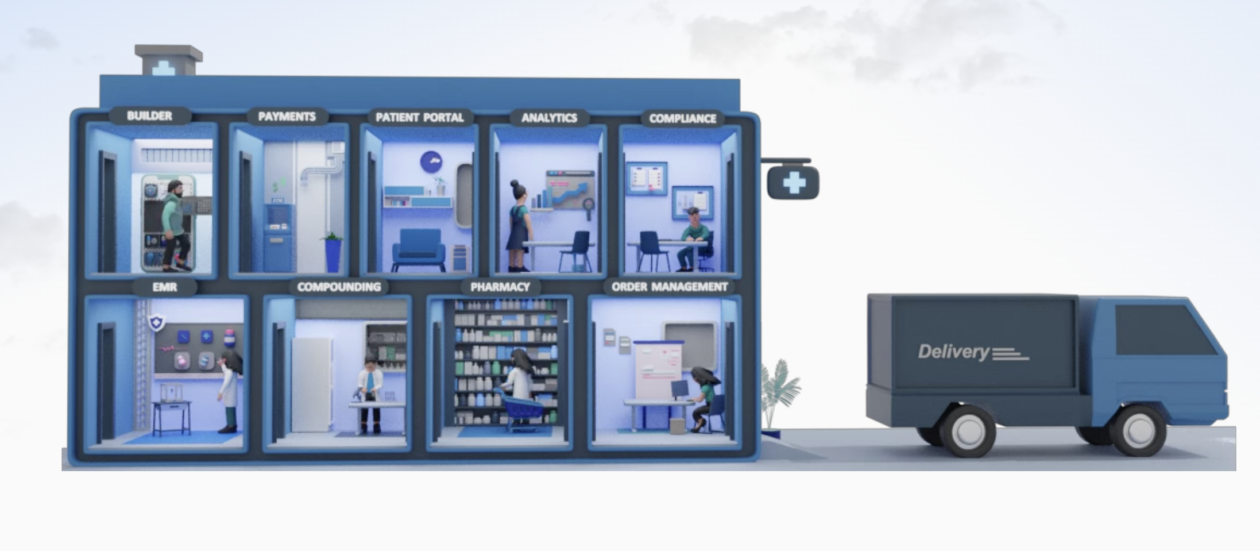
Bask Health engineered its platform to give engineering and design teams complete control over the user experience, a concept they call “Total Brand Sovereignty.” Because Bask operates as a headless API, the complex, highly regulated code runs invisibly in the background. A startup’s product team can design a beautiful, frictionless frontend using modern frameworks, while Bask seamlessly handles the messy, regulated backend: asynchronous digital intake, electronic prescribing, physician routing, and HIPAA compliance.
The result is a patient journey that feels as intuitive and premium as an Apple product, powered by an enterprise-grade medical engine.
Solving the “Orange Bottle” Bottleneck
However, the hardest problem in telehealth isn’t just writing code; it’s translating that code into physical logistics.
Historically, the Achilles heel of D2C healthcare has been multi-pharmacy fulfillment. A founder might spend their entire seed round building a sleek digital brand, only for the actual product delivery to rely on a patchwork of legacy third-party pharmacies. When a patient completes a beautifully designed digital intake process, they expect a premium experience. Instead, they receive their prescription in a generic, rattling orange pill bottle shipped in a flimsy mailer.
For a consumer brand, this logistical failure breaks psychological trust and destroys lifetime customer value.
Bask Health solves the physical supply chain programmatically. Their API doesn’t just route the prescription to a doctor; it standardizes the fulfillment process across their pharmacy network. They ensure that the medication packaging remains entirely consistent with the startup’s brand, effectively killing the generic orange bottle. By controlling the logistical endpoints, Bask allows founders to lock in patient trust and dramatically boost retention.
Enterprise Scale Meets “Builder Culture”
The danger of rapid-deployment software is that it often breaks under the weight of true viral success. But Bask Health has intentionally positioned itself as the infrastructure for extreme volume.
While the company heavily champions ‘builder culture,’ actively courting agile solo founders with the grit to deploy a clinic in 48 hours, their underlying architecture is strictly enterprise-grade. By granting independent operators access to this institutional-caliber framework, Bask Health has created the ultimate equalizer. The very same platform empowering scrappy bootstrappers is already the silent operational backbone for massive healthcare networks and rapidly scaling telehealth juggernauts.
To prove they can handle the latency and throughput required by multi-billion-dollar incumbents, Bask routinely stress-tests its capabilities. To prove they can handle the extreme latency and throughput required by multi-billion-dollar incumbents, Bask routinely stress-tests its capabilities. They are actively shattering volume records, recently processing an unprecedented daily influx of custom-packaged orders and seamlessly serving a massive, surging patient base within a single 24-hour window.
For private equity operators and enterprise companies looking to expand their virtual care footprints, Bask is proving that “turnkey” functionality does not require sacrificing Fortune 500-level scalability.
The Abstraction of the Medical Degree
What separates Bask Health from legacy healthcare IT providers is its aggressive psychological positioning. The company doesn’t sound or act like a healthcare conglomerate; it operates like a hyper-ambitious tech incubator.
They are selling a “state of mind” to a demographic of high-achievers. Their core message is radical: You no longer need a medical degree or a hospital network to build a healthcare empire. If a founder brings the marketing playbook, the SEO expertise, and the vision, Bask provides the entire regulatory and logistical world underneath it.
We are witnessing a fundamental shift in how digital health operates. Healthcare is no longer an impenetrable fortress reserved for legacy institutions. By providing the foundational infrastructure, Bask Health is ensuring that the next generation of industry-defining telehealth platforms will be built by agile, brand-obsessed software entrepreneurs. And no matter which startup ultimately captures the lion’s share of the $450 billion market, the infrastructure powering their success will belong to Bask.
Disclaimer: GeekWire newsroom and editorial staff were not involved in the creation of this content.
