
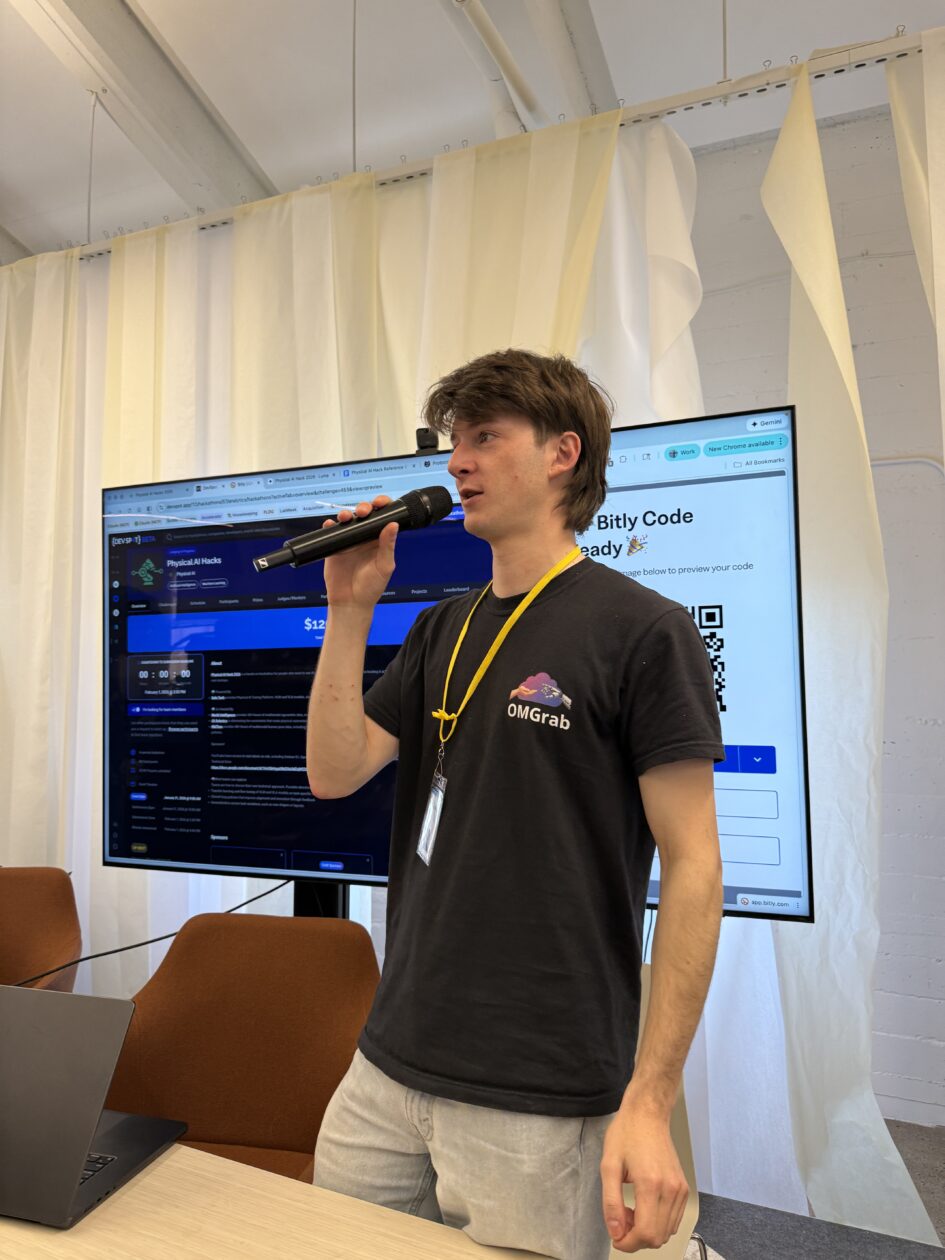
Most startup origin stories get compressed into something tidy: an idea, a pitch deck, a funding round. Hendrik Chiche’s version includes more than 500 rejected job applications, a year of sitting in on PhD classes he wasn’t enrolled in, and six months of building alone before he could convince anyone to join him.
The 27-year-old French-born mechanical engineer is now the cofounder and CEO of OMGrab Inc., a hardware-software company that makes wearable recording devices and a cloud platform for collecting robotics training data at scale. But the path from Chiche’s first engineering degree in France to a funded startup in the Bay Area was anything but direct.
A Career Pivot Built One PhD Class at a Time
Chiche arrived at UC Berkeley as a mechanical engineer pursuing a second master’s degree, this time with an emphasis on data science. This dual interest defined his future path toward AI as part of a slow, self-directed growth of knowledge that went well beyond his time as a student.
After graduating, Chiche kept returning to Berkeley’s campus every week to audit PhD-level deep learning courses. He had the professor’s approval, but no enrollment, no tuition bill, and no credentials at stake. He did this while working a full-time engineering job in the Bay Area, squeezing the coursework whenever he could. “After I graduated from UC Berkeley, I started my full-time job in the Bay Area, but I would go back to Berkeley to sneak into PhD classes,” Chiche recalls.
The classes gave him a better understanding of tech like diffusion models and the AI methods currently dominating modern robotics research, all technical knowledge that would directly shape OMGrab’s product.
Before any of that, though, Chiche had to survive a stretch of more than 500 applications before landing his first Bay Area role. Despite strong technical credentials, the vast majority of companies simply did not sponsor work visas at the entry level, turning the post-graduation months into a test of persistence rather than a reflection of his qualifications.
What followed was a calculated bet: assess the technical knowledge required, find a way to master it, and stick with it long enough for the market to catch up.
Becoming A Professional Engineer
The professional experience Chiche accumulated before OMGrab spanned multiple domains of applied AI and engineering. At Mainspring Energy, he built a predictive maintenance system that used time series machine learning models to identify mechanical failures across the company’s fleet of linear generators before they occurred. Earlier, while sponsored by GENCI, France’s national high-performance computing center, he conducted research on training neural networks to enhance the detail of low-resolution medical scans.
At Zendar, a Bay Area autonomous vehicle startup, he worked on radar point cloud classification, developing object detection models that helped self-driving systems interpret sensor data in real time.
Each of these roles sharpened a different edge of Chiche’s technical range: time series prediction, medical imaging, computer vision, and sensor fusion. That breadth would later prove essential to designing OMGrab’s full-stack system, which requires simultaneous expertise in hardware constraints, streaming infrastructure, and machine learning pipelines.
OMGrab: A Robotics Product Born Out Of Chiche’s Field Experience
Chiche worked on what would later become OMGrab solo for roughly six months before recruiting two co-founders from his existing network: Antoine Jamme, a mechanical design engineer and longtime surfing partner whose prior work included building robotic arms for semiconductor manufacturing, and Isaac Neal, a software engineer and ML researcher who reached out after seeing Chiche post about his robotics work on Instagram.
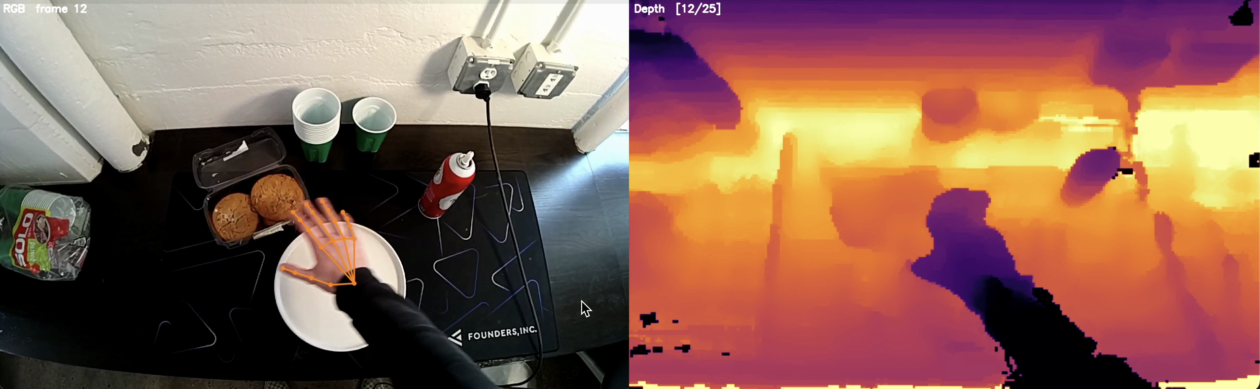
Now fully launched, OMGrab’s core offering is a wearable recording device paired with a streaming system and cloud platform, and its goal is to let robotics companies collect high-quality egocentric video data from operators anywhere in the world.
The system grew directly out of the technical problems Chiche had encountered across his prior roles, and the design choices behind it reflect specific engineering lessons Chiche carried forward.
His experience with time series data at Mainspring Energy shaped how OMGrab handles streaming reliability, ensuring continuous data flow without corruption or loss over extended recording sessions. His computer vision work at Zendar informed the camera system’s approach to capturing consistent, high-quality video under variable real-world conditions. And his deep learning coursework under Professor Pieter Abbeel gave him the theoretical grounding to design a data pipeline optimized for the diffusion models and imitation learning frameworks that robotics companies actually use to train their systems.
The result is a device built around full simplicity for operators, with single-button activation, automatic Wi-Fi connection, and seamless cloud sync, but it’s underpinned by a stack of technical decisions that required cross-domain expertise to get right. “The device is super simple. There’s literally a single button on it. It connects automatically to Wi-Fi. All the video gets synced to the cloud, there are no extra steps,” Chiche says.
That simplicity, he argues, is itself the engineering achievement: making a reliable, field-ready system that requires no technical knowledge to operate while maintaining the data quality that machine learning pipelines demand.
Continuing To Grow OMGrab
OMGrab had secured four pilot customers before closing its pre-seed round from Founders Inc. in December 2025. Early partners included Deplace AI, YC-backed Asimov, a healthcare data company in Cambridge, Massachusetts, and a data collection firm in Mexico. More recent negotiations include Xsens, a Netherlands-based motion capture company, and Encord, a major data annotation platform in the Bay Area, showing a shift from early-stage pilots toward larger enterprise relationships.
Chiche is candid about where the competition stands. He identifies Chinese hardware companies as the most capable global competitors, noting their method of fast prototyping and their near-unparalleled manufacturing infrastructure. But he argues that OMGrab could, in the future, match and even exceed their quality for customers outside the Chinese supply chain, and that few U.S.-based startups are building dedicated hardware for this market at all.
More recently, Chiche has also taken on an advisory role at UC Berkeley, where he leads two graduate capstone teams: one developing a next-generation tactile sensing glove for collecting robotic hand data, and another running experiments to quantify the gap between human hands and robot grippers when training from egocentric video.
From a French engineering classroom to a funded Bay Area startup, Hendrik Chiche has built a professional background that spans hardware design, machine learning, and applied engineering. Through OMGrab, he’s building the data infrastructure that the next generation of intelligent robots will depend on, and he’s positioning himself as a distinctive technical voice in the AI robotics infrastructure space, one that’s still figuring out how to collect the data that makes autonomy possible.
Disclaimer: GeekWire newsroom and editorial staff were not involved in the creation of this content.
