
AI agents now work in the background and reach users through messaging apps, but most were built for one person. A new set of products is testing what happens when agents join the group conversation.
Since August, three AI developers have put an always-on agent in front of consumers. xAI’s Grok Bot entered beta that month. Meta announced Muse on September 8, an agent that works on its own cloud computer and can be reached through WhatsApp. OpenAI introduced Dots, persistent ChatGPT agents with their own cloud computers, at its DevDay event. The rush of capital reflects this momentum. Startups like Instinct, Manus, and Today AI have each raised over $200 million in a single funding round before showing substantial business traction, fueling investor FOMO.
Most of these products began as individual tools: one person, one agent. Work rarely happens that way. Teams plan in group chats, hand tasks to each other and share context. The next question for the industry is what an agent should do when more than one person is talking to it.
Agent Adoption Is Rising, Mostly in Isolation
Enterprise surveys point the same way. Salesforce’s 2026 Connectivity Benchmark Report, which polled 1,050 IT leaders in late 2025, found organizations run an average of 12 agents, a number projected to climb 67% within two years. Half of those agents operate in isolated silos rather than as part of a multi-agent system. Microsoft’s 2026 Work Trend Index reported that active agents in the Microsoft 365 ecosystem grew 15-fold year over year.
Vendors are starting to add team features, but they define “team” differently. xAI’s documentation describes Team Bots that a group shares, with a common setup and team memory, while each person’s conversation stays private. Shared conversations happen in Slack. IT Brief reported that OpenAI expects, over time, to support “teams of dots working together on behalf of an individual or organisation.” That describes several agents, not several people in one thread. Muse coverage mentions WhatsApp access but not group use.
Why Teams Are Harder Than Individuals
Putting an agent into a shared conversation raises questions a single-user agent can avoid. Whose permissions does it act under when two people ask for conflicting things? What does it remember, and who can see that memory? How does it know a message is meant for it? Each is a design decision, and xAI’s private per-person chats are one answer.
Builders of team products argue the order matters. A multi-agent system is only as good as the single agent underneath it, so large vendors have focused on the individual case first.
What an Agent Teammate Does
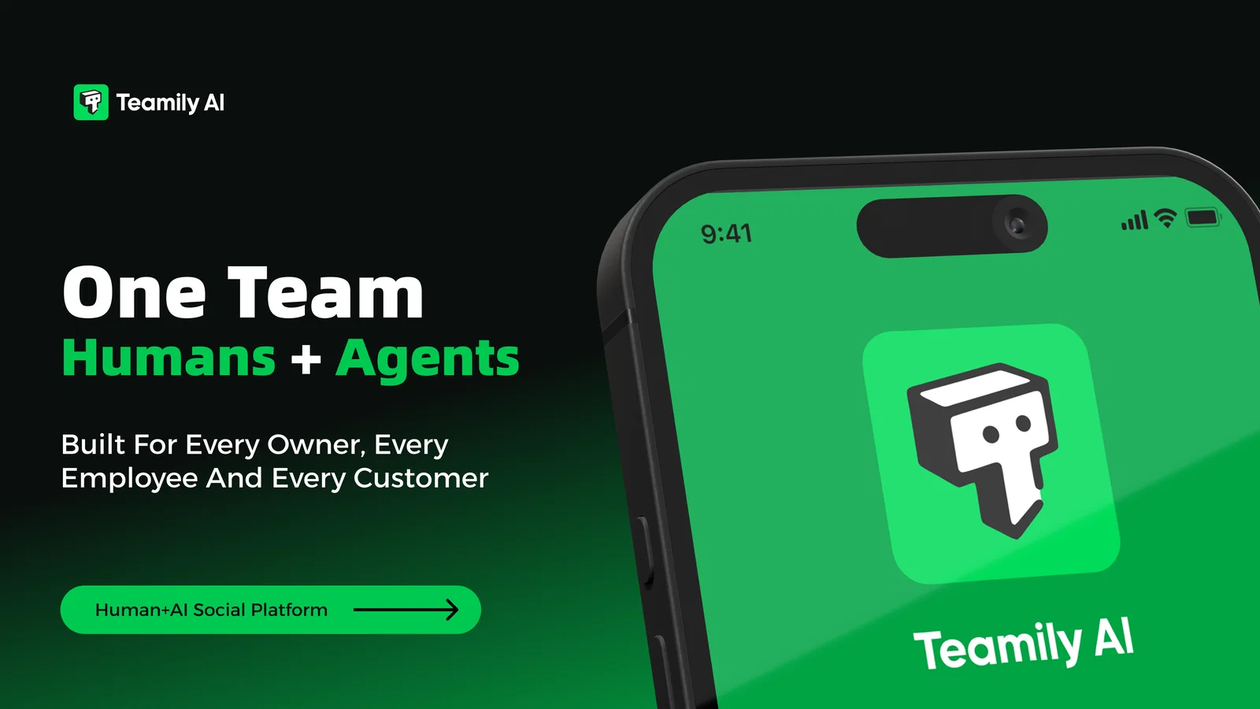
Teamily, from TensorOpera AI, puts agents inside group conversations alongside human members. TensorOpera, formerly FedML, started in distributed machine-learning infrastructure (mostly LLM training and serving) before moving to the application layer. Teamily has 200K users, while TensorOpera has served 5 million users worldwide.
In practice, a Teamily group holds several people and several specialist agents in the same thread, so everyone sees and builds on the same work. That differs from setups where each person talks privately to their own bot, as in xAI’s Team Bots. Teams use the agents to produce briefings, reports, slide decks, documents and websites, and to run scheduled automations such as weekly checks. The platform also reaches beyond the chat: a website builder with data analytics connects to a voice agent, messaging channels (WhatsApp, iMessage, Slack) and email, and Agent Loop links frontend customer service with back-office operations, both inside and outside the company.
A Real Example
A media and PR agency on a paid plan uses Teamily as a shared workspace. In the team’s group chat, a staffer asked an agent about the current news cycle and the best pitch angle, and the briefing came back in the thread for everyone to build on. The team now runs about 15 agents.
Sharing was the draw. “I had created many agents on ChatGPT, which are great, but again we can’t share everything which makes it frustrating,” the user wrote to Teamily. The user also praised the agents’ ability to sign in to the team’s SaaS tools: “It’s really saving time.”
Customer service shows why Teamily sees the strongest value in connecting the inside and outside of a company. Take a small online shop: a customer messages its WhatsApp number at night, and an agent answers from the shop’s product and order data. If the request is a refund, the agent posts it to the team’s group chat with the order history, a staff member approves it in the morning, and the agent replies to the customer.
A software team at an inspection-device maker asks the agent in its group chat for executive progress reports. A farmland-estate founder in India said the venture’s website prototype, feasibility reports and pitch decks were all developed on Teamily.
Where This Is Going
It is not yet clear which model wins: a shared bot with private chats, teams of agents behind one user, or agents that sit in the shared thread. Teamily founder Aiden He is betting on building it now.He describes the end state as an “agentic society” in which people and agents work side by side, and expects agent-based services to gradually replace conventional software-as-a-service over the next five to ten years. In his view, the best way to predict that future is to build it, starting with collaboration, communication and connection. In Teamily, More than 200,000 users worldwide already use Teamily that way.
The opening question still stands. Once an agent has to serve a group, the product has to decide who it answers to. The market has only begun to answer.
Fact-check and open items
Every claim in the draft, with the page it was read from. Dates are as published.
| Claim in draft | Source | Status |
| Grok Bot entered beta in August 2026 | i-scoop, Sep 7 2026 | Single third-party source |
| Team Bots: shared setup and team memory, private per-person chats; shared conversations in Slack | xAI docs, updated Oct 15 2026 | Verified in docs |
| Muse announced Sep 8; reachable via WhatsApp; runs on its own cloud computer | The Rundown AI, Sep 9 2026 | Verified; page does not say if group chats are supported |
| OpenAI introduced Dots at DevDay, each with its own cloud computer | AI Weekly, Sep 30 2026 | Verified |
| OpenAI expects to support “teams of dots working together” | IT Brief, Oct 2 2026 | Verified; no timeline given |
| WorkBuddy WeCom bot controls the agent on a user’s computer | WorkBuddy docs | Verified; no group-chat detail |
| Average of 12 agents per organization, +67% in two years; half in silos; 86% worry about complexity | Salesforce, Feb 5 2026 | Verified; survey fielded Oct to Nov 2025, n=1,050 |
| Active agents in Microsoft 365 grew 15x year over year | Microsoft Work Trend Index, May 5 2026 | Verified; Microsoft telemetry |
Disclaimer: GeekWire newsroom and editorial staff were not involved in the creation of this content.
