The first thing I do when Microsoft’s 10-K or 10-Q comes out is hit Ctrl-F and go waaaay down to the section called “Revenue, classified by significant product and service offerings.” It’s on Page 85 of the 10-K that came out Wednesday with its quarterly and annual results.
From my perspective, this gives the clearest view of what’s actually happening in Microsoft’s business. It groups things into categories and product names that match a real-world understanding of the company, as opposed to the mumbo jumbo you have to decode otherwise.
Microsoft reports its results in three broad segments: Productivity and Business Processes, Intelligent Cloud, More Personal Computing. Businesses like Azure, Xbox, Windows and LinkedIn all basically disappear inside them, until you dig into the filing.
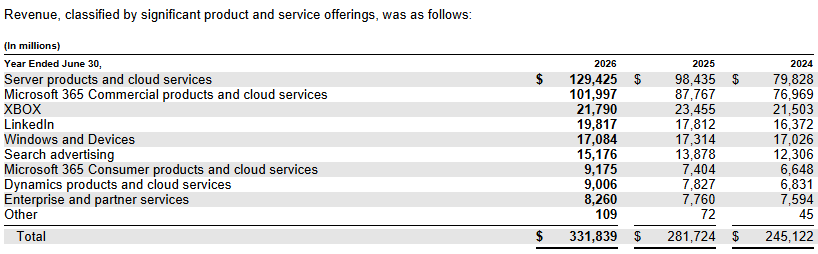
Overall, for the fiscal year ended June 30, Microsoft’s revenue increased 18%, or $50.1 billion, to $331.8 billion. Here is what the 10-K table shows about the real drivers of the business.
Two business lines are driving nearly all of Microsoft’s growth.
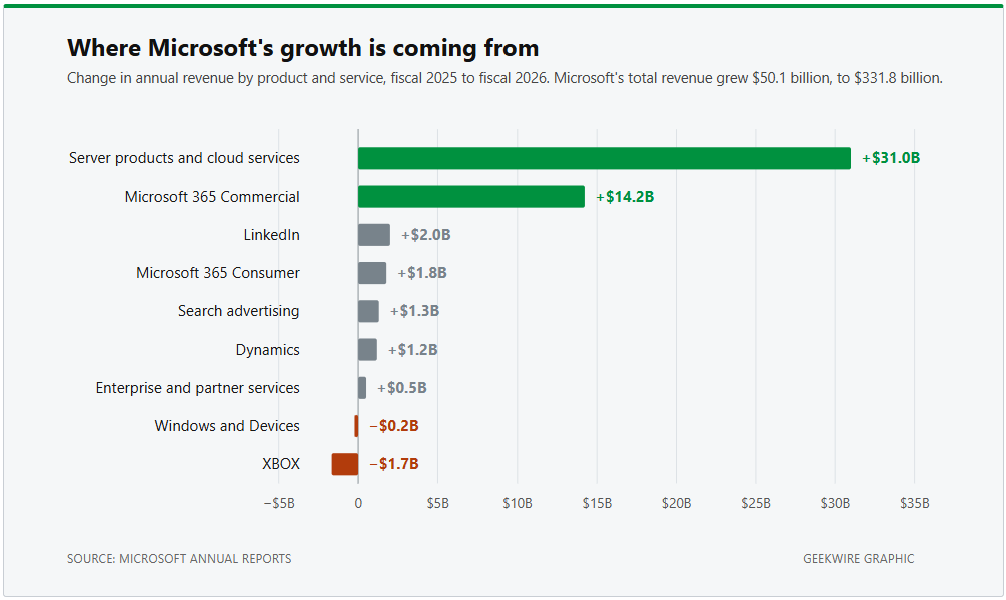
Of the $50.1 billion in revenue that Microsoft added for the fiscal year, $31 billion came from Server products and cloud services, accounting for 62% of the company’s growth.
This category includes Azure, along with SQL Server, Windows Server, Visual Studio, GitHub and Nuance. Microsoft doesn’t detail Azure revenue in its financial statements, but CEO Satya Nadella said on the earnings call that Azure passed $100 billion in annual revenue for the first time this year.
At total revenue of $129.4 billion, this is by far Microsoft’s biggest business, accounting for nearly 40% of its annual revenue.
The second biggest growth came from Microsoft 365 Commercial, which added $14.2 billion in revenue, up 16% to $102 billion. Microsoft 365 Commercial covers the business subscriptions: Office, Teams, SharePoint, Exchange, security and compliance, and Microsoft 365 Copilot.
Taken together these two business lines produced 90% of Microsoft’s growth for the year.
They’re also where the company is monetizing AI most successfully: Azure, AI infrastructure and GitHub Copilot in server and cloud; and Microsoft 365 Copilot in Microsoft 365 Commercial.
Two of Microsoft’s longtime businesses got smaller.
- Windows and Devices revenue fell $230 million, to $17.1 billion. Once the biggest growth engine for the company as a whole, the PC operating system business has been flat for the past four years, using the categories as Microsoft now defines them.
- Xbox revenue fell $1.7 billion, to $21.8 billion. That’s the first annual decline since Microsoft completed its $69 billion Activision Blizzard acquisition. It comes as Microsoft overhauls the business, cuts jobs and takes a write-down on unspecified Xbox assets.
Other notes and observations from the table:
- LinkedIn, at $19.8 billion, now generates more revenue than Windows and Devices. It passed Windows in fiscal 2025 and extended the lead this year, growing 11% while Windows declined.
- Microsoft 365 Consumer was the fastest-growing category after server products, up 24% to $9.2 billion.
- Search advertising grew 9% to $15.2 billion, and is closing in on Windows and Devices.
- Dynamics grew 15% to $9 billion. Enterprise and partner services, the consulting business, grew 6% to $8.3 billion.
Thoughts? Let me know on LinkedIn. Here’s our coverage of the earnings.