T-Mobile is introducing new wireless plans that change how customers get perks and phone deals, giving them a set number of “Picks” to spend on a new phone or an expanded menu of extras that they can swap out every 90 days.
The company says it will be the only carrier that lets customers choose which benefits come with their plan. Instead of fixed bundles of extras plus a discount on a new phone for each line, customers get a single allowance to spend on options ranging from Netflix and ESPN to Xbox Game Pass, Google’s Gemini AI and Delta SkyMiles.
One catch is that phones and perks come out of the same pool of Picks, so a family that wants a new phone on every line may have little left to put toward extras.

The plans, called T-Mix, will be available in November. Existing customers can switch or keep their current plans, said Allan Samson, T-Mobile’s chief marketing officer.
The move comes as T-Mobile’s customer growth slows and new rivals emerge, including SpaceX, a current T-Mobile partner that is reportedly planning a wireless service of its own. T-Mobile’s stock is down about 26% this year, including a drop of nearly 8% on Friday after a report on SpaceX’s wireless plans.
The Bellevue, Wash.-based company has relied for years on “Un-carrier” moves — splashy changes that defy industry conventions — to capture consumer attention.
Samson described T-Mix as the latest of those moves, aimed at what the company’s research identified as a top customer complaint: paying for extras they don’t use. Picks are “essentially a form of currency,” he said. “You can use them for anything you want.”
A subscription hub: With the new plans, T-Mobile is adding a much larger menu of subscriptions in an attempt to turn its plans into a hub for streaming, music, gaming and AI services.
Along with longtime perks such as Netflix, Hulu and Apple TV, the new options include ESPN’s Unlimited streaming service, Xbox Game Pass, YouTube Premium, Apple Music and Google’s Gemini AI subscriptions.
The company says people spend far more on subscriptions than they realize. In T-Mobile’s research, customers estimated spending about $90 a month, Samson said. A separate study by C+R Research puts average spending at $219.
A big part of the idea is to consolidate that spending and let customers move among services more freely, picking up a streaming service for a new show, for example, or adding satellite coverage for a summer trip, then dropping it afterward.
Customers can make those changes every 90 days in the T-Life app. T-Mobile texts them when a 10-day change window opens, and their choices roll over if they do nothing. T-Mobile handles the switch between services in its plans, although the fine print notes that customers may need to initially cancel existing subscriptions on their own to avoid paying twice.
T-Mobile buys subscriptions below retail prices through deals it negotiates with streaming services and other partners. That lets T-Mobile include the services in its plans for less than it would cost customers to subscribe on their own.
Phones vs. perks: For consumers, one trade-off for the newfound flexibility is that phones and perks now draw from the same finite supply.
Customers who hold on to their phones or choose less-expensive models can put that value toward streaming and other extras, but a family that wants a new phone on every line may not have enough Picks to cover them.
Whether consumers end up getting more or less for their money depends largely on how many lines they have and how often they buy new phones. Smaller accounts that keep their phones are likely to come out ahead. Larger families that upgrade every line may pay more and get less, because T-Mobile is also dropping its long-standing free third line.
Samson estimated that accounts with one or two lines will pay $5 to $10 a month less than on T-Mobile’s current plans, while a five-line account might pay $10 to $15 more. Across all of its customers, he said, pricing is roughly the same.
T-Mobile says a family of three on its Loaded plan, which costs $200 a month ($2,400 a year) with AutoPay before taxes and fees, gets more than $4,320 a year in plan features and benefits, based on its own valuation.
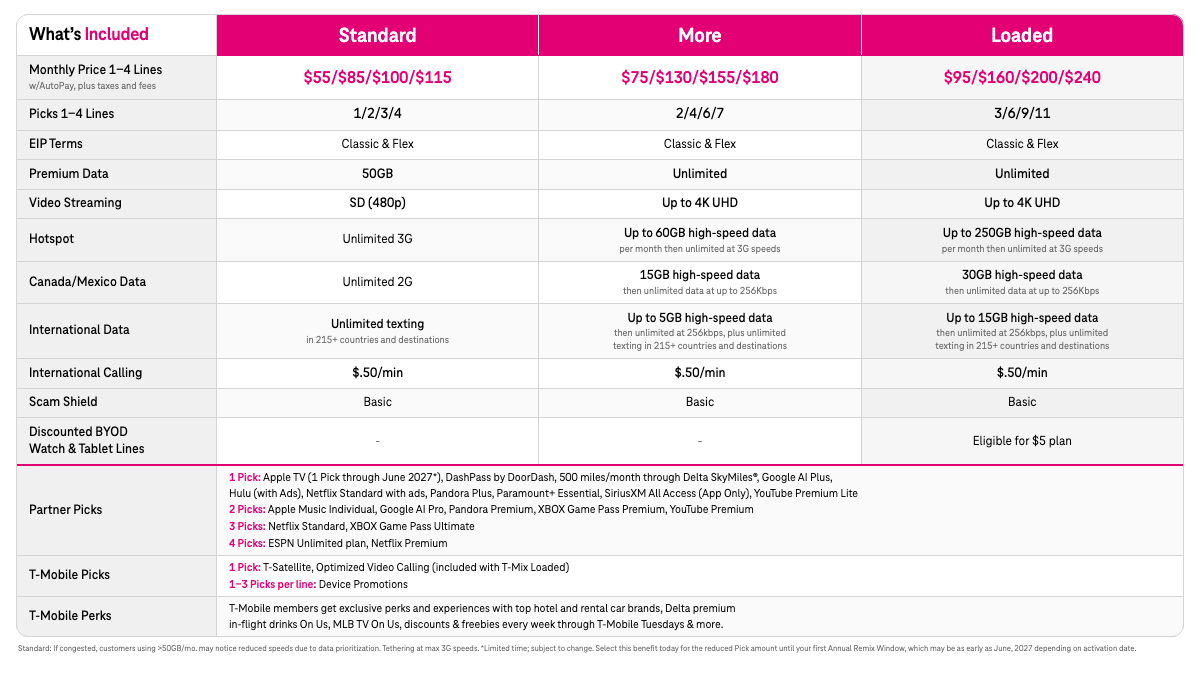
The math behind the Picks: Customers choose from three plans, with base prices for customers on AutoPay, before taxes and fees:
- Standard: $55 a month for one line, with one Pick. It’s the basic plan, with limits on high-priority data and video quality.
- More: $75 a month, with two Picks, unlimited high-priority data and 4K video.
- Loaded: $95 a month, with three Picks and the largest allowances for hotspot use and international data.
Adding lines adds Picks, and Picks apply to the whole account, so one Netflix subscription covers the family. Unused Picks don’t accumulate from one quarter to the next.
Most extras cost one or two Picks. Ad-free Netflix costs three, and ESPN Unlimited costs four. Phones cost Picks, too: two for an iPhone and three for an iPhone Pro, Samson said, tied up for the three-year payment plan. A four-line account on the More plan gets seven Picks, not enough for a new iPhone on every line.
No price guarantee: The terms say T-Mobile may change the benefits and the number of Picks each one requires at any time, with changes taking effect the following quarter. Customers who change a partner benefit outside a change window may have to pay a fee. Once a year, customers will also be asked to reselect their benefits.
The launch comes less than a week after New York Attorney General Letitia James announced a settlement with T-Mobile over its 2017 “Price Guarantee” plans, which promised customers the carrier would “never change the price you pay.”
T-Mobile raised prices on those plans by about $5 a line in 2024. It agreed to offer refunds and other options that the attorney general’s office expects to provide more than $38 million in value, and to freeze prices for affected customers until at least 2029.
Asked about price protections, Samson said T-Mix plans don’t come with a guarantee. T-Mobile can control its network costs, he said, but not what partners such as Apple and Xbox charge, although it has multiyear deals in place.
“We didn’t want to be disingenuous,” he said, adding that partner prices are set for the next couple of years but “I can’t tell you what’s going to happen in 2030.”
The Un-carrier playbook: T-Mobile launched its Un-carrier campaign in 2013 by dropping two-year contracts. Samson said the company makes an Un-carrier move only when it sees a big customer pain point and believes it has something unique to offer.
T-Mobile has been testing T-Mix since Oct. 1 in 37 stores in Kansas City. Only about 70% of Picks were chosen in the store at the time of purchase, Samson said, in part because families wanted to go home and decide together, and some customers were saving Picks for phones coming out later.
Details of the plans leaked in recent weeks, first reported by The Mobile Report and later by PhoneArena.
Verizon lets customers add discounted streaming bundles to its plans for an extra monthly charge. Samson said the difference with T-Mix is that the benefits are included in the plan price.
Upholding the company’s tradition of jabbing at rivals, he described one competitor’s approach as “naked connectivity.” The other, he said, will “throw you a nice phone and then leave you alone. And every now and then, there’s a rate increase.”
The plans are also one of the first major consumer moves under CEO Srini Gopalan, who succeeded Mike Sievert in the role last November.
T-Mobile’s account growth has slowed this year. In the second quarter, it added a net 277,000 postpaid accounts (households and businesses that pay a monthly bill rather than prepaying for service). That was down 13% from 318,000 a year earlier.
The company reports third-quarter results Wednesday, two days after Verizon.
SpaceX is also reportedly seeking cell sites to build a rival wireless network, even though T-Mobile’s T-Satellite service runs on SpaceX’s Starlink.
Samson, who joined Sprint in 2016 and stayed on after its 2020 merger with T-Mobile, became CMO earlier this year. He previously ran the company’s broadband business and was CMO of T-Mobile for Business. He said T-Mix has been his pet project since taking his current role, starting with interviews with hundreds of consumers.
Samson said it’s too early to say how T-Mix will affect the business. “Ask me in six months once I have about six months under my wings nationwide,” he said, “and then we’ll have some actuals to report.”