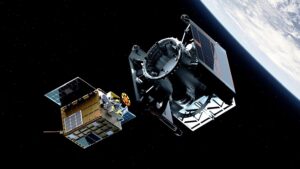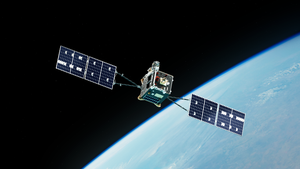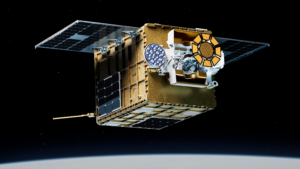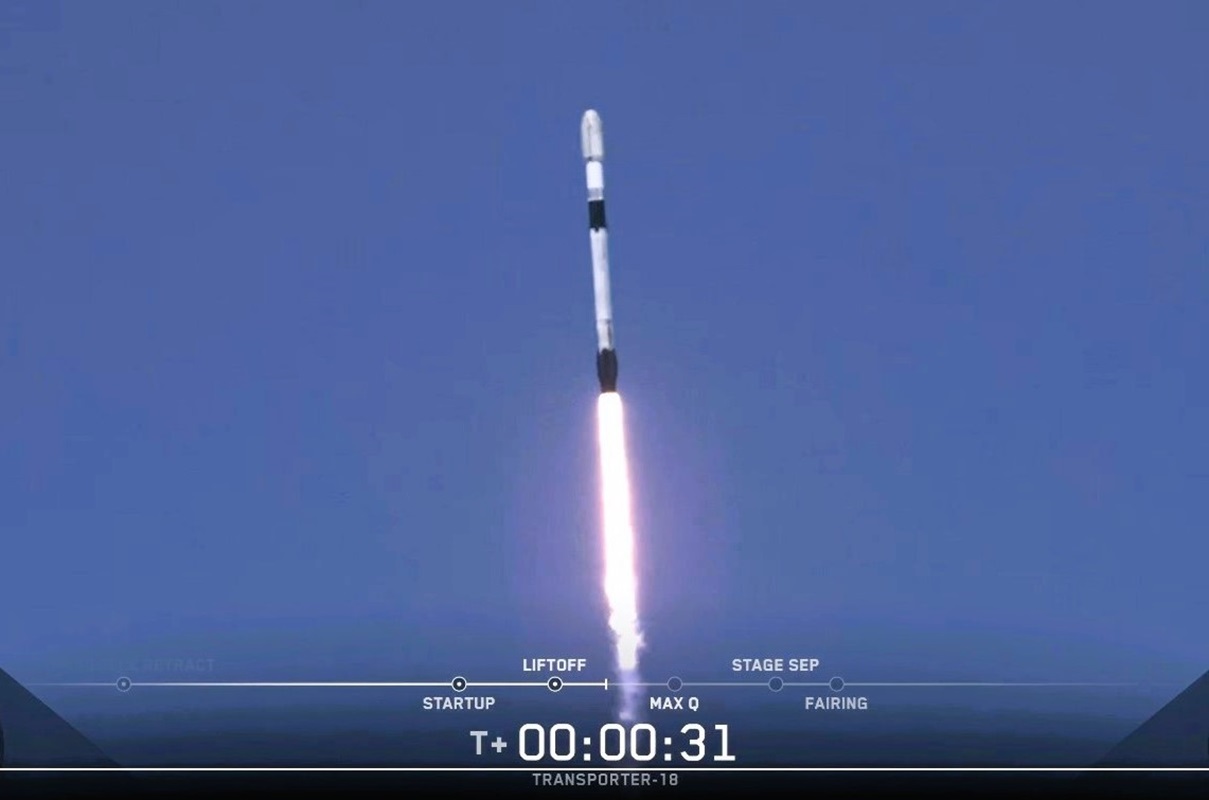
Starfish Space’s first full-scale Otter satellite servicing vehicle went into orbit today, marking a major milestone for the Tukwila, Wash.-based startup.
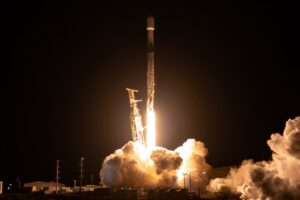
The Otter spacecraft was among 130 payloads launched from Vandenberg Space Force Base in California aboard a SpaceX Falcon 9 rocket. Otter is roughly the size of a kitchen oven, with solar arrays that were folded up for launch.
Other payloads on the satellite rideshare mission, known as Transporter-18, included Cowboy Space’s first power-beaming satellite, a prototype for Google’s AI data-center constellation, and a NASA-funded probe that will track the energy released by galaxies and supernovas.
Today’s liftoff through surface-level fog — and the return of the Falcon 9’s first-stage booster to a nearby landing pad — proceeded like clockwork. A little more than an hour after launch, Otter separated from the rocket’s upper stage and powered up for orbital operations.
Once Otter is fully commissioned, it will rendezvous with and inspect a series of inoperable satellites for a $15 million NASA mission known as Small Spacecraft Propulsion and Inspection Capability, or SSPICY for short. The capabilities demonstrated by SSPICY could be used during future missions to check the health of active satellites, or dispose of defunct satellites.
SSPICY may not be the only mission that Otter takes on during its operating lifetime.
“Success in the mission is to actually go and provide this commercial inspection service on a number of these different spacecraft, and that will be a huge win in and of itself,” Starfish co-founder Trevor Bennett told GeekWire last week. “But we’re also bringing Otter along to provide servicing well beyond that, so we could go and inspect more spacecraft, or potentially do some additional docking past the initial mission.”
This inaugural Otter mission follows up on two orbital flight tests involving smaller-scale Otter Pup prototypes. The first test fell short of linking up with its target satellite but was able to demonstrate Starfish’s satellite-tracking system. The second Otter Pup went into orbit last year and is currently closing in on its target.
Starfish Space is already preparing for future Otter missions — including a satellite disposal job for the Pentagon’s Space Development Agency, two commercial satellite servicing missions in geostationary Earth orbit, and two servicing missions for the U.S. Space Force.
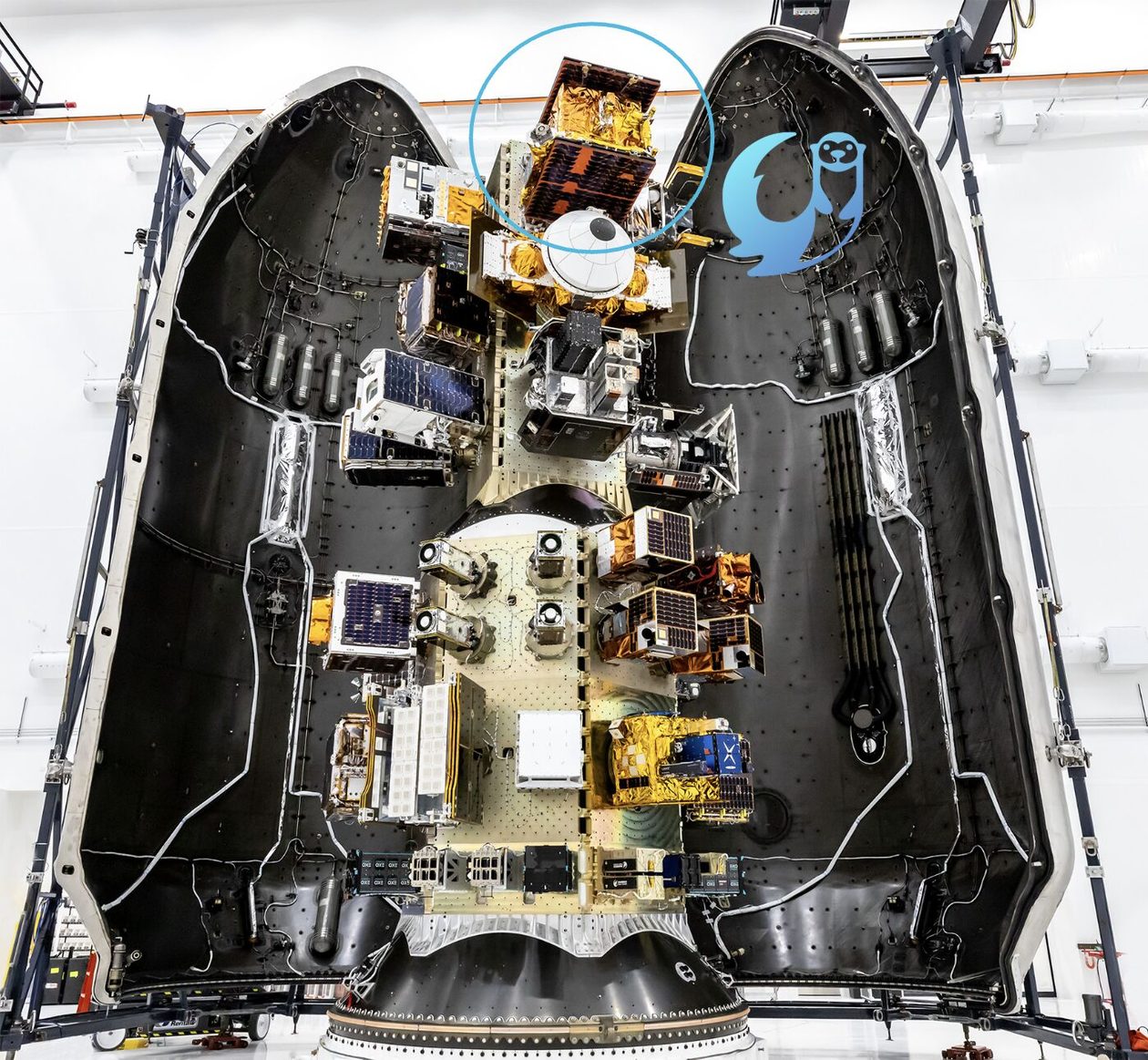
More about Transporter-18’s payloads:
- Cowboy Space’s Reason-1 satellite is designed to collect solar energy in space and transmit it to a ground receiver with a kilowatt-class laser, advancing technologies central to the company’s planned orbital data centers. Cowboy Space, formerly known as Aetherflux, is headquartered in California but is setting up a 291,035-square-foot manufacturing facility in Kent, Wash.
- Google’s Project Suncatcher M1 prototype, built by Planet Labs, will test the tensor processing units that Google plans to use for its orbital AI data-center constellation. The prototype is “designed to gather in-orbit data on how our TPUs handle the physical stress of spaceflight and the radiation and thermal extremes of space,” Google said in a blog post.
- Star Catcher’s Protostar satellite will be involved in an experiment to beam power from the main spacecraft to a smaller deployable satellite equipped with off-the-shelf solar panels. The Protostar mission is meant to blaze a trail for the orbital power grid that Star Catcher hopes to create.
- The SPRITE CubeSat is part of a NASA-funded mission led by the University of Colorado that will study how stars and galaxies shaped the evolution of the early universe. The satellite is equipped with a far-ultraviolet imaging spectrograph. SPRITE stands for Supernova Remnants and Proxies for Reionization Testbed Experiment.