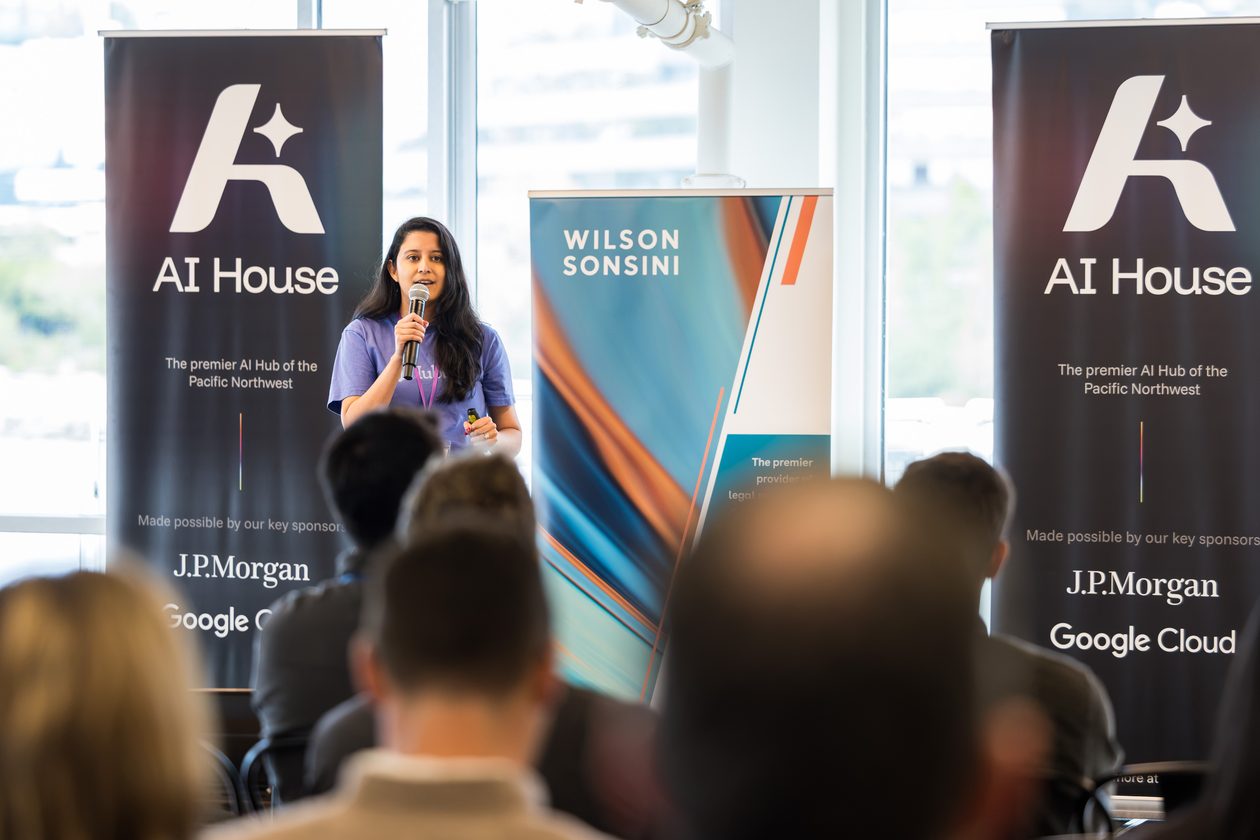
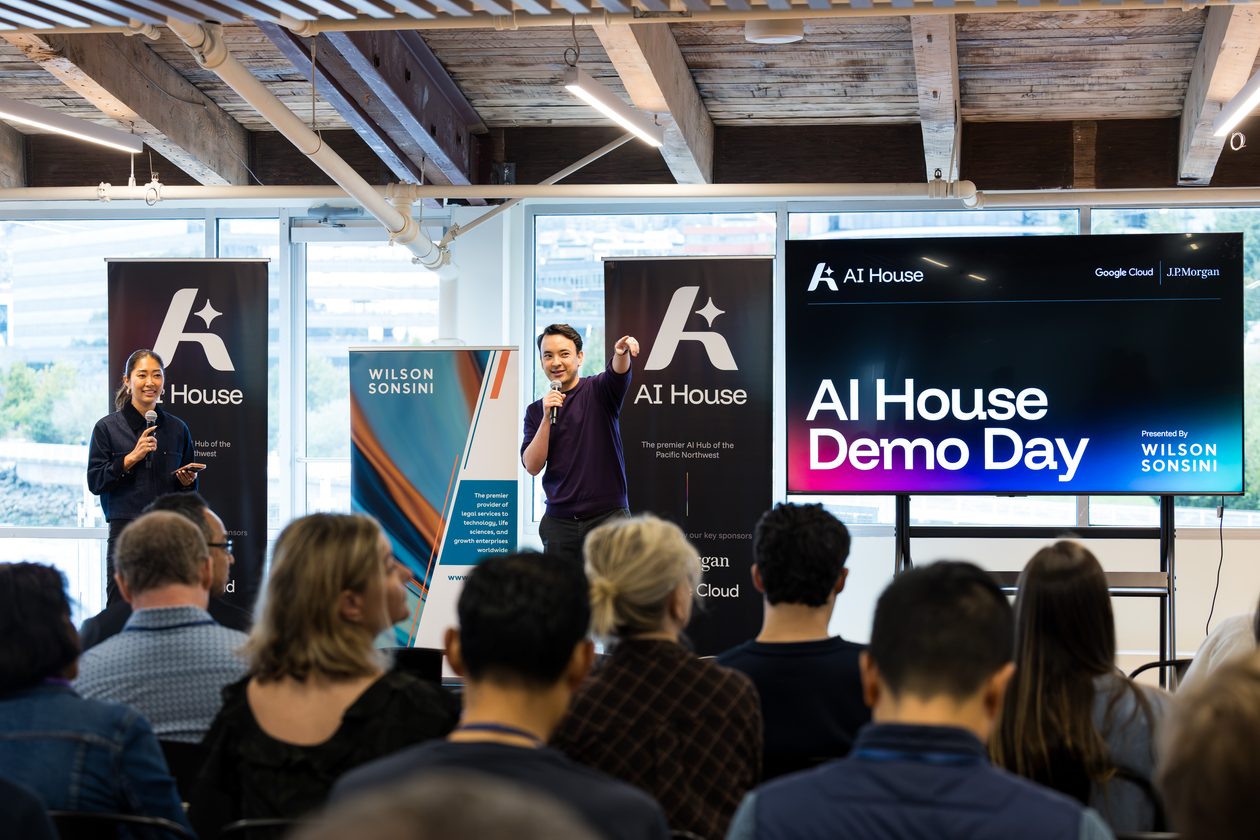
AI House brought investors from as far as Boston, New York, Colorado and the Bay Area to Seattle this week for something the city’s startup scene has rarely tried: a demo day meant to help bring outside money to local founders.
Twenty-five early-stage startups pitched at the event, held Wednesday at the startup incubator and venture capital fund’s offices on Pier 70. Many of them weren’t part of AI House’s own portfolio, and that was by design, said Yifan Zhang, an AI House managing director, who came up with the idea for the event.
“We all complained about not having enough capital here, but no one was doing anything about it,” Zhang said. So AI House tapped its own connections to investors in other parts of the country, she said, and “people flew in from all over for this.”
Investors in attendance included Mike Vernal, a partner at San Francisco-based Conviction; Emily Melton, founder and managing partner of Threshold Ventures; and Rob Go, co-founder of Boston-based NextView Ventures. Many well-known Seattle-based venture capitalists also attended the event.
Zhang said she wanted the lineup to show multiple sides of Seattle: startups built around real problems and revenue, and technologists doing “crazy ambitious things.”
Theo Ellis, CEO of Seattle mortgage-tech startup Friday Harbor, called it “Seattle’s answer to YC Demo Day,” a reference to Y Combinator’s showcase in the Bay Area.
Many of the city’s startups are “not necessarily in the flashiest spaces,” he said, but they have real customers and are growing fast. For his part, Ellis said, mortgage lending technology is “not exactly nuclear-powered robots landing on Jupiter, but it’s an enormous market with a lot of businesses willing to pay for it.”
Ellis told the crowd during his pitch that Friday Harbor underwrote 0.6% of all U.S. residential mortgage applications in August, and that the company is starting to raise its Series A round.
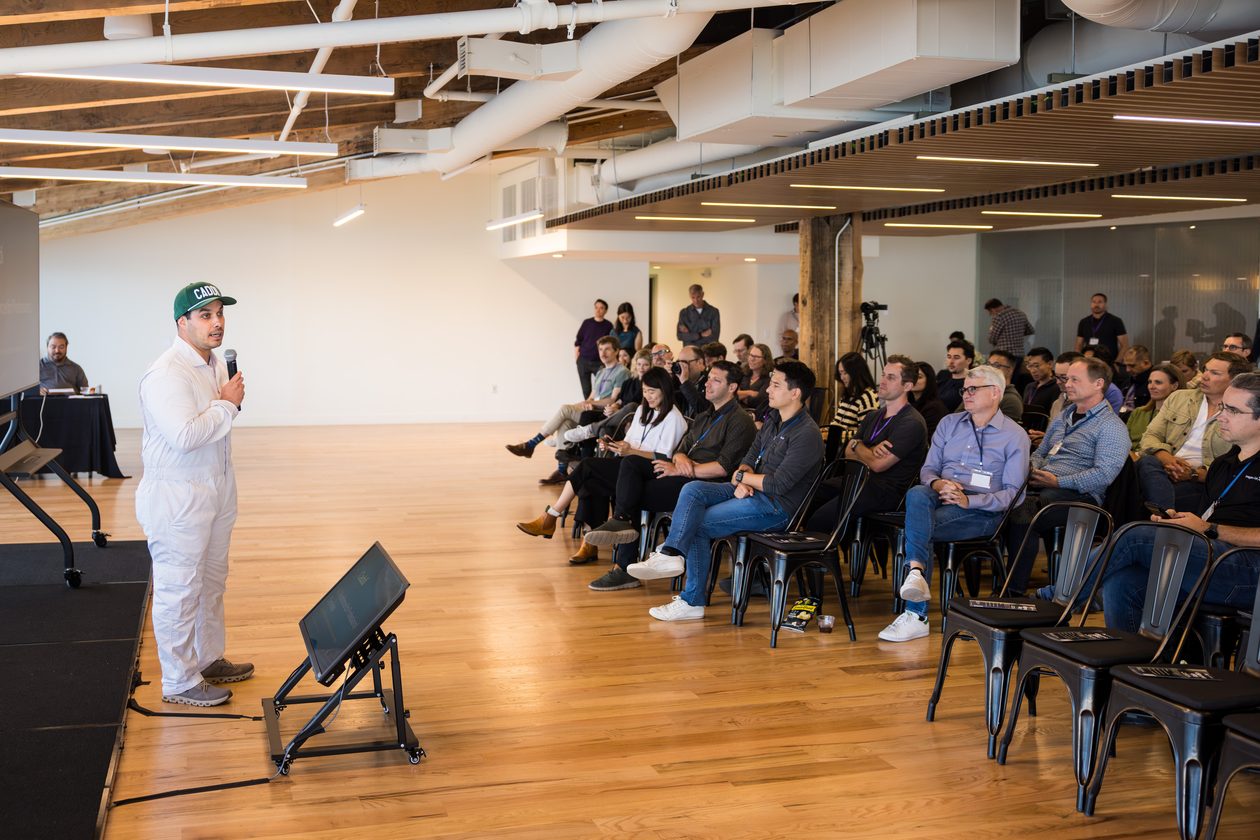
Many of the companies that pitched have been covered by GeekWire. In addition to Friday Harbor, they included Optimly, Vantari, Jinn Labs, GateIn, Casium, Orbital Robotics, Viata, Ridge AI, Caddi, Lev, Aria (formerly Alpyne Labs) and Synthesize Bio.
Others were new to us, at least in their current incarnations:
- Moria, co-founded by Chris Mutzel and Jimmy Voorhis, uses AI to produce technical studies for mining companies. Voorhis said one customer expanded a $100,000 contract to $900,000 in two months.
- Hubble, a Y Combinator Summer 2026 company co-founded by CEO Prabha Dublish and CTO Aaron Leon, is building an API to retrieve patients’ medical records.
- Atlas, co-founded by CEO Chandra Bhagavatula, a former Ai2 researcher, and Martín Ramírez, is developing AI to run much of a company’s day-to-day operations.
- Reflection Robotics, led by co-founder and CEO Arsalan Mousavian, a former Nvidia robotics research manager, is building AI models that let factory robots learn precise tasks from a single demonstration.
- Eidol, an AI House portfolio company based in Los Angeles, makes software that listens to a live singer and keeps pre-recorded vocal tracks in sync with the performance. Founder and CEO Clayton Janes pitched alongside the company’s chief artist officer, Letters to Cleo singer Kay Hanley.
- Comment.io, co-founded by CEO Jon Gordner, a former Microsoft and Textio product leader, and CTO Max Winderbaum, a longtime Textio engineering leader, is building a tool for people to review and approve work produced by AI agents.
- Axel, led by founder and CEO Stephen Grabowski, is an AI travel agent that says it finds flight and hotel deals below public prices. Grabowski said it has about $30 million in annualized travel bookings.
- Suede, founded by Danielle Dantche, a former merchandising director at Seattle retailer Pipe and Row, automates product listings and purchase orders for independent boutiques. Dantche said it has processed $9.9 million in inventory over the past 90 days.
- Ergoly, co-founded by AJ Gleser and Dan Moore, helps small service firms train and deploy AI workers for each of their clients.
- Finch, founded by former Brightflow AI CEO Jeffrey Priebe, is building AI to plan and run in-person events that companies use to meet potential customers.
Closing the event, Jacob Colker, AI House co-founder and managing director, made his pitch to the out-of-town investors, building on the themes in his recent GeekWire guest column and a rallying cry he delivered during Seattle Tech Week in July.
The region is full of “space, science, tech, bio, health, startup builders,” he said, with far more good ideas than local investors can fund. “The reality is there’s just not enough capital in the Pacific Northwest.” That’s where the visitors come in, he said, predicting that they’ll find “great investment opportunities and great deals.”
Seattle, Colker said, “is worth your time, your investment, your focus, your energy.”