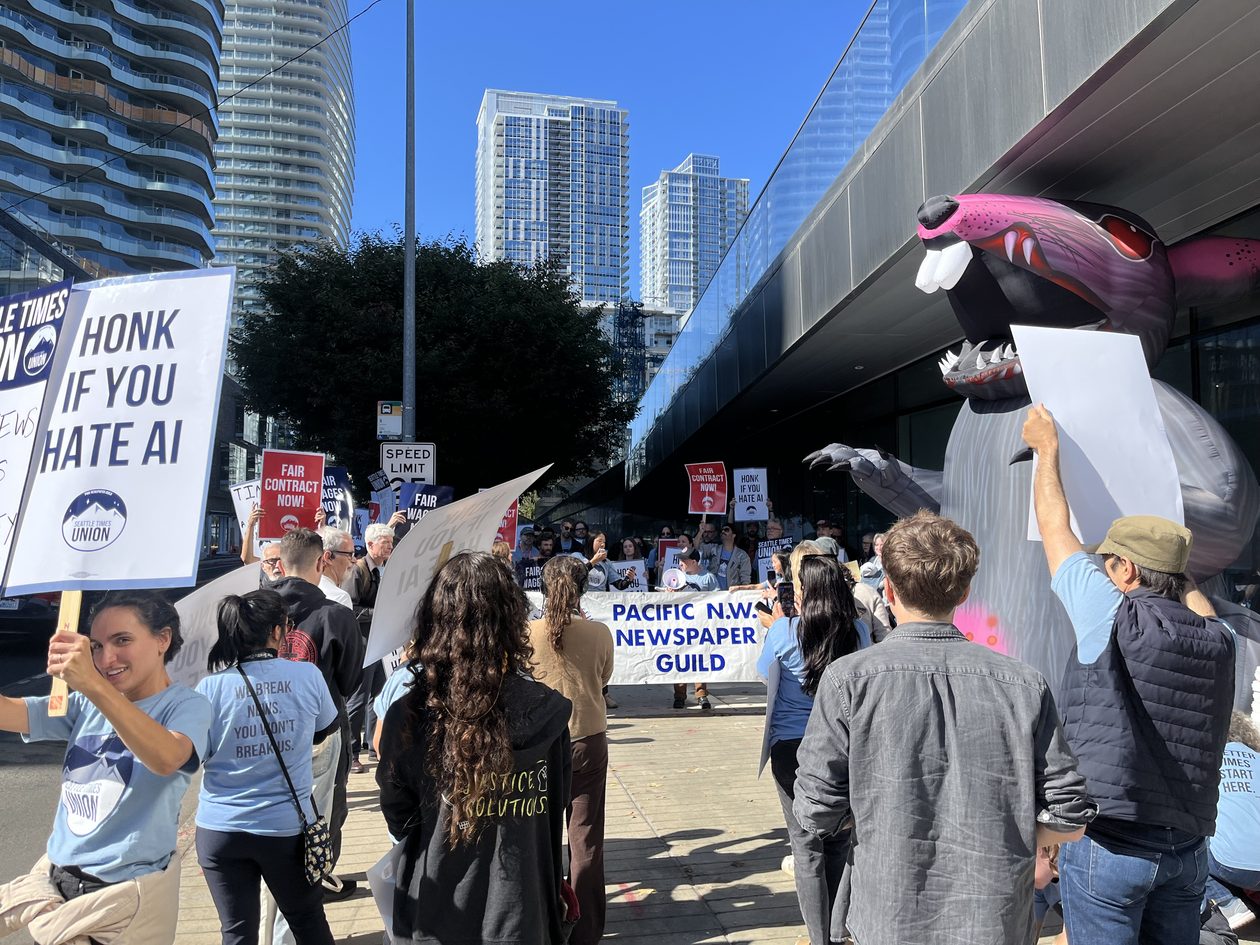
Members of the Seattle Times Union held a lunchtime picket outside the newspaper’s offices Wednesday, calling on the company to guarantee that AI won’t replace any newsroom jobs.
The picket comes six months into contract negotiations that the union says are currently stalled over wages and AI use. While the company has agreed to prohibit the use of AI to interview people or write articles, it has declined to extend protections to other newsroom roles, such as photojournalists, copy editors and social media producers, according to the union.
“Management has admitted at the bargaining table that it could use AI to replace jobs,” journalist Alexandra Yoon-Hendricks said in a speech. “All of our members in the newsroom — reporters, photographers, copy editors, page designers, graphic artists, digital producers and more — deserve job security against machines.”
From the start of bargaining, the union says it has called for a contract in which “interviewing sources, writing stories, and all other journalistic and production related functions will be done by humans.” Management has only accepted the interviewing and writing clauses, excluding roles such as copy editors, graphic artists and photojournalists, according to the union.
That worries reporters like Manuel Villa, a data journalist at the Times, who cited the example of copy editors. “There is nothing to say that they wouldn’t be completely replaced,” Villa said. “I trust in them to make my pieces better. I am not sure I trust an AI agent to do that.”
The Seattle Times Union is part of the Pacific Northwest Newspaper Guild, which won a contract this summer barring McClatchy from using AI to replace staff, decrease pay or reduce working hours at five newspapers in Washington and Idaho. McClatchy laid off 17 journalists at those papers this month as part of nationwide cuts.
Michele Matassa Flores, Seattle Times executive editor, addressed the paper’s use of AI in a column published Sunday. “The Seattle Times does not publish news stories produced by artificial intelligence. Full stop,” she wrote.
At the same time, Matassa Flores wrote, there are “ways artificial intelligence can help us do our work.” The weekly News Quiz and an audio player that reads stories aloud are the paper’s only reader-facing AI products, she wrote.
Behind the scenes, she wrote, the newsroom occasionally uses AI to transcribe interviews and analyze large data sets, and it is piloting a program that scans government meeting videos for potential story ideas. Every use of AI in the newsroom needs approval from newsroom leadership, according to the column.
The column quoted Seattle Times Publisher Ryan Blethen telling a reader that “AI should be treated as a tool to aid and assist our journalism, not replace it.” The column did not mention the union or the contract talks.
Seattle Times Co. President and CEO Alan Fisco, in a statement provided to GeekWire, said the company will continue talks with the union over AI issues.
“We understand the Guild’s concerns regarding the development of AI in the workplace, and especially its potential impact on journalism,” Fisco said in the statement. “To that end, we remain committed to negotiating with the Guild toward mutually acceptable contract language regarding AI use at The Seattle Times.”
The Seattle Times Co. and Newsday sued Microsoft and OpenAI on Sept. 4, alleging the companies used their journalism to train AI models without permission.
The union said at the time that it supported the lawsuit, but that “if the Seattle Times Co. truly cares about the threat AI poses to journalism’s business model, it should protect the workers who produce the copyrighted material at the heart of this case.”
At the picket Wednesday, union members said they were hopeful that the company would come around, citing the broader trend of AI skepticism. A recent union petition, calling on the company to pledge not to replace any newsroom workers with AI, has received more than 1,600 signatures from the public.
“We’ve been doing a lot of public outreach, and we’ve been hearing sentiments from the community that they don’t want their local paper to be made with AI,” multiplatform desk editor Brandon Foster said. “It’s nice to know we’re on the same page as our readers.”
The union says it’s awaiting the company’s response after Tuesday’s bargaining session. The next session is scheduled for Oct. 13.