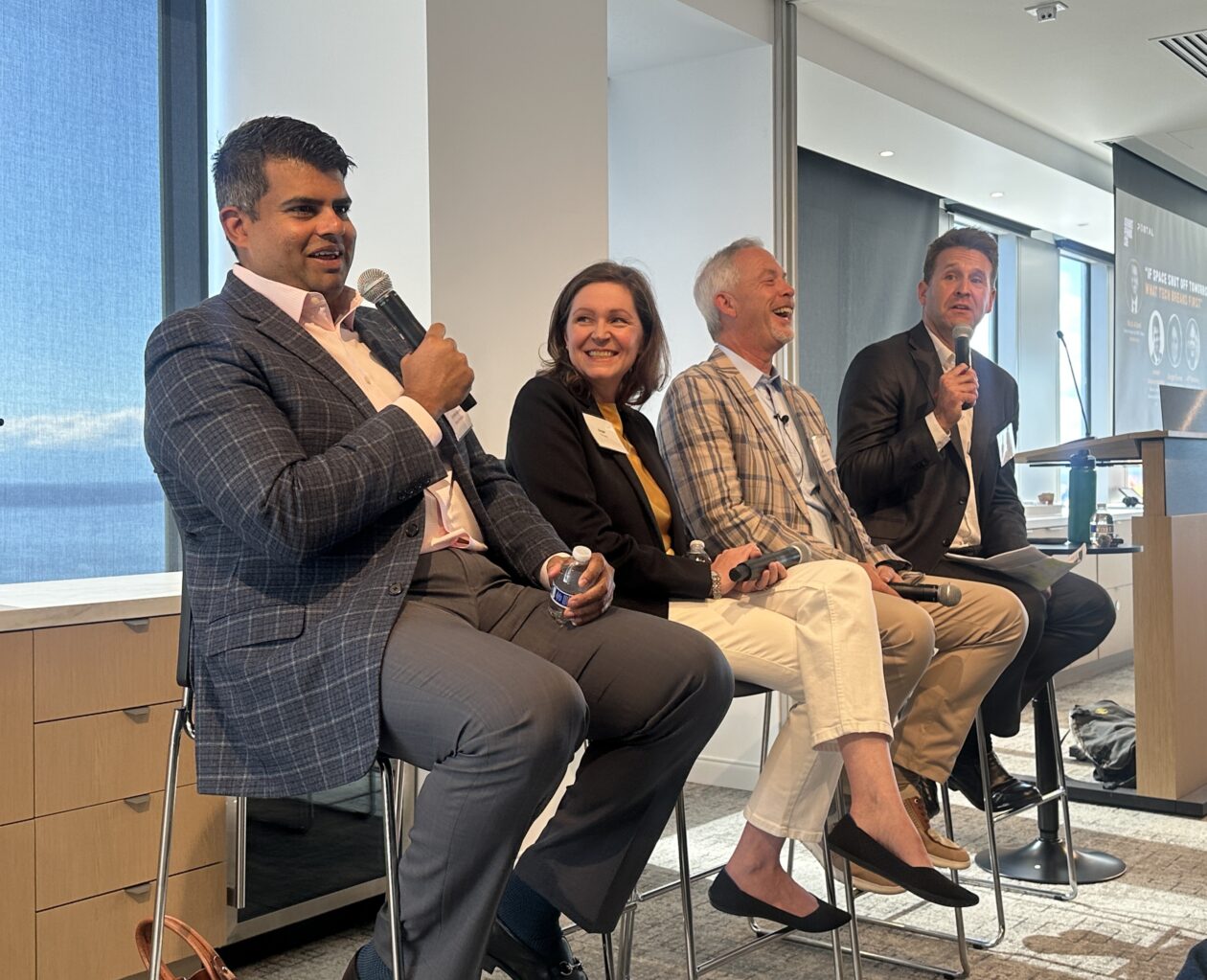
The road to space isn’t always a straight line. Sometimes, the itinerary for a career in the space industry begins with years of experience in other tech fields. And sometimes, it starts at an espresso stand.
“I actually started as a barista at SpaceX, and I somehow got recruited to go build Starlink satellites,” Kayla VanderPutten, a technical recruiter at Anduril Industries, said Monday at a downtown Seattle Tech Week session focusing on the intersection of space and technology. “I don’t know why they let me do that, but I was there for the first 500 satellites before I transitioned into recruiting.”
Over the course of 25 years, Joydeep Hazra’s career path took him through a series of jobs in telecommunications and network engineering, including management positions at Nokia, Mavenir and TRIDENTX. Now he’s the manager of a federally funded program focusing on electric vehicles at South Seattle College — and he’s getting involved in aerospace as well.
Last week, South Seattle College and the nonprofit Mars Society announced a partnership to build a space research station on campus, complete with a habitat that can be used for simulating missions on the moon or Mars.
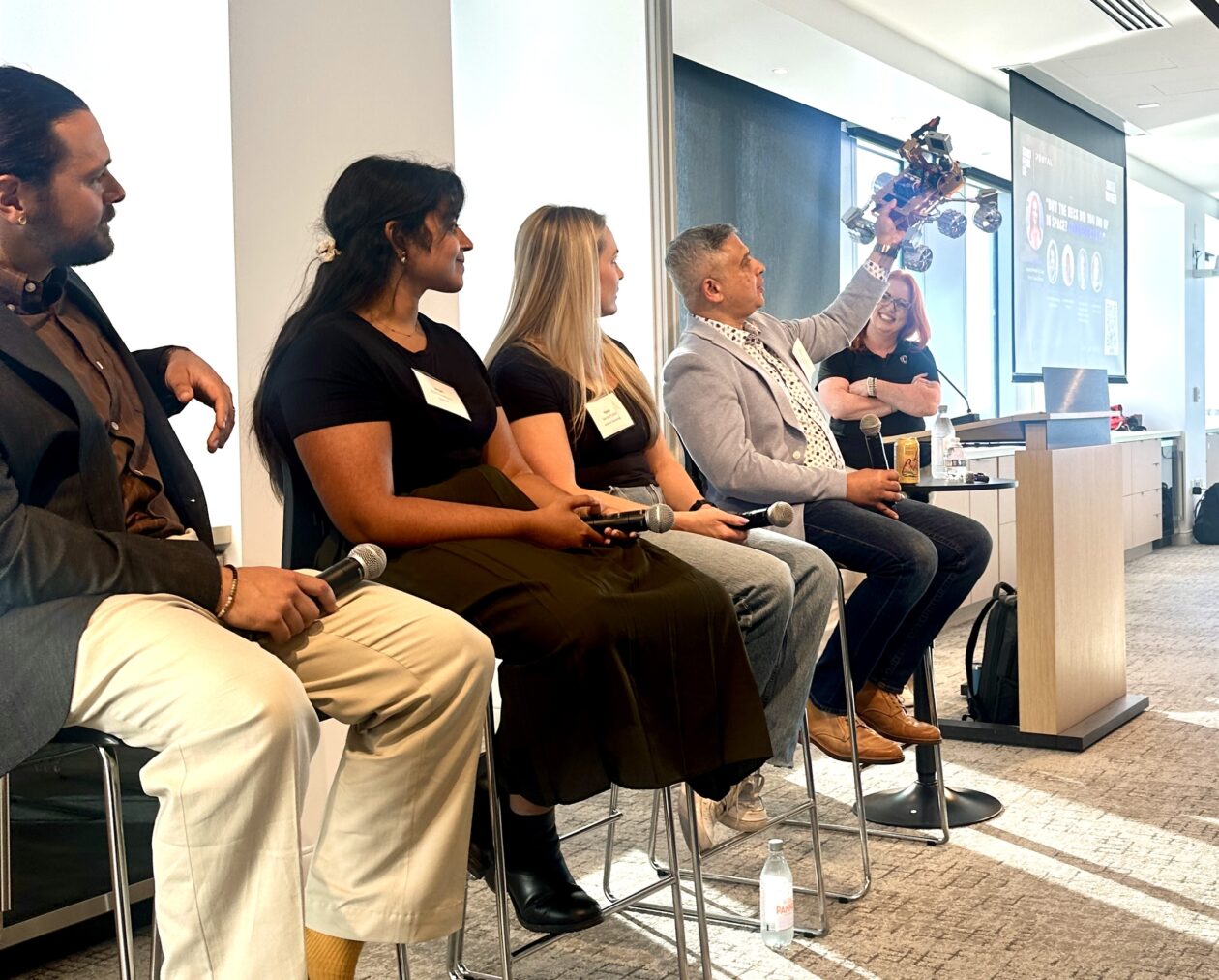
The electric vehicle program could help students prepare for careers building Mars rovers, like the Chinese-built prototype rover that Hazra displayed during the Seattle Tech Week session.
Other technical fields could provide further opportunities for space-centric crossovers.
“When you’re building a lunar habitat, there are a lot more things to do than just going up and down in the rocket, and that’s where all of us count,” Hazra said. “Interoperability, frequencies, microgrids, plumbing, psychology, cooking — everything is going to be super-important, because without that, the lunar habitat would only have robots from China, and not our astronauts.”
South Seattle College isn’t the only Seattle-area school expanding into the final frontier: Two years ago, Amazon Leo (formerly known as Project Kuiper) partnered with Lake Washington Institute of Technology in Kirkland to launch a certification program for satellite technicians. Amazon also offers a Career Choice program that gives non-technical employees, such as workers in fulfillment centers, the opportunity to train for satellite manufacturing jobs.
VanderPutten’s career followed a less formal path. While she made coffee for the engineers at SpaceX, she also made conversation about the satellites they were building — and eventually jumped at the opportunity to join them.
“When you’re trying to build 10 satellites a day, it has to be really, really easy to do,” she said. “Once I moved onto the floor, the engineers really wanted my feedback, and I really enjoyed that. I don’t know if they always enjoyed my feedback, because it sometimes created more work for them. But that was probably the biggest surprise — being brand new and having these really talented engineers want my feedback, and want to help improve their designs based on what I was seeing.”
From there, she transitioned into recruiting for tech ventures. In June, she started a new job at Anduril, a defense tech company that’s rapidly expanding in Seattle. So, as a recruiter, what would she tell someone who’s not highly technical but is interested in the space industry?
“I would tell new grads and people who are junior in their careers to be curious, to learn how everything works together, and to ask questions,” she said. “You might feel that your question is silly or dumb, and you don’t want to embarrass yourself. But I can guarantee you that someone else in that room is going to have that question, and now you can go on and help other people.”