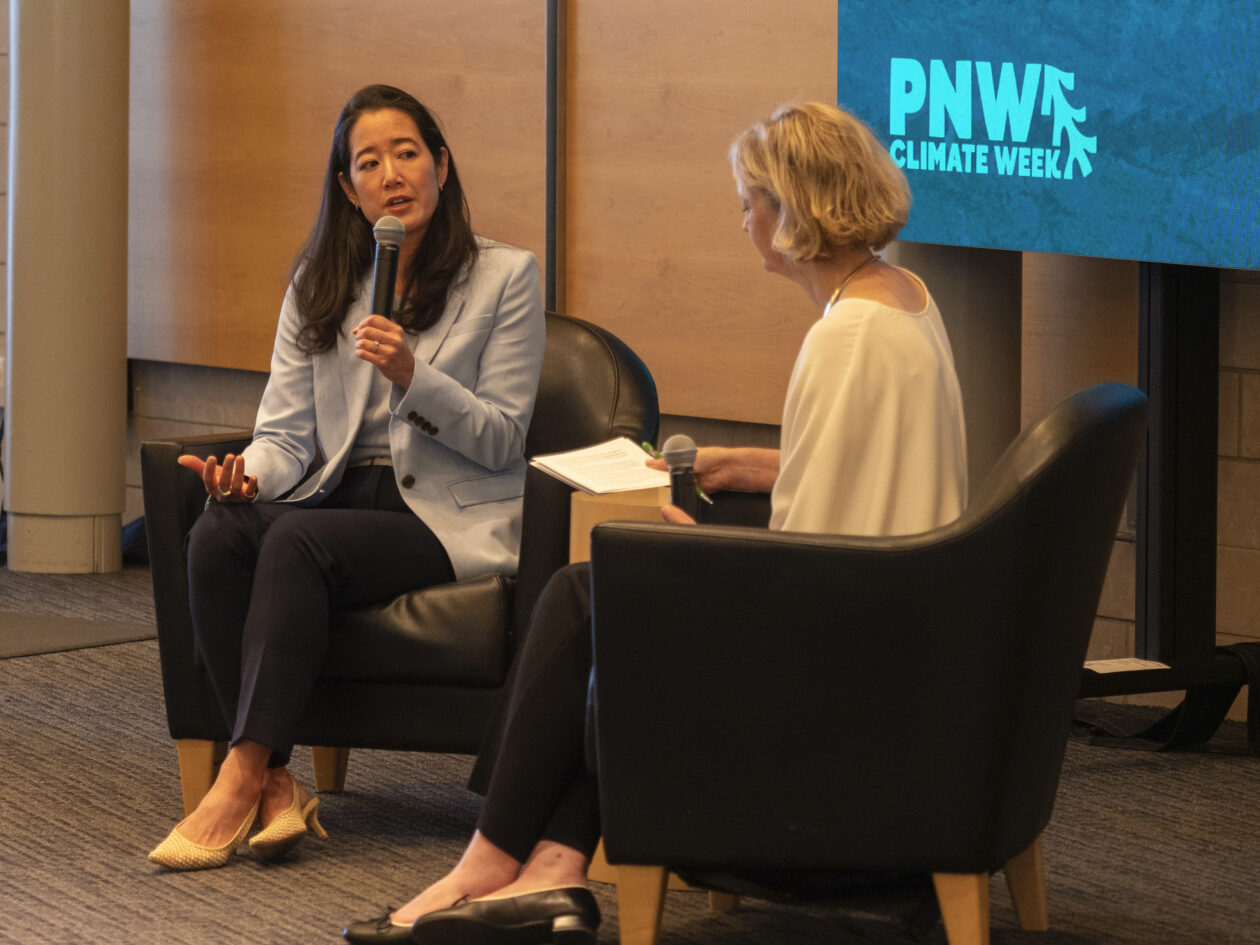
Microsoft Chief Sustainability Officer Melanie Nakagawa faced a barrage of pointed questions from the audience Friday during a session at the annual Pacific Northwest Climate Week in Seattle.
Protesters challenged Nakagawa through most of the 30-minute event held in a conference room at Seattle’s City Hall, calling out the company’s use of fossil fuel energy sources to power its AI data centers and challenging Microsoft’s commitment to climate goals set years ago.
As a reporter covering sustainability issues for GeekWire, I moderated the conversation. Many of the issues raised by the crowd were on my list of questions for Nakagawa. The disruptions also included chants from protesters seated among attendees, at times going beyond climate issues to condemn Microsoft’s technology deals with Israel.
Security guards ultimately ushered some protesters out of the space, while others remained. Interruptions from the audience continued for all but the final 10 minutes of the session.
The event capped off Pacific Northwest Climate Week, which included conversations around the city and region about climate change solutions, policies and innovations.
Microsoft has for many years been viewed as an environmental corporate leader, setting an ambitious goal in 2020 to become carbon negative within a decade. It created an internal carbon tax — one of the corporate world’s largest — that charges individual Microsoft divisions for emissions from sources like air travel to fund climate-friendly initiatives. The company is credited with helping create and sustain the carbon dioxide removal sector, among other roles.
But the rapid expansion of AI data centers and their huge energy demands are undercutting Microsoft’s standing. The company recently released its annual sustainability report, disclosing that its carbon footprint grew 25% last year, moving it further from its 2030 target.

One protester’s question was about a deal announced earlier this year in which Microsoft is partnering with Chevron to build a 2.7 gigawatt natural gas facility to power a data center campus in Texas. I asked Nakagawa how the company defends the agreement, and she pointed to the 4.7 gigawatts of renewable energy that Microsoft has supported in the state. I followed up by asking about the Redmond, Wash.-based company’s commitment to carbon dioxide removal (CDR) projects given recent reports about a pause on new deals.
Nakagawa was unable to answer before the crowd drowned her out with a call-and-response chant: “Microsoft, you can’t hide. We can see your dirty side.”
Another protester criticized the escalating pursuit of AI. “You’re selling us a product that we don’t even need, and we never should ask for,” he said. “No one wants AI. You’re destroying the climate with AI.”
I brought up legislation proposed earlier this year in Washington to mandate clean energy use and bring transparency to data center impacts in the state. Microsoft opposed and helped defeat the bill, though the company says it wants to work with lawmakers to pass rules next year. I asked what needed to change in the legislation for Microsoft to support it.
Nakagawa didn’t provide specifics, but noted that this year, for the first time, the company shared facility-level information in its annual report on electricity and water use for data centers worldwide.
“People want to know more about the data, and we believe you can have an honest and candid conversation with transparency and access to that information and data,” she said.
Given the obvious public concerns, I asked Nakagawa, “Do you really honestly believe that by 2030, the company can hit that carbon-negative goal?”
Nakagawa pointed to wide-ranging initiatives that are starting to help curb specific emissions, including investments to make Xbox devices lower carbon and financial support for the recent opening of a production plant in Moses Lake, Wash., for sustainable aviation fuel company Twelve.
“There are a couple areas where we’re seeing a lot of promising progress,” she said. “Look, this is going to be a hard target. We’ve not been at all shying away from the fact that this is a difficult goal.”