Seattle Mayor Katie Wilson on Tuesday proposed a budget that closes the city’s inherited deficit largely through spending cuts and rules out new taxes on big business. That includes any increase to the JumpStart payroll tax she helped create, a decision that comes amid a rocky stretch for the region’s tech industry.
The $9.1 billion proposed 2027 budget, the first year of the city’s 2027–28 biennial plan, aims to erase a $175 million General Fund deficit without new progressive revenue.
Wilson’s plan cuts nearly $50 million a year in General Fund spending and eliminates 128 full-time positions, 15 of which are currently filled. It also continues using JumpStart revenue to prop up general city services, while keeping more than 30% of the tax’s annual revenue — about $140 million — dedicated to affordable housing.
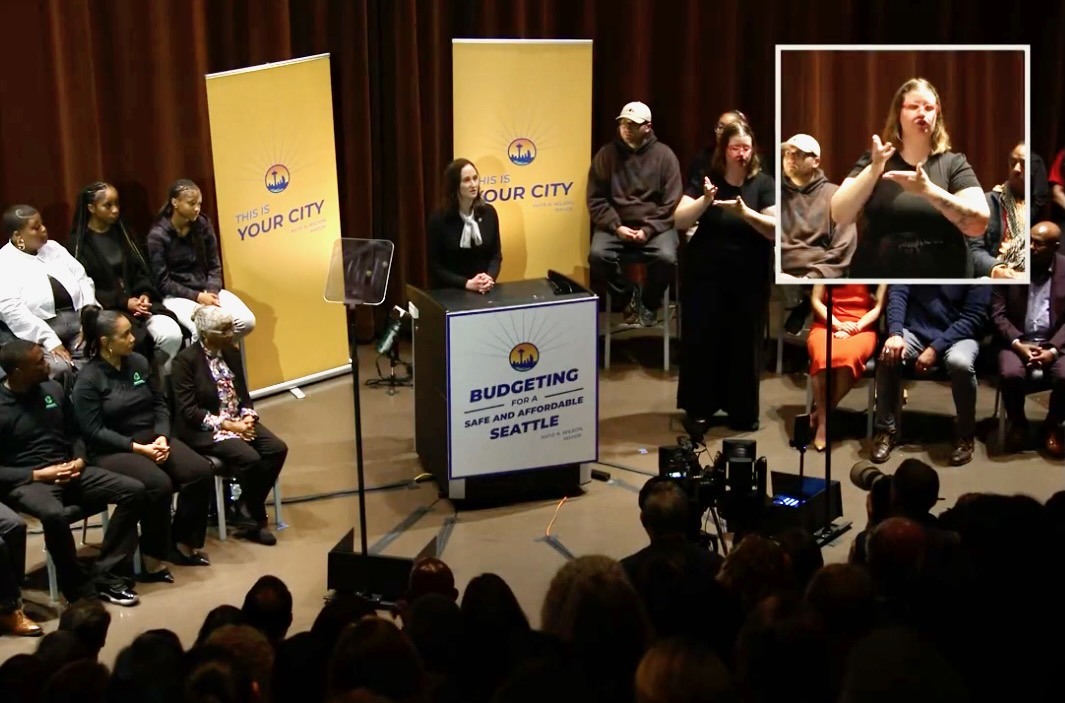
Speaking at the Seattle Central Library on Tuesday, Wilson framed the decision as a response to economic conditions.
“We are watching seismic shifts in the tech sector, which anchors so much of our regional economy,” Wilson said. Raising additional progressive revenue presents high risks while downtown remains fragile, she added, noting that expanding taxes like JumpStart is “not the right move” right now.
The stance marks a notable turn for Wilson. Before taking office, she helped design and push for JumpStart as a community activist. As recently as July, she called raising the tax an option for closing the budget gap. On Tuesday, she acknowledged she is “continuing to direct JumpStart dollars beyond the programs it was originally intended for,” and said she aims to grow the tax’s housing share in future budgets.
Passed by the City Council in July 2020 during the height of the COVID-19 pandemic, JumpStart was pitched as a way to fund affordable housing, climate initiatives, small business support, and equitable development. It applies to businesses with large Seattle payrolls and taxes the pay of employees earning roughly $194,000 or more, at rates ranging up to 2.55% depending on payroll size and salary levels.
Because of high salaries and equity-heavy compensation across major tech firms, the tax falls heavily on big tech. Just 10 top taxpayers, led by companies like Amazon, Meta, and Google, account for roughly 70% of JumpStart revenue.
JumpStart was designed with guardrails to protect spending on housing and community development, but it quickly became a lifeline for City Hall during post-pandemic revenue shortfalls. Under Wilson’s predecessors, the city routinely shifted roughly $200 million or more a year from the tax into the General Fund to patch structural deficits.
By holding rates steady, Wilson’s budget offers Seattle tech employers a period of tax stability amid growing friction over the city’s business climate. Business groups have long argued that heavy payroll taxes undermine Seattle’s competitiveness, pushing job growth and tech investment toward Eastside hubs like Bellevue and Redmond that don’t impose comparable payroll taxes.
That debate was reignited in June by a Downtown Seattle Association report examining the tax five years after its passage. The report tied JumpStart to the loss of about 30,000 downtown jobs and found that downtown Seattle office properties lost 48% of their assessed value between 2020 and 2025, while downtown Bellevue’s rose 7%.
While Wilson cautioned at the time against blaming downtown’s complex post-pandemic recovery on a single policy, her decision to hold JumpStart rates steady reflects her administration’s apparent willingness to listen to business concerns as City Hall works to revitalize the commercial core.
On Tuesday, DSA President and CEO Jon Scholes welcomed her budget, saying that not adding business taxes while employers face headwinds is “important and a helpful signal to the business community.”
And Amazon also responded to the mayor’s plan.
“We appreciate Mayor Wilson putting forward a budget that focuses on making use of existing resources,” an Amazon spokesperson told GeekWire. “Like Mayor Wilson, we believe the city’s first priority should be making sure those resources are used effectively and deliver results for residents.”
Beyond payroll taxes, Wilson’s budget speech and recent executive actions touched on several tech-adjacent priorities:
Housing permitting acceleration: Following an executive order last month launching a Housing Production Task Force, the budget funds a new Affordable Housing Ombud position to help community developers navigate city permitting faster.
Algorithmic pricing transparency: The budget funds implementation of the city’s Fair and Transparent Pricing policy. The City Council was scheduled to take a final vote Tuesday on the ordinance, making Seattle the first city in the country to ban algorithmic price discrimination (also known as surveillance pricing) for groceries.
Economic diversification and AI exposure: The budget proposal follows an executive order Wilson signed earlier this month aimed at diversifying Seattle’s economy. A city-commissioned report warned that local employment is 42% more exposed to AI disruption than the national average, prompting the order’s call for targeted support to retain growing startups.
Green technology investments: The budget maintains JumpStart-funded Green New Deal programs, including building decarbonization, urban forest support, and clean energy apprenticeships.
With the proposed budget now formally submitted, the Seattle City Council begins a nine-week review process chaired by Councilmember Dan Strauss. Public hearings are scheduled for Oct. 6 and Nov. 5, and councilmembers have until Oct. 20 to submit proposed amendments before Strauss presents a revised balancing package in early November.
A final council vote to adopt the final budget is slated for Nov. 20.