Members of Washington’s AI task force point to the state’s new AI regulations as evidence that regulation and innovation can coexist, but a panel discussion this week marking the end of their two-year effort showed just how unsettled the core issues remain.
The task force is caught between consumer and labor groups calling for more extensive guardrails, and tech industry representatives concerned about compliance costs, exposing the tension between the demands of the fast-moving AI industry and the risks the technology poses to individuals.
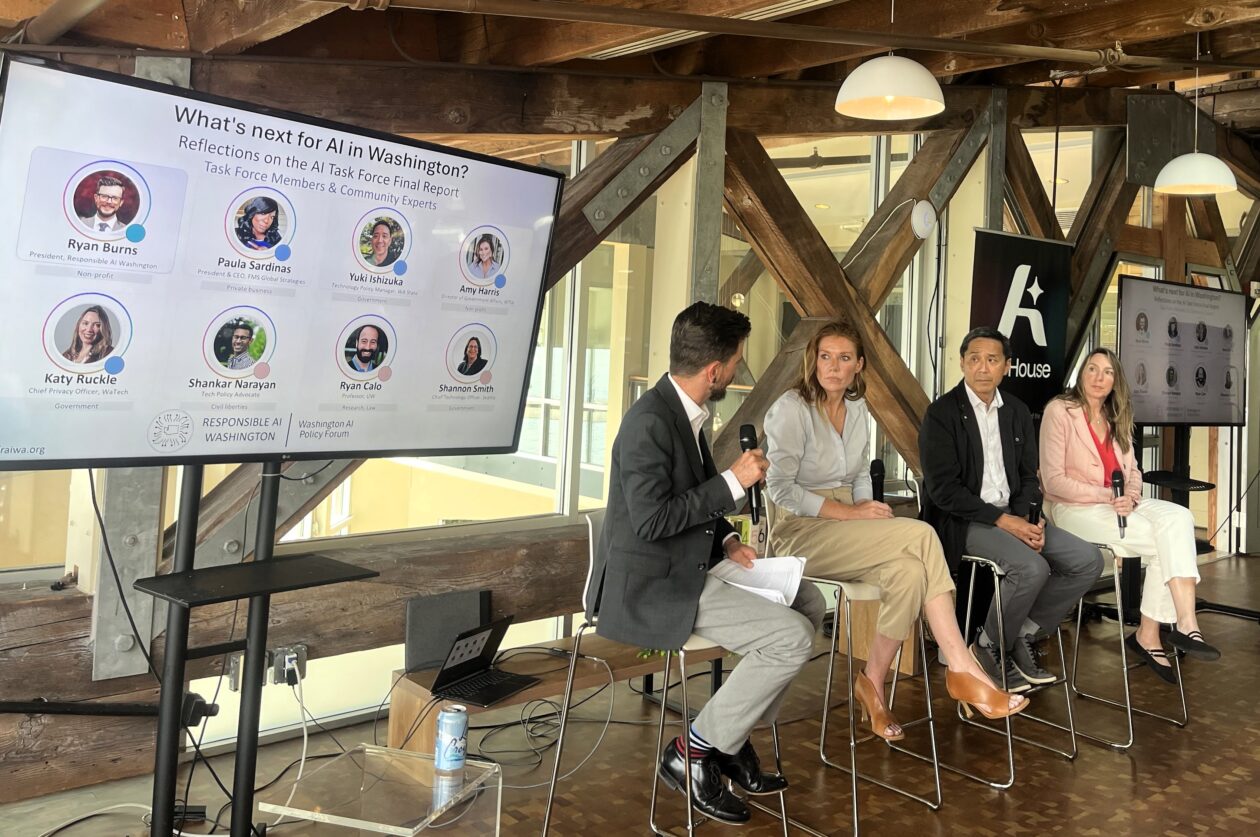
That came to the fore at a panel on Wednesday, held at the Seattle startup incubator AI House, where task force members faced an unusual mix of people: an audience of AI startup founders, plus a roster of pro-regulation experts representing the legal, labor, and consumer protection fields.
Panelists were there to discuss the task force’s final report, which recommended AI regulations to the state legislature. Four of the eleven recommendations were adopted, in part or in full, and passed into law this spring.
“We are here today to see how much of this sentiment — that Washington does not have to choose between embracing innovation and protecting people — comes out in the content of the report,” said Ryan Burns, co-founder of Responsible AI Washington, who moderated the panel.
That line has become a refrain for AI regulators in Washington. Gov. Bob Ferguson, then the state’s attorney general, requested the legislation creating the task force in 2024. He appointed representatives from government, labor, academia, and the tech industry, directing them to explore how AI could be “regulated without stymieing innovation.”
In the final report, published in July 2026, Attorney General Nick Brown wrote that the task force had “made clear” that the two priorities could coexist, despite the federal government’s pro-innovation agenda. But Wednesday’s event showed that might not be so simple.
Narrow regulations passed
Washington passed its first AI regulations this spring, including a requirement that companion chatbots remind users that the bots are not human and another that prohibits medical insurers from denying a patient coverage solely on the basis of an assessment made by AI. For Burns, the laws that did not pass were more telling.
“It did strike me as meaningful that the recommendations that have been adopted pertained to narrower application areas,” Burns said. “The recommendations that have not yet passed were a lot bigger.”
One of those recommendations was to regulate the use of AI for high-risk decision making, meaning applications of AI to hiring processes, algorithmic pricing, criminal justice, and healthcare. A similar law has passed in states such as New York, Connecticut, Illinois, California, and Colorado, but the Washington bill died before reaching a floor vote in either chamber.
The task force’s recommendation to require AI developers to disclose the datasets they are using to train their models, as California does, also died, as did a third recommendation to develop guidelines for the use of AI in the workplace.
In an interview with GeekWire, state Rep. Mia Gregerson, who sponsored some of the comprehensive bills, said she appreciated the work of the task force but maintained that there is much more work to be done.
“We are a tech heavy state, so we have an even bigger responsibility to do good work to catch up to what other states are doing,” Gregerson said. “We are so behind.”
On Wednesday, panelists said broader AI regulations failed in part because they drew less interest from the public.
“What passed in the legislature was more sector specific things where the consumer harm was more clear, and I think that’s a product of political dynamics,” said Yuki Ishizuka, technology policy manager for the Washington State Attorney General’s Office. “It’s harder to connect broader governance or transparency bills to harm to people.”
Broad AI regulations also faced heightened opposition from the tech industry, where a patchwork of state regulations means higher legal fees. At task force meetings, which were open to the public, representatives from the tech industry opposed regulations around AI development that would add “procedural hoops.”
Cost of compliance
Concern about overregulation was echoed by attendees of the event, the majority of whom were founders of small AI startups.
When it came time for the Q&A, multiple audience members asked the task force to consider the financial burden for small startups of complying with complicated state regulations.
The distinction between big tech and startups has become a refrain for AI House, where entrepreneurs met with U.S. Sen. Patty Murray last month to discuss the nuances of AI regulation for so-called “small tech.”
“As these recommendations turn into policy, it’s important that startup founders are part of the conversation,” AI House Managing Director Jacob Colker told GeekWire. “A five-person startup doesn’t have the same legal, compliance, or policy capacity as a trillion-dollar company.”
But Jai Jaisimha, co-founder of a pro-regulation organization called the Transparency Coalition and a former startup founder himself, cautioned against creating legal carve outs for certain AI developers.
“Arguing that you’re exempt because it’s too much data to disclose, or it’s a trade secret, those arguments send a sign that normal software development and governance does not apply to AI,” Jaisimha said. “Disclosure and consumer protection, these are standard practices in other industries.”
While the bills that would have been most costly for developers to comply with did not pass into law, those that did will still create significant legal consequences for AI developers who don’t abide by them.
Panelist and technology law expert Ryan Calo, a University of Washington law professor who was not a member of the task force, said the state’s new companion chatbot law will be “blood in the water for the plaintiffs’ bar” for two separate reasons.
- First, any failure to comply could now be treated by the courts as “negligence per se,” meaning that the plaintiff will not have to show broader negligence but will simply have to show that the defendant violated the law.
- Second, any failure to follow these regulations is deemed an unfair or deceptive act under Washington’s Consumer Protection Act, giving consumers a private right of action and exposing developers to higher financial penalties.
The question for the tech industry will be about where the state’s attorney general will prioritize enforcement.
“The AG has a lot of power, but not enough to bring every violation of the law. So you have to think of the Eye of Sauron, and whether it will focus on you. If you’re a little startup, probably not, but if you’re Meta, probably yes,” Calo said.
Future AI regulation
As Washington state prepares to implement its new regulations this January, regulators are bracing for backlash from the federal government.
A December executive order from the Trump administration called on Congress to pass a “minimally-burdensome” AI policy preempting state laws, created an AI Litigation Task Force to challenge state laws that don’t “sustain and enhance the United States’ global AI dominance,” and threatened to cut broadband funding to those states. It named Colorado, which enacted the first comprehensive state AI law in 2024.
Federal preemption would require Congress to pass AI regulation of its own, which it has yet to do, but Trump’s order still seems to be having an effect.
- This spring, Colorado repealed its AI regulation and replaced it with a more conciliatory law.
- In Virginia, where no AI regulations have gained traction, legislators pointed to the federal government’s threats.
- And in Utah, lawmakers withdrew a bill to regulate frontier models after the Trump administration sent them a memo criticizing it for “opposing the federal government’s agenda,” according to Politico.
“We believe that, if the federal government is going to act, they should act with meaningful AI regulation, and should not preempt the state’s ability to protect its citizens,” said Ishizuka of the Washington state AG’s office.
The federal pressure has not stopped some leaders from calling for far-reaching regulation. Some members of Wednesday’s second panel, which was made up of representatives from labor, academia, and consumers from outside the task force, proposed redistribution: Future AI regulation should reallocate the profits made by developers to pay for AI’s impending costs, such as cybersecurity improvements, worker retraining, and updates to school curricula.
“My worry is that there is going to be a lot of money being made, and I really think that bill should go to the people that are making a lot of money off of it,” Calo said. “I’m not sure that all of the [task force’s] recommendations directly address that redistribution element.”
Some state lawmakers are ready to address it. Gregerson, whose district includes SeaTac Airport and whose constituency includes many Uber drivers, told GeekWire she hopes to allocate state funds for retraining rideshare drivers who are replaced by autonomous vehicles.
State Rep. Clyde Shavers, who was not present at Wednesday’s panel but was a member of the task force, has said he wants to spend the next session establishing liability frameworks for AI-related harm.
Now that the report has been published, the task force will be disbanded, but the work will continue at the Attorney General’s Office, where a new Tech Policy Team will be led by Ishizuka.
“With the completion of the task force’s work, there is strong interest in the AG’s office to continue to focus on AI policy,” Ishizuka said. “We’ll look at emerging technologies and bring in outside expertise so that there is informed regulation.”