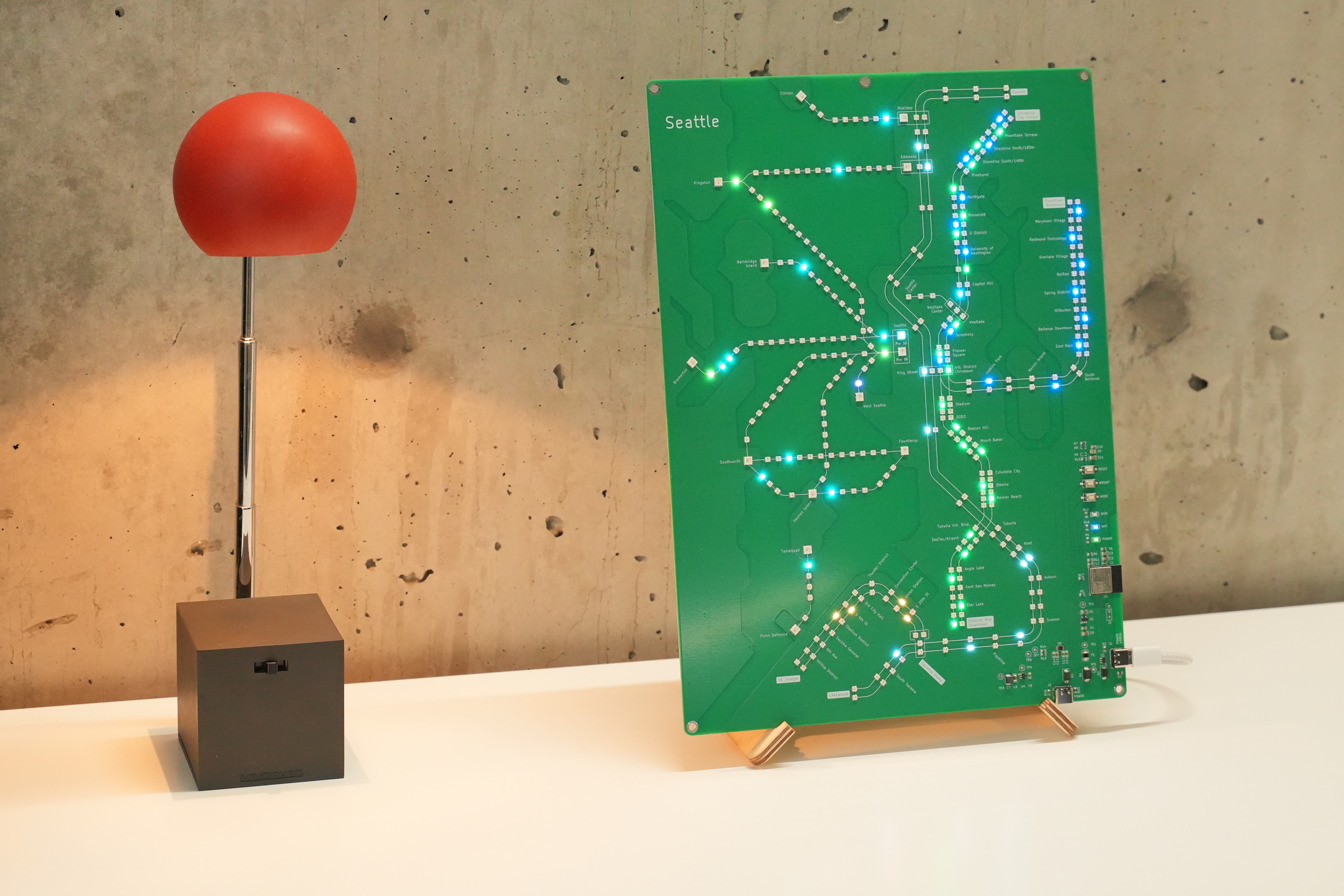
When Sound Transit opened the light rail 2 Line across Lake Washington in March, software engineer Michael Benedict built a custom gift to mark the milestone for his transit-fanatic wife: a circuit board map of Seattle with tiny lights depicting moving trains.
Today, that personal birthday project has evolved into Seattle Transit Live, an interactive LED map that tracks Puget Sound-area light rail, trains, ferries, and the water taxi in real time using public transit data.
The extra time to indulge in such a detailed build came after Benedict was laid off from Amazon — where he worked as an engineer for a little over three years. Rather than rushing into another full-time corporate role, he picked up some freelancing and gave himself room to dive into CAD design, custom hardware and the prototyping process.
“I put way more time than is ever going to be economic into this,” Benedict told GeekWire. “I really kind of luxuriated in it because I didn’t have a job and I could just go deep.”
Designed on a custom fiberglass circuit board with etched copper detailing Seattle-area waterways, the $219 device plugs into Wi-Fi to display live positions of vehicles like Sound Transit trains, Washington State Ferries, the Sounder, and Monorail.
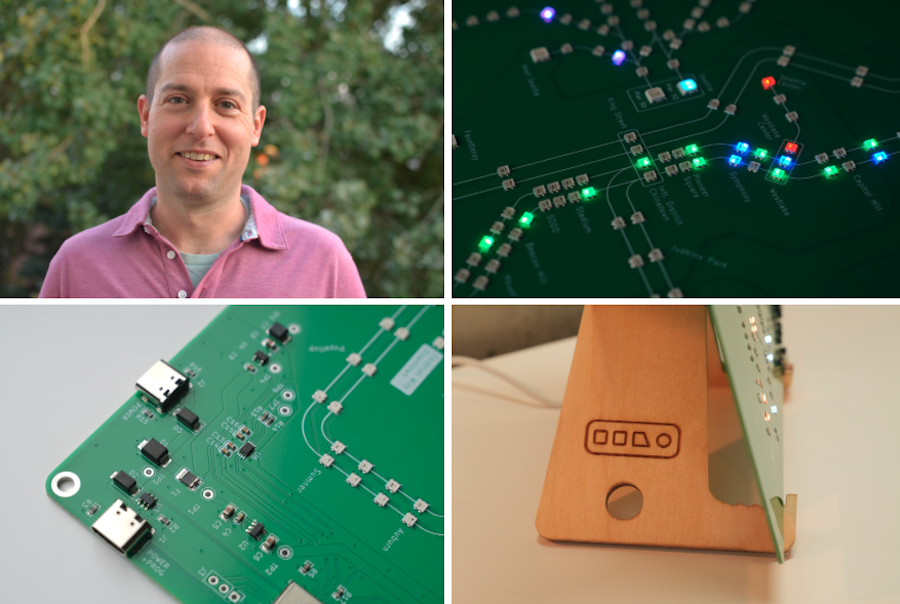
After Benedict posted an early prototype on Reddit and saw an enthusiastic response from local transit geeks asking to buy one, he refined the design and turned the side project into a full production run.
To power the display, the board uses an ambient light sensor to adjust to room brightness and features three distinct software modes. Alongside the real-time data mode, users can switch to a schedule replay mode or a fast-forward option that cycles through a full 24-hour transit schedule at 400x speed — letting users watch a day’s worth of regional traffic zip across the board in minutes.
The 8.6-by-11.8-inch boards are pretty jammed with assorted routes, but we had to ask if there would ever be room for Sound Transit’s eternally delayed Ballard neighborhood line.
“If I’m still making transit maps by the time they put Ballard in,” Benedict laughed, “I’m going to consider that a huge win all around.”
While circuit board maps and LED transit art have been built for transit networks in major cities like New York and Tokyo, Benedict sees Seattle’s unique geography and growing light rail as a compelling canvas for the concept. The board isn’t intended to replace trip-planning apps like OneBusAway, but rather to serve as a piece of functional art that captures the living movement of the region in a physical medium. And it’s all open-source.
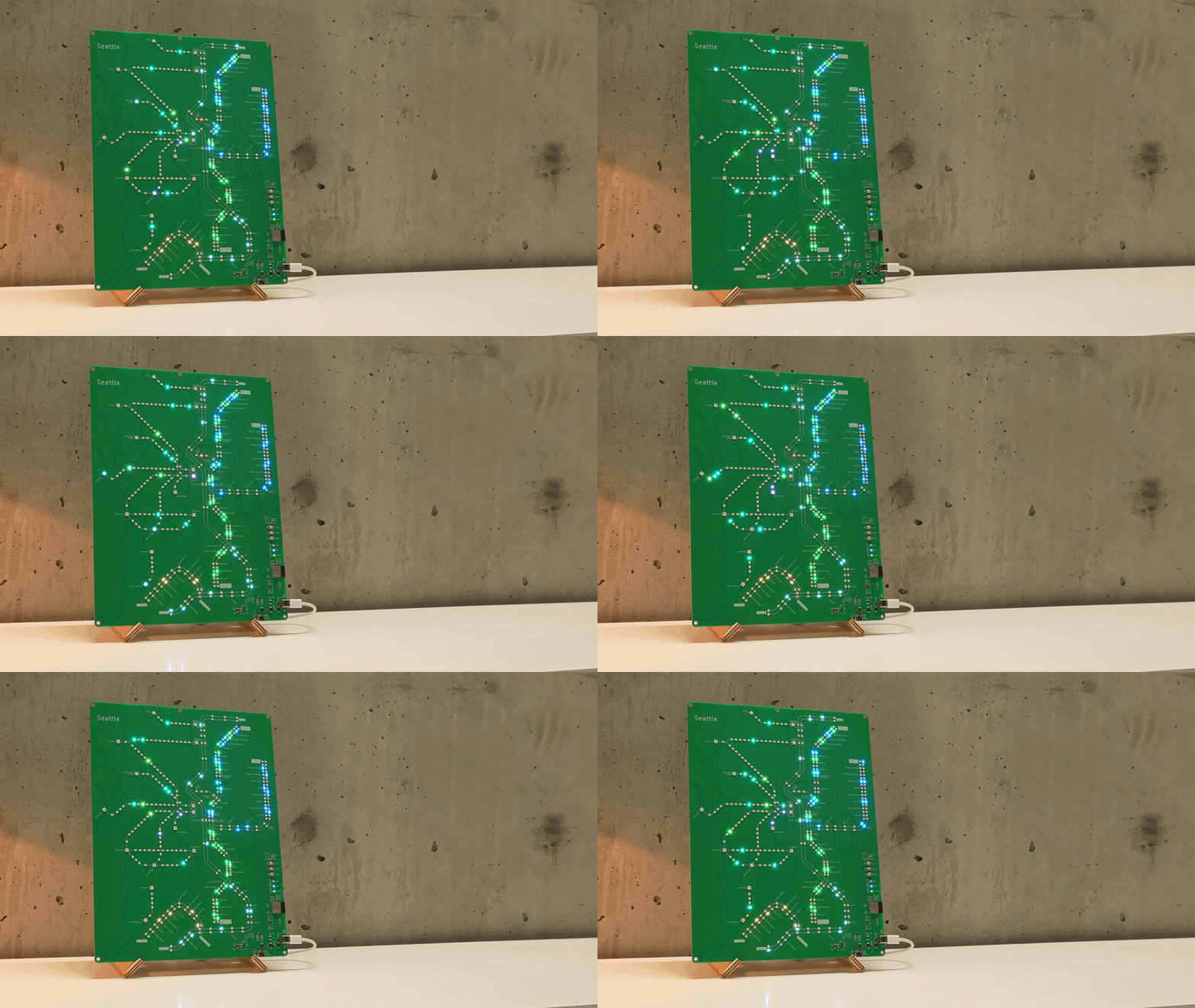
The printed circuit boards are manufactured in Shenzhen, China — a standard approach for small-batch electronics — but Benedict wanted to keep a key part of the production local. He partnered with Oxbow Fabrication in Seattle’s Georgetown neighborhood to CNC-machine custom wooden stands, ensuring each board ships with a locally made mount.
The initial run of 50 pre-orders sold out quickly, prompting Benedict to order another 150 units to carry him through the end of the year. And going all-in on an independent hardware project has come with its own brand of founder anxiety.
“Putting 75,000 LEDs on your personal credit card is enough to make you think, ‘Maybe I should send some emails,'” he laughed.
Benedict recently showcased the project at the Seattle Design Festival, and he’s considering potential retail establishments in the city where offering such a niche piece might make sense — such as the gift shop at the Seattle Art Museum.
Beyond Amazon, Benedict’s tech career has included data science roles at 98point6 and Modernist Cuisine. Originally from Queens, N.Y., his embrace of the Pacific Northwest has been accentuated by his hardware project. Living next to the new Judkins Park station for the 2 Line, with a front-row seat to the region’s evolving transit landscape, has helped, too.
“Transit is just a really cool subject matter for it,” Benedict said. “It’s on a schedule, the data’s there, and it feels very Seattle — how the boats and trains move around.”