
Editor’s note: GeekWire has been examining the economic challenges facing Seattle and the lessons the region can learn from Cleveland’s industrial decline and ongoing comeback. This three-part series from GeekWire columnist and angel investor Charles Fitzgerald explores how Seattle can navigate its own economic transition, adapt to a changing technology landscape, and preserve the prosperity that generations of innovation have built.
As you think about Seattle’s next act, let me offer a catchphrase: Don’t be Cleveland.
Before anyone from Northeast Ohio takes me to task again, let me quickly clarify: Don’t be the Cleveland of the last half of the 20th century. Today’s Cleveland is a story Seattle should study.
I’m far from the only one worried about Seattle. City Hall, the Seattle Metropolitan Chamber of Commerce, and the newly formed Partnership for a Competitive Puget Sound are all sounding alarms about the region’s economic future.
An independent 127-page City of Seattle-commissioned economic assessment — Seawall: Building a Resilient Seattle Economy — takes issue with the Cleveland comparison I penned for GeekWire earlier this year. The report says claims that Seattle could become the “next Cleveland” are “likely hyperbolic,” while acknowledging that “Seattle has real economic challenges.”
Hyperbolic is far from the worst thing I’ve been called.
Despite a reluctance to fully embrace Cleveland as a cautionary tale, the city’s report provides more to agree with than disagree with. And kudos to the city for taking an honest look at the economy, including criticism of the mayor’s signature policies.
Preparing for Seattle’s Next Act
Over the past decade, Seattle delivered more broad-based prosperity than almost any U.S. region, according to the Seawall report. Wages rose across the income spectrum, with the biggest gains at the bottom. Even after adjusting for living costs, workers at the 25th percentile earned roughly 15% more than their counterparts in Atlanta, Charlotte, and Minneapolis.
That’s a remarkable record.
It also makes Seattle’s current economic anxiety harder to dismiss — and its prosperity worth protecting. If Seattle’s performance disappoints, where exactly would you rather be? Growth brings problems, especially when poorly managed. But the alternative is worse.
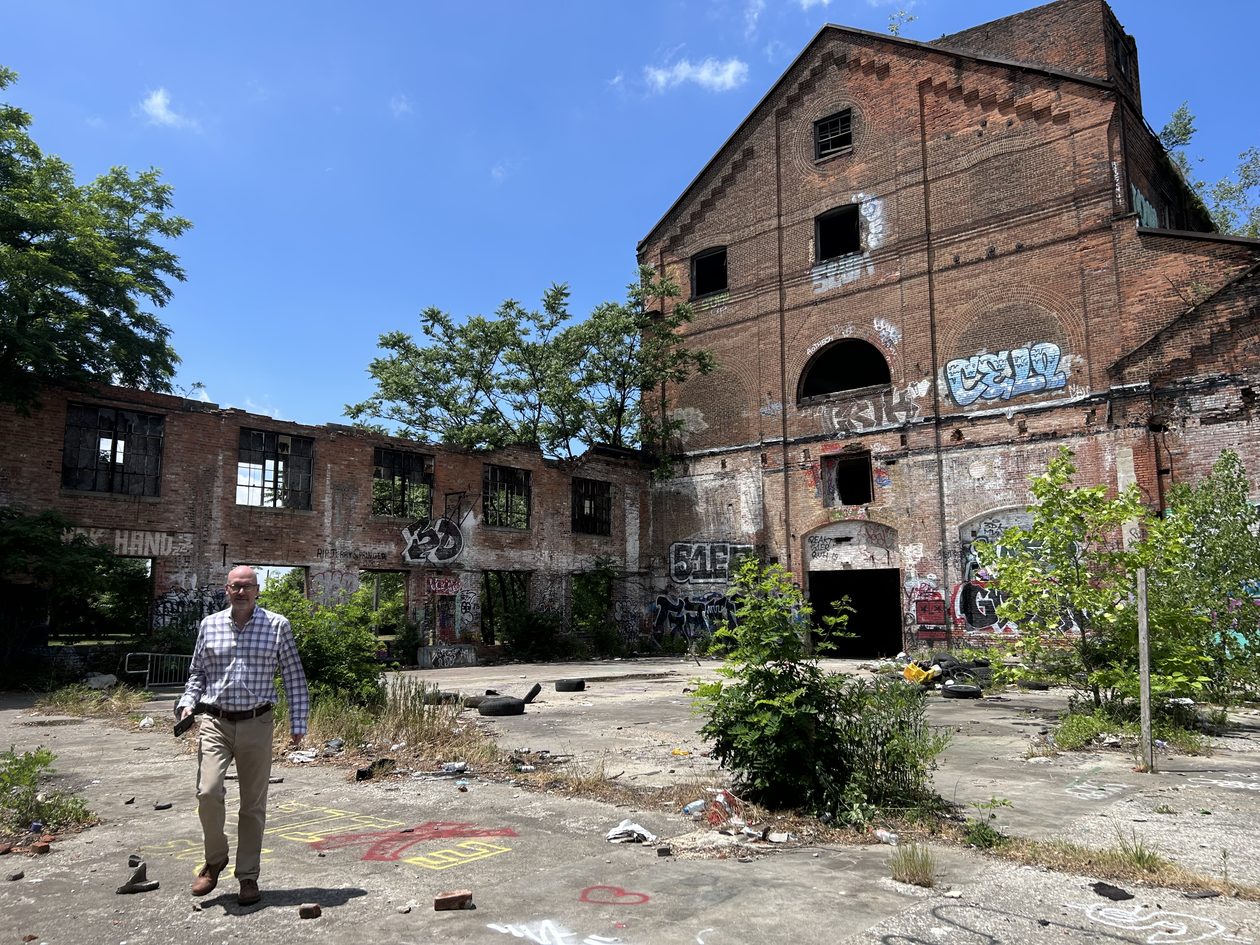
We saw the aftermath firsthand when we visited Cleveland earlier this year. Its story is a reminder that prosperity isn’t permanent — and rebuilding an economy after decades of decline is a lot harder than keeping one healthy.
Much like Seattle today, Cleveland 75 years ago was a very successful city riding decades of strong economic and population growth, and home to some of that era’s Big Tech giants. The Cleveland Browns even dominated the 1950s NFL.
But Cleveland’s prosperity unraveled quickly.
The world changed. The Rust Belt started to rust. Employers closed down.
Cleveland’s population dropped 59% from its 1950 peak to 2020 — from 914,808 to 372,624 residents.
It went from one of the nation’s richest cities to one of the poorest. Seahawks fans take note: the Browns have never been to the Super Bowl.
When we visited Cleveland earlier this year, we asked everyone from the mayor to real estate developers to arts leaders what they wish they’d done differently and sought their advice for Seattle.
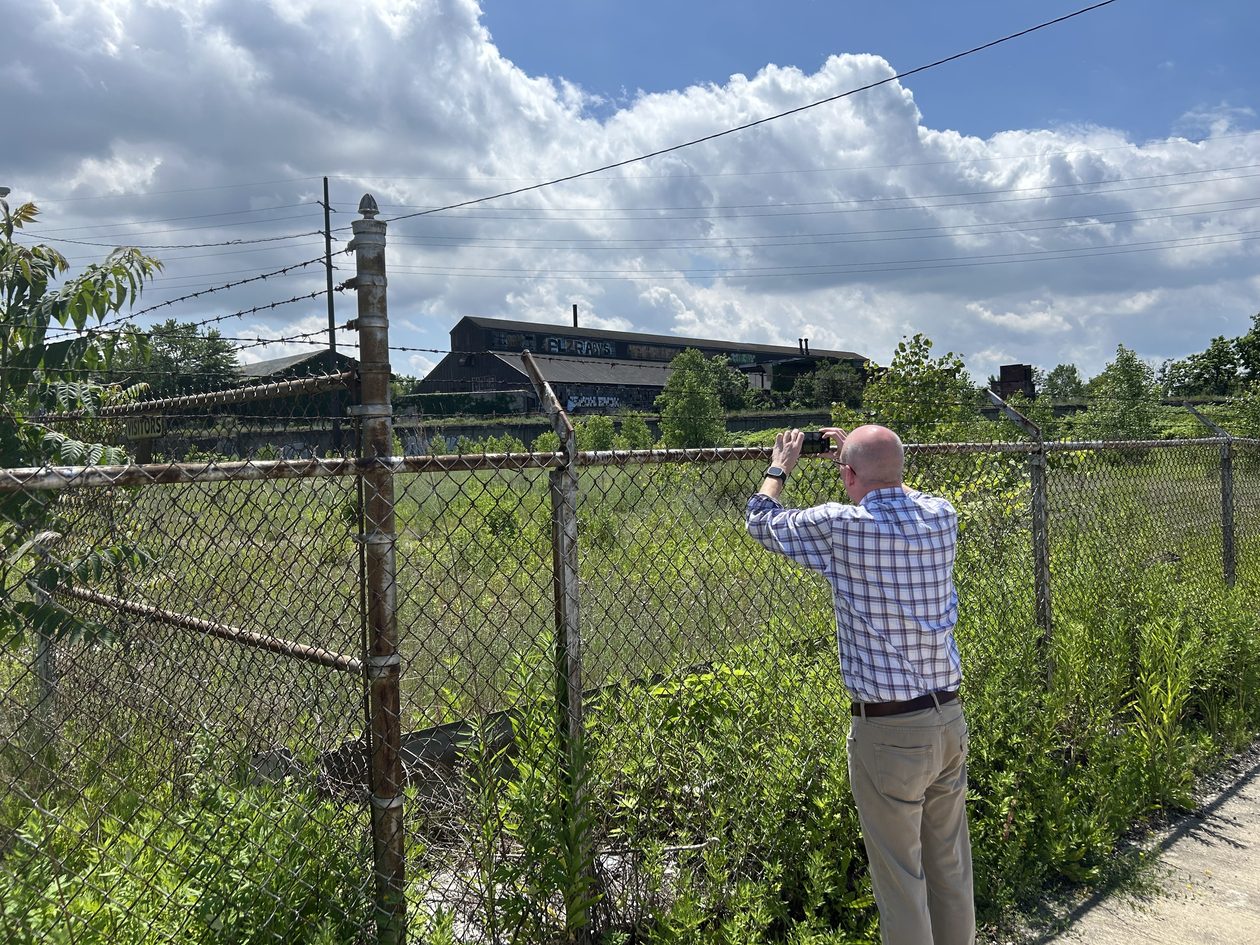
We learned a lot from a city hungry, united and focused on building prosperity for its residents.
Seattle rode the software boom to remarkable prosperity. Can it do the same in the AI era?
The warning signs are hard to ignore.
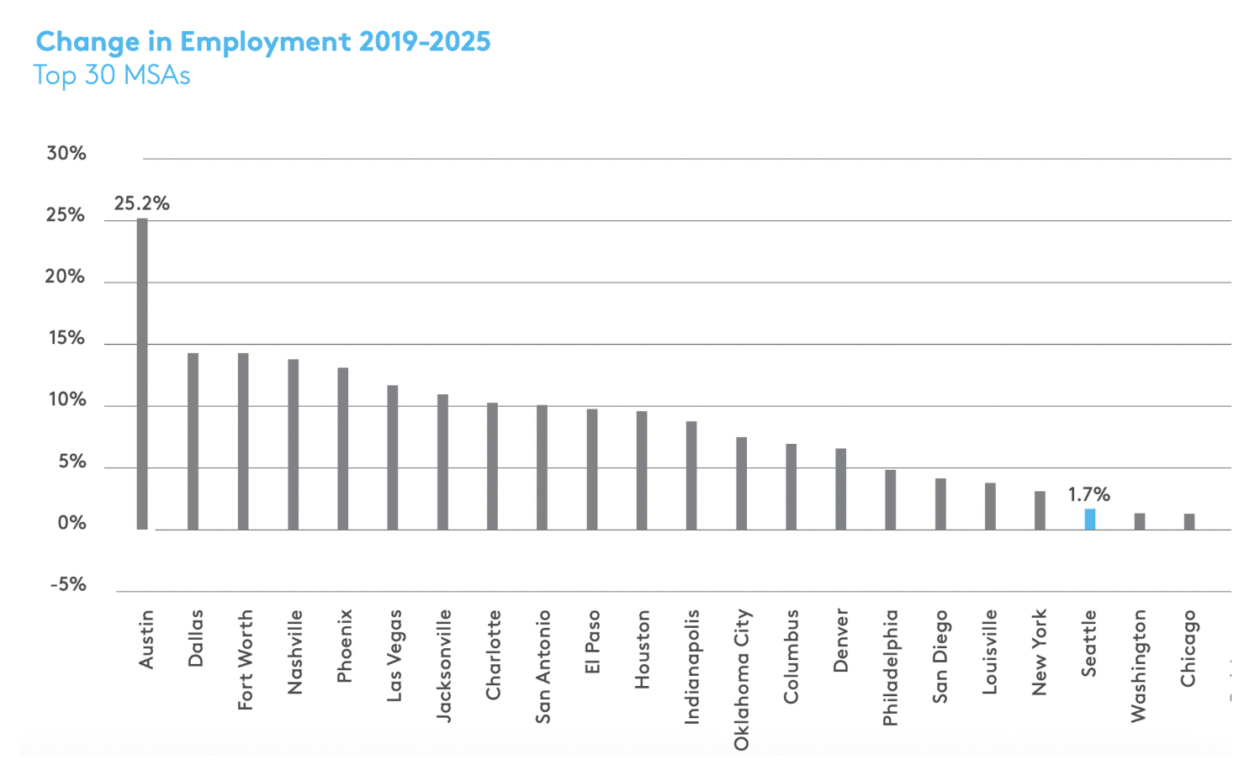
Amazon and Microsoft have cut more than 10,000 jobs across the Seattle metro area since 2023. Downtown office vacancy remains among the highest in the country. And the center of gravity for the AI boom is in the Bay Area, raising questions about Seattle’s ability to capture the next wave of growth.
The city’s economic report puts the challenge bluntly: “The version of the tech sector that drove the last wave of economic growth will not drive the next one.”
The report warns that Seattle’s next generation of startups may not be ready to replace the growth engines of the past. The risk isn’t just layoffs or empty office towers. It’s the company never founded, the midsize business squeezed by rising costs, or the engineer who leaves to build a startup somewhere else.
So how does Seattle prepare for its next economic chapter?
A Grand Unified Theory of Urban Success: Attract People
At its simplest, a city’s job is to attract people — and give them reasons to stay.
Population isn’t a perfect measure of prosperity, but it’s a useful proxy for a city’s appeal. People come for opportunity. They stay when the opportunities and quality of life are worth it. Growth brings challenges, but those are preferable to the alternative.
As Cleveland Mayor Justin Bibb told us, “I envy problems around growth.”
Seattle’s population has grown nearly 40% since 2000.
But that growth is slowing as our economic engine sputters.
The Boeing Bust of the 1970s, when Seattle’s population fell 7% and unemployment hit 17%, is a reminder that what goes up can come down.
Today, cities compete globally for talent, entrepreneurs and employers. That competition will only intensify as populations age and immigration restrictions tighten.
The most talented workers and entrepreneurs can go where they see the greatest opportunity — and where they feel wanted.
Consider what Seattle’s last century might have looked like without three people: Bill Boeing, Bill Gates and Jeff Bezos.
Boeing helped turn Seattle into an aerospace powerhouse. Gates chose to move Microsoft from Albuquerque to the Seattle area to usher in the software boom. Bezos and his then-wife, MacKenzie, famously drove their Chevy Blazer from Texas to Seattle to start Amazon.
Each helped shape the region’s economic future. We can’t predict who the next generation of business builders will be. But does Seattle have the same pull today? Or are the people we need choosing Austin, Miami, San Francisco or somewhere else?
Attracting newcomers matters. So does keeping the people who are already here. Do the economic opportunities still justify the cost of living? Is Seattle still a place where people want to live, work and play?
Residents have plenty of reasons to question the deal: public safety, housing costs, homelessness, schools, government services and taxes. Do the positives still outweigh the negatives?
Decades of growth brought extraordinary people and companies to Seattle. Our best chance of building the next era of prosperity is to keep them here — and give them room to build what comes next.
Yet we risk losing people and businesses we can’t easily replace: talented workers, entrepreneurs, executives, inventors, technologists, engineering teams and global headquarters.
As Seattle’s mayor waves goodbye to departing business leaders, the city’s own Seawall report offers a blunt warning: “Headquarters and top-tier tech jobs are very hard to replace.”
The report makes the broader case for growth, too. Losing tech jobs and companies won’t make Seattle more equitable, it warns. “If they leave, Seattle won’t become more equal, it will just become poorer.”
There’s a practical reason for that. Seattle’s fiscal model depends on a growing economy.
More residents and businesses generate property and sales tax revenue without requiring higher tax rates on those already here. As the report puts it, “it is easier to distribute the benefits of a growing pie than a fixed one.”
That’s another way of saying that when government spending outpaces population growth, a stagnant economy leaves fewer options for paying the bills — a challenge we’ll revisit in the next post.
Thanks to Cleveland for reminding us prosperity is fragile, decline is real, and recovery can take generations.
Seattle’s next era of prosperity is ours to build — or squander.
In the next post, we’ll look at what Seattle needs to do to get the fundamentals right to ensure the city is a great place to live, work and play.


