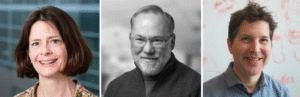
Mary Brunkow of the Seattle-based Institute for Systems Biology (ISB) and Fred Ramsdell of Sonoma Biotherapeutics, which has offices in Seattle and South San Francisco, today were awarded the 2025 Nobel Prize in Physiology or Medicine for their research on the immune cells that prevent the human body from attacking itself.
Shimon Sakaguchi of Osaka University in Japan will also share the prize for their work identifying regulatory T cells, dubbed the “immune system’s security guards.”
“Their discoveries have been decisive for our understanding of how the immune system functions and why we do not all develop serious autoimmune diseases,” Olle Kämpe, chair of the Nobel Committee, said in a statement.
In 1995, Sakaguchi made the initial discovery of immune cells that protect the body from autoimmune diseases, but many in the field were skeptical of his conclusions.
Six years later, Brunkow and Ramsdell were working together at Celltech, a biotech company that previously had an R&D facility in Bothell, Wash. They identified a gene they named FOXP3 that, when damaged, caused severe autoimmune illness in mice. They also showed that a mutation in the human version of this gene caused the rare, life-threatening autoimmune disease IPEX.

The research done by the trio solidified the role of regulatory T cells, or Treg cells, and launched a new field in peripheral tolerance research, which is the study of how the body makes the distinction between dangerous invaders and its own cells. Work in this area has led to therapies for cancer and autoimmune diseases.
Brunkow earned her bachelor’s degree in Molecular and Cellular Biology from the University of Washington, and holds a master’s degree and PhD in Molecular Biology from Princeton University.
When the Nobel Committee tried to reach Brunkow today to inform her of the award, she ignored the call, the Associated Press reported.
“My phone rang and I saw a number from Sweden and thought: ‘That’s just, that’s spam of some sort,’” Brunkow told the AP.
“When I told Mary she won, she said, ‘Don’t be ridiculous,’” said her husband, Ross Colquhoun.
Brunkow worked at Celltech for a decade, until the United Kingdom-based company closed its Bothell facility in 2004. She has been a senior program manager at ISB for more than 16 years.
“ISB congratulates Dr. Brunkow on this extraordinary honor and celebrates her contributions to science and human health,” ISB President Jim Heath said via email.
ISB is a nonprofit studying cancer, aging, infectious disease, chronic illness and other health challenges. Renowned Seattle scientist Dr. Lee Hood co-founded the organization in 2000 for research into systems biology, an interdisciplinary field that tackles biology from an integrated perspective. ISB is an affiliate of the Providence health care system.
Ramsdell is based on Bainbridge Island, just west of Seattle. In 2019 he helped co-found Sonoma Biotherapeutics, which opened a new R&D center and office space on Seattle’s waterfront last year. The company is focused specifically on Treg cells. It has a partnership with Regeneron to co-develop cell therapies for Crohn’s disease, ulcerative colitis, and two undisclosed conditions.
“Like many great scientists, [Ramsdell] spent years working behind the scenes to identify the gene that caused devastating systemic autoimmune diseases in a little-known strain of mice,” Jeff Bluestone, Sonoma CEO and president said in a statement. “The discovery of the gene, FOXP3, changed our understanding of peripheral tolerance and led to a new field of immunotherapy.”
Ramsdell earned his PhD in microbiology and immunology from the University of California, Los Angeles and holds a bachelor’s degree in biochemistry and cell biology from the University of California, San Diego.
His career includes roles at Seattle biotech giants Immunex and Zymogenetics, and he spent six years at Celltech. Ramsdell was previously chief scientific officer at Sonoma, and is now chair of the company’s scientific advisory board.
The Seattle area is home to numerous companies and organizations working on autoimmune diseases, a list that includes but is not limited to:
- Adaptive Biotechnologies has done research on T-cell receptor genetic sequences associated with Crohn’s disease.
- Bothell’s Sana Biotechnology has a drug program pursuing allogeneic CAR-T cells that target autoimmune diseases and leukemia.
- Mozart Therapeutics, a company targeting celiac and conditions including gastrointestinal disorders such as Crohn’s disease, Ulcerative Colitis and others.
- Indapta, a biotech company with facilities in Seattle and Houston, is using its universal natural killer cell platform to develop therapies.
- Seattle’s Alpine Immune Sciences, which was acquired last year by Boston-based Vertex Pharmaceuticals.
The prize was announced today at the Nobel Assembly at the Karolinska Institutet in Stockholm. The trio of winners will share 11 million Swedish kronor, which equals about $1.17 million.
Last year, UW biochemist David Baker won a Nobel Prize in chemistry for his research and discoveries about the molecular structure of proteins.
Editor’s note: Story updated to correct that Fred Ramsdell is based on Bainbridge Island, Wash., and to add additional information on his career.