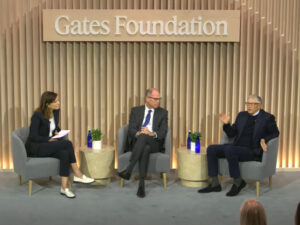
Bill Gates today announced plans to give away $200 billion — including nearly all of his wealth — over the next two decades through the Gates Foundation, a groundbreaking organization focused on global health and other social initiatives.
The Seattle-based foundation, which is celebrating its 25th anniversary this year, will sunset its operations on Dec. 31, 2045. The philanthropy is the world’s largest and has already disbursed $100 billion since its founding, helping save millions of lives.
“There are too many urgent problems to solve for me to hold onto resources that could be used to help people. That is why I have decided to give my money back to society much faster than I had originally planned,” Gates wrote on his blog.
The news comes as the Trump administration has slashed America’s support for global foreign assistance, spiking the U.S. Agency for International Development (USAID) and working to dramatically cut funding for health and scientific research.
“I don’t need to stress the massive volatility and some setbacks, and massive political and economic headwinds,” foundation CEO Mark Suzman said today in a call with media. He noted that governments from the U.S. to Europe are cutting back their international support, while the philanthropy is “going to be able to stay steady.”
The foundation had already begun ramping up its grant making, issuing $8.75 billion this year, and committing to distributing $9 billion next year. It has a $77 billion endowment.
Suzman said he wants today’s news to be a message of hope and inspiration. “It’s a reminder,” he said, “at a time people are very focused on many of the negatives of the present that … the last quarter century has seen the greatest improvements for the greatest number of people across the world, in a very geographically diverse way, across Asia, Africa, Latin America, than has ever happened in human history.”
Gates, in a New York Times interview, said he hopes other super wealthy individuals follow his lead.
“I do think good examples influence other people,” he said. “I think the rich people today should do more philanthropy, and we have some examples of that. And I think the rich people 20 years from now should do more in philanthropy.”
In sharing the news, the foundation highlighted three focal areas for its next 20 years:
- Helping to prevent the deaths of mothers and babies
- Working to end deadly infectious diseases
- Aiding millions of impoverished people with the goal of “putting them on a path to prosperity”
“Our impact is measured not by the money we spend. It’s ultimately the human impact,” Suzman said. “It’s lives saved and opportunities provided for the poorest and most vulnerable in the United States and around the world. And we track that every day.”
Gates had already committed to giving away the bulk of his wealth — but not shared the pace or target amount of his donating. In 2010, the Microsoft co-founder joined his now ex-wife Melinda French Gates and Warren Buffett in creating the Giving Pledge, a public vow that they encouraged others to join in which signatories agree to disburse the majority of their fortune in their lifetimes.
Over the years, Buffett has been a major contributor to the Gates Foundation, which Bill Gates formed alongside French Gates and his late father, Bill Gates Sr.
French Gates resigned as co-chair of the philanthropy last June, roughly three years after she and Bill Gates announced their divorce after 27 years of marriage.
Buffett, who has given approximately $43 billion to the foundation, left his role as trustee shortly after news broke of the divorce. Last year, the CEO of Berkshire Hathaway made clear he would not provide any additional dollars after his death — though news reports suggested the foundation had expected a significant posthumous donation.
Both French Gates and Buffett have been “kept in the loop about the plans” to increase funding and wind down operations, said Suzman, who thanked them for their impactful work with the foundation. “They are pleased and excited about today’s announcement,” he added.
Since launching, the foundation has been a leader in the global health arena and says that it has helped save 82 million lives through two key initiatives: Gavi, the Vaccine Alliance and the Global Fund to Fight AIDS, Tuberculosis and Malaria.
The Gates Foundation has also provided resources to creating technologies targeting people in low- and middle-income countries, including new vaccines, diagnostic tools and health treatments.
The organization today reinforced that it will also continue its work outside of health. That includes investments in:
- Education in the U.S. with a focus on low-income, Black and Latino students
- Support for agriculture and small-holder farmers
- Gender equality programs that increase access for women and families to education, healthcare and financial services
- “Digital public infrastructure” to provide access to financial and social services
In 2022, Gates said he could see the foundation winding down in 25 years, with himself and French Gates still around “to help make sure it stays on track.”
That declaration ran counter to the foundation’s governance documents, French Gates noted at the time. The agreed-to plan had been to operate the philanthropy for an additional 20 years after both she and Bill Gates had died.
In announcing the sunsetting of the foundation, Gates referenced another legendary philanthropist, steel magnate Andrew Carnegie. Carnegie in 1889 wrote a treatise on the moral imperative that the ultra rich donate their wealth while still living.
“In the essay’s most famous line, Carnegie argues that ‘the man who dies thus rich dies disgraced,'” the 69-year-old Gates wrote.
“I have spent a lot of time thinking about that quote lately,” he continued. “People will say a lot of things about me when I die, but I am determined that ‘he died rich’ will not be one of them. There are too many urgent problems to solve for me to hold onto resources that could be used to help people.”
Follow-up: Bill Gates details optimistic plan for foundation’s final chapter amid ‘incredible crisis’