

We live in a world built on connectivity. Look around. Chances are, if you’re in a public setting, be it work, school, or at your local coffee shop, everyone around you is connected to the internet on multiple devices. The Internet has become fundamental to today’s culture, indivisible from nearly everyone’s daily life and routines.
On a large scale, the internet has revolutionized global sectors such as business, communications, education, healthcare and government. On a smaller but equally important scale, it’s revolutionized global social structures and communications. Today, whether businesses need high-speed connections to support cloud-based industrial applications or simply to provide their retail customers with reliable in-store connectivity while shopping, fast, high-capacity connectivity is a must. It’s the same story at home for virtual learning, remote working, or simply sitting on the sofa catching up on a favorite show—a high-speed connection has become key to our modern existence.
That makes it easy to see why internet service providers (ISPs) like my company, Ziply Fiber, are working so hard to not just make sure your internet allows you to do all those things today, but also that we’re thinking ahead and building technology (like 5-gig and 2-gig residential fiber and beyond) to ensure you receive the best possible connectivity for years to come. We’re futureproofing our network for your home and business.
The Internet: Then and Now
The transformative effect the internet has on society is directly correlated to how the internet itself has been transformed throughout the years. Let’s look at one of today’s most popular businesses. Netflix started in 1997 as an online, rent-by-mail, DVD service. Users would browse their website—typically on a dial-up internet connection with speeds around 40 kbps, if you were lucky— to rent a movie delivered straight to their door. As the allure of online ordering and preference customization attracted millions of customers to Netflix, competitors like Blockbuster explored the possibility of streaming. However, with dial-up internet connection still the norm, the technology simply wasn’t compatible.
Throughout the next decade, ISPs continued to innovate—introducing services like broadband and WiFi that allowed for accessible, high-speed connections anywhere in the home. Years later when Netflix decided to pivot from DVDs to the streaming service millions of people know and love today, the technology had evolved, and the internet was finally able to keep up with the needs of users.
In the last two years alone, we have seen the rapid acceleration of digitalization across all sectors of business. From customer relations to internal and external operations, companies big and small have used the internet to stay competitive in our new digital environment. Traditional businesses like grocery stores and healthcare are even embracing online channels with $59.5 billion in digital grocery sales expected in the US, and telehealth spending expected to reach $106B in 2023.
As the world continues to move dramatically towards online channels, the nature of how and why we use the internet is evolving. That evolution won’t stop, which is why it’s critical for ISPs to focus on the future and invest in what people and companies will need years from now, not simply what they’re desperate for today.
Futuristic fiber-optics
This need for network evolution is why Ziply Fiber has prioritized aggressive fiber expansion across the Northwest, bringing the fastest possible internet to millions of people at their homes and businesses—and not just in big cities, but in smaller suburbs and rural and frontier communities too, because we believe zip codes shouldn’t determine the quality of someone’s internet.
Simply put, fiber-optic internet is the best available internet—better than cable or DSL. With a fiber-optic network, not only can you get multi-gig-speeds, but also the unique advantage of symmetrical upload and download speeds combined with super low latency. Because fiber-optics are designed for data they deliver speeds and reliability that is far superior to other connection types. In fact, it is fiber that is in the backbone networks that feed all other types of connections. In short, fiber is the gold standard.
For example, we recently added equipment that enabled both the new and old portions of our network to deliver both 2-gig and 5-gig residential service—the fastest in the Northwest—and the speed and capacity does not stop there. Fiber is capable of far more as the needs of our users grow. Our all-fiber infrastructure ensures both symmetrical speeds and that neither your download nor upload abilities are constrained by large file sizes or lack of bandwidth in high-traffic areas—a crucial advantage for consumers and businesses in today’s digital world. Cable internet, although more widely available, lacks the capacity, speed, and reliability that fiber provides.
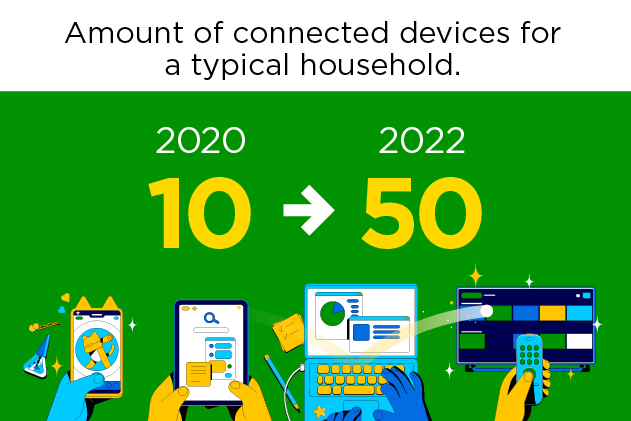
A key takeaway from the last few years is how crucial a reliable connection is for students and employees. As of 2020, the typical household averaged 10 connected devices, with numbers expected to rise to 50 by this year. More so, many of these devices are being used simultaneously. When shifted to a remote environment, the sudden influx of video and audio across devices has proven troublesome for networks operating with asymmetrical speeds and became frustrating to many users. However, those using fiber-optic networks have generally experienced clear, consistent, reliable connections.
By anticipating consumer needs and social trends, ISPs like Ziply Fiber were able to build our network with greater capacity, allowing businesses to have high-functioning capabilities, and entire families to simultaneously work, stream, game, order takeout, chat and much more without any lag or congestion. So why stop there?
A network built for tomorrow’s needs
In addition to the expected increase in connected devices, the content we consume and create will continue to evolve as the world is becoming increasingly online.
Content streaming will become more and more prevalent in business and entertainment. Video calls with embedded video content sharing will become the norm for businesses. Neighborhood coffee shops will see multiple people logged on and all video conferencing at once. We’ll see the rise of immersive 8K sports, online events, and gaming. In summary, file sizes will increase, digital channels will grow exponentially, and online operations will require large amounts of bandwidth, greater capacity and much quicker download and upload speeds.
Many current networks will not have the capacity to manage this influx of devices and usage, high quality content and round-the-clock connectivity that are increasingly required by users as more online services are integrated into daily life. According to a report by CISCO, the average internet user was projected to generate 57 gigabytes of internet traffic per month in 2021, up 139% from 2016. Our fiber users greatly exceed this prediction now, with the average fiber connected home starting to approach one terabit/month of usage. Usage growth continues and with more and more events and services moving online, it is crucial for ISPs to prepare for these upcoming higher bandwidth needs now or risk congestion in the near future.
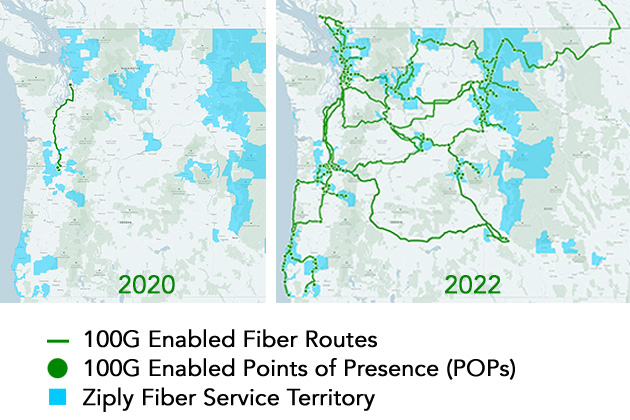
Ziply Fiber is doing just that. We’re building a network with more capacity, made for a world where the average person owns more than 15 IoT devices, and the average business operations are 75% online. We’ve built networks capable of terabits per second between our offices and are constantly upgrading our core and aggregation networks to operate at 40% peak load, ensuring that even during peak usage hours our network will support your use at full speed. A consistently fast connection 24/7 is our design goal.
More so, our network upgrades feature rigorous route diversity and a redundant core backbone that is operated by us for our customers and is capable of 20+ terabits per second on all major inter-city fiber paths. We utilize fully redundant local aggregation networks and multiple fiber connections so that we can keep your service up even when someone’s errant backhoe digging miles away accidentally tries to slow you down.
This allows us the capacity to support not just at-home 5-gig connections, but much more for both our residential and business customer-base well into the future. It also protects against single-location incidents or disasters that might break a customer’s connection.
The internet is going to continue to evolve and grow, and how people and businesses use it will evolve as well. Networks must evolve with it, and we must choose to innovate today to provide for the needs of consumers and businesses tomorrow. We choose to futureproof our networks for ourselves and for our customers and by doing so today, customers in turn will choose us. As I always tell my engineering team, we are building the network that we want to use, which means everyone else will, too.
