
Businesses have come to realize that no one cloud can fulfill all their requirements.
It’s 2021, and multi-cloud deployment is becoming the new reality of corporate IT.
The world’s businesses are either evaluating or already using multiple cloud providers to serve their diverse needs. What’s striking about this is that for a long time, one major tech vendor denied the very existence of “multi-cloud” deployments—actually banning the use of that term by employees and partners. But even that industry giant has now, apparently, seen the light.
While businesses might like the simplicity of dealing with a single provider, the tradeoffs are too big to overlook.
First and foremost, not every cloud is a carbon copy of other clouds. Yes, all public clouds offer basic computing and storage, and networking, but some are better than others at supporting and protecting enterprise-class applications and the data that feed them, or scaling quickly to support video streaming or gaming businesses. Some offer more flexible terms and conditions than others.

Broadly speaking, the advantages of using multiple clouds boil down to the core technological strengths of each cloud and the degree of flexibility each provider is willing to offer in pricing and other terms and conditions.
A business wanting to field only new “cloud native” applications could probably pick any of the four or five name-brand public clouds, all of which offer vast pools of resources that will meet these needs. But most businesses are more complicated than that and likely run an array of applications of different vintages. These companies should evaluate which cloud is best for each of their main categories of applications.
Different Clouds for Different Applications
That’s already happening as many business customers are adopting Cloud 1 for end-user productivity applications and Cloud 2 for heavy-duty server-side database and database-reliant business applications.
The reason, as noted above, is that different clouds have different strengths. Some are better than others at running enterprise-class databases and database-reliant applications which run better and faster on bare-metal or clustered infrastructure as opposed to the heavily virtualized infrastructure common to early cloud offerings. So, if a business wants to run databases in the cloud, it better make sure that the cloud is properly equipped to run them optimally.
And, businesses that want to use Cloud 1 and Cloud 2 should ask those providers if they are willing to work together to make this shared model work. One key sign would be whether the two providers support high-speed interconnects between their respective clouds.
Wanted: Flexible Deployment Choices
Some cloud providers are more able and more willing than others to integrate their cloud infrastructure with customers’ existing in-house technology. So, if a business wants to keep running at least some key services in its own data centers or in a private cloud, it should make sure that the cloud provider will accommodate and support those choices.
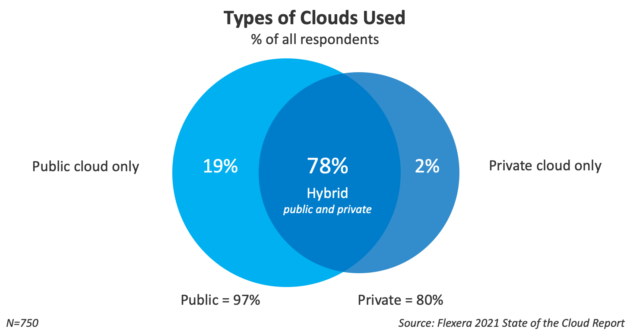
The 2021 State of the Cloud Report from Flexera found that, of 750 IT executives surveyed worldwide, 92% said they have a multi-cloud strategy in place– meaning that they want to use multiple public clouds or a mix of public and private cloud deployments.
That being said, companies should study pricing models carefully — for basic compute and storage services of course, but more importantly for network bandwidth. Many customers have found, often after the fact, and much to their dismay, that while shipping data into their cloud of choice is free, getting that data out again is definitely costly.
For a company that needs to stream data to end-users on the Internet, those data egress charges add up extremely fast and often result in sticker shock. Some cloud providers even charge to move data within their cloud regions.
This is why 100% of businesses assessing a cloud provider should compare data egress charges among all the cloud candidates under consideration. This is true not just for video streaming companies, but any business moving data from one application to another, if all its applications aren’t managed from a single cloud.
But more to the point, if a company is one of the vast majority of businesses that want to use mixed cloud environments, it needs to make absolutely sure that its cloud providers charge reasonable data networking fees to make that model as economical as possible. They should also look for high speed interconnection and compatibility with standards for automation, monitoring, logging, and service catalogs.
