
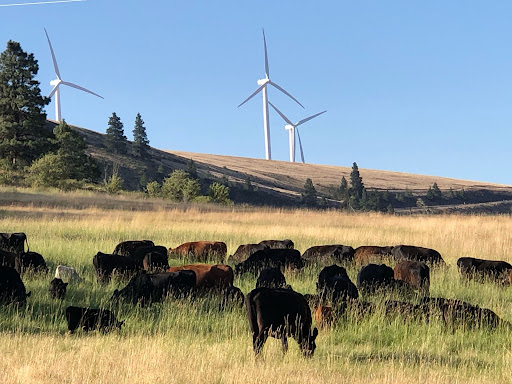
 When it comes to animal agriculture and its role in climate change, we can have our beef and eat it too, as the industry unites to take a sizeable bite out of its greenhouse gas emissions.
While livestock certainly leaves a carbon trail, scientists like Frank Mitloehner and Sara Place believe the animal ag sector can balance its global-warming scale in the not-too-distant future. Once it does that, it can actually – wait for it – be part of the solution to climate change by playing a supporting role in removing atmospheric carbon dioxide.
“Animal agriculture is one of the few industries that can pull carbon out of the atmosphere,” Mitloehner says. “That puts it in a position to help mitigate the effects of other industries once it achieves climate neutrality. But business as usual won’t get us there. We have to be aggressive in reducing emissions.”
Mitloehner and Place, who work extensively with farmers to lessen their environmental impact, are working with producers to bear down and reduce emissions dramatically. But instead of merely preaching, they are offering practical ways for the industry to reach climate neutrality. Beyond that, continued emissions reductions will help offset emissions from sectors that put megatons of carbon dioxide in the atmosphere from, for example, the burning of fossil fuels. More on that in a minute.
First, when we’re talking about livestock in general, we’re often giving the stink eye to cattle specifically. It’s likely due to their natural tendency to belch methane. The compound is a big deal to the makeshift greenhouse that we’re all living in. It’s also the key to helping us figure out what the devil to do about it.
To get the picture, think back to your elementary school science class and the circular diagram that showed plants using carbon dioxide to perform photosynthesis and animals eating the plants to become food for humans. Included in those ongoing events is a process known as the biogenic carbon cycle.
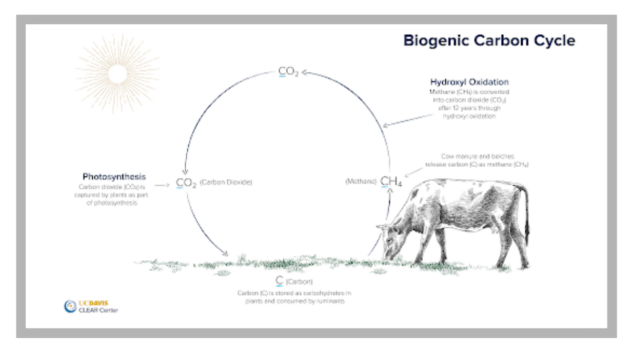
Methane is given off by animals in ways that make sixth-graders giggle. They burp it, poop it, and well, you get the idea. It goes into the atmosphere, where it hangs around for about a decade. After that, it’s broken down into carbon dioxide and water vapor. Plants pull the carbon dioxide out of the air to live, grow and become food for animals that can digest what humans cannot, and the cycle continues.
For that reason, scientists from the University of Oxford have suggested that we consider methane differently from other greenhouse gases. As opposed to carbon dioxide, the most plentiful gas stoking our planet’s heat blanket, methane is a short-lived flow gas. Though it’s more potent than carbon dioxide while in the atmosphere, it soon becomes a bovine of a different color.
For starters, it likes to clean up after itself. Methane produced today will be destroyed and removed by a natural process in the atmosphere about 10 years later. If methane emissions remain constant, there is no additional warming; it’s being pulled out at the same rate it’s being added. Reduce methane today, and you’ll help dial the Earth’s temperature back rapidly. That’s because less methane will be in the atmosphere and it will result in less carbon dioxide as a byproduct, forcing plants to get it from other sources. Your car might be able to parallel park itself, but the carbon dioxide emitted from its tailpipe can’t hold a candle to methane’s environmental magic.
While labs like Mitloehner’s are working on innovative ideas to help cattle reduce methane emissions, many are calling for a better way to measure methane’s warming impact. The old standby, GWP100, essentially treats methane like carbon dioxide on steroids, and that doesn’t always work. A new metric known as GWP star (GWP*) is a much better fit when we want to see the impact methane has on global temperatures. As the saying goes, we can’t manage what we can’t measure. GWP* gets us closer to effective management of methane.
Place is steadfast in her belief that GWP* is a major step in the right direction, saying it will go a long way toward helping the industry grapple with the scale of change that’s needed.
“Talking about measuring emissions from an animal is different from, say, a tailpipe, whose measurement and control is straightforward,” said Place. “With livestock, we’re operating with a moving process that has daily variables. In that environment, measurement and benchmarking are key components to moving forward.”
In the meantime, work continues on seaweed and essential oils as feed additives, and other way-cool things that will make our bovine buddies less gassy. Much of the work is voluntary at this point, but increasingly, legislation is fueling it too. The current administration recently committed the United States to the goal of reducing methane emissions worldwide by 30 percent by 2030.
“I’m bullish on the beef sector’s ability to be part of a climate solution with the right tools. Reaching climate neutrality is the first step,” said Mitloehner.
If ever there were a time to get this right, it’s now. Hunker down, bite the bullet, go all in and every other metaphor you can think of. Focus soon and hard on reaching climate neutrality, and we can all breathe easier, even while we share a (Dick’s or Burgermaster) burger.
Click for more about underwritten and sponsored content on GeekWire.
