
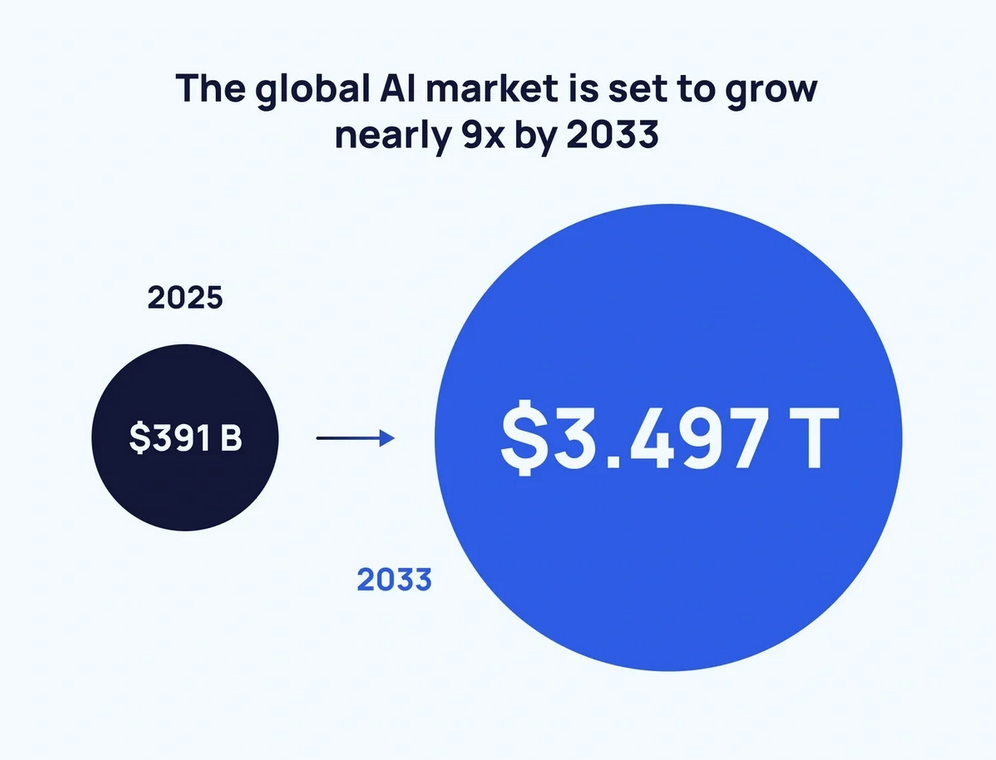
Artificial intelligence is scaling at a pace that outstrips the very systems meant to contain it. With the global AI market projected to grow by 9x to nearly $3.5T by 2033 at a 31.5% CAGR and reshape everything from enterprise workflows to consumer behavior, the infrastructure layer beneath it is straining under the weight of new demands.
Modern AI models require not only massive computational throughput but also unambiguous rules for how data is sourced, shared, validated, and secured. Yet the world’s data architecture was never designed for an era where algorithms learn in real time and value is created through continuous data flows rather than static datasets.
What’s emerging now is a structural gap. AI is accelerating, but the mechanisms that govern data rights, provenance, and ownership remain fragmented, jurisdictional, and in many cases outdated. That tension is pushing the industry toward blockchain-enabled frameworks that provide trust, traceability, and programmable transparency missing from legacy systems.
The transition is no longer theoretical. AI’s next major leap hinges on whether the world can build decentralized, interoperable data rails robust enough to support global-scale intelligence systems, and whether blockchain’s core primitives can become the foundation that finally aligns innovation with accountability.
Building Decentralized Data Economies
Data is becoming an indispensable digital commodity as its use cases expand across industries. However, the way it is fairly used and made accessible remains largely unresolved. Through blockchain’s utility and AI’s reliance on data, AI tokenization can enable data creators to reclaim ownership previously captured by technology monopolies.
The process of tokenizing AI relies on blockchain’s ability to provide ownership through an immutable network. Thus, AI datasets can be transformed into digital assets on the blockchain and used with smart contracts to enable access, retrieval, and rewards for contributors. Moreover, smart contracts can encode usage rights into tokenized AI assets, helping ensure programmable compliance and self-execution.
Binance Chief Security Officer Jimmy Su emphasizes the company’s push to pioneer AI security As stated, Binance is building the “world’s first global standard for AI management systems,” helping “validate our rigorous frameworks for ethical development, bias detection, transparency, and full compliance with the EU AI Act—safeguarding users and ecosystems alike.”
Furthermore, Binance’s AI development “isn’t just a badge of excellence; it’s a testament to our proactive stance against evolving AI risks, ensuring every innovation is built on trust and accountability.” Su underlines that he is “proud of our global teams whose expertise and collaboration made this possible. Looking ahead, Binance will continue leading the charge in trustworthy AI, empowering the crypto industry to thrive securely in an AI-driven future.”
Tokenized Data Empowers Producer-to-Consumer Value
AI and blockchain are converging as both sectors seek solutions to the rising demands of large-scale data use. In a few years, AI models will have increased their capabilities and use millions of data parameters to improve operations. As such, data is regarded as the core driver of innovation and value creation by artificial intelligence systems.
An estimated 2.5 quintillion bytes of data are generated each day; however, over 90% of all data has been created over the past two years.
Furthermore, by 2028, the world will generate 394 zettabytes per year, driven by increased reliance on AI, IoT, and machine learning. Major technology companies retain the majority of user-generated data behind proprietary barriers, creating a ‘data wall’ that limits broader availability.
Decentralized AI Training Networks Reduce Computational Monopolies
Decentralizing the training network can democratize new model developments. As a foundational basis, AI tokenization seeks to replace centralized AI infrastructure with decentralized processing nodes. With training computation doubling every 6 months, global access to GPUs can increase AI efficiency by distributing the workload to idle processing units.
Additionally, AI systems are increasingly able to scale their processes and automate data handling through blockchain-based execution. To enable such integration at a global level, these systems require robust security frameworks. Jimmy Su of Binance noted that the company has strengthened its AI infrastructure through the ISO/IEC 42001 certification, marking a significant milestone in its commitment to developing secure and responsible AI systems.
With better certification, AIs can rely on data decentralization without centralizing sensitive data in computational monopoles. As a result, enhanced security builds trust and supports greater data collaboration, strengthening the resilience of emerging digital infrastructures.
Reward Mechanisms for Data Contribution
AI development depends on large, reliable data systems, and blockchain infrastructure provides mechanisms to support these needs. Data can be tokenized and tracked on-chain, while smart contracts can provide dynamic compensation for AI model usage or data contributions.
As decentralized data networks grow, they shift the model from centralized data extraction to shared ownership. Instead of platforms capturing all the value, individuals who contribute data can receive rewards automatically and proportionally to their impact. This makes the system more equitable while keeping the incentives aligned.
Disclaimer: GeekWire newsroom and editorial staff were not involved in the creation of this content..
