
Microsoft back in hiring mode: Where it’s adding new jobs

Microsoft returned to modest employment growth in 2011, adding more employees around the world than at any point since making its first widespread cutbacks during the recession of 2008 and 2009.

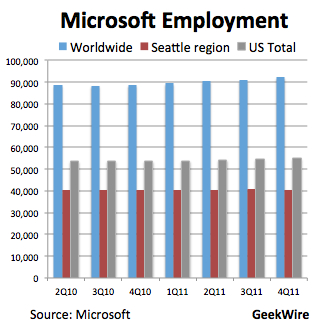
The company added a net total of 2,900 people over the past year — a 4 percent increase that brought its total direct workforce to more than 92,000 people as of Dec. 31, according to new job numbers released by the company in response to a GeekWire inquiry.

If the trend isn’t obvious in Microsoft’s backyard, there’s a reason. Our crunching of the numbers shows that the company’s employment in the Seattle region grew by less than 1 percent in 2011 — and even declined slightly between the third and fourth quarters, finishing the year at 40,649 employees in the region.

The numbers don’t include contractors and others who work for Microsoft through outside firms.

Microsoft’s largest growth during the past year came internationally. That was due in part to Microsoft’s $8.5 billion acquisition of Luxembourg-based Skype, which had about 800 employees prior to the announcement of the Microsoft deal.

But it wasn’t just Skype. Microsoft added a net total of about 1,700 employees internationally in 2011, an increase of 6 percent.

That compared with net additions of 1,147 employees (2 percent growth) in the United States overall in 2011. That brought the company’s total U.S. employment to 55,000, including people based in the Seattle region.

Even with the recent increase in Microsoft’s rate of hiring, Google and Amazon have both been hiring at significantly faster rates coming out of the recession. The search company grew its employment by 33 percent in 2011, to more than 32,000 people.

Amazon’s employment as of the end of the third quarter was 51,300, up 64 percent from the same point prior year. Amazon reports its year-end financial and employment numbers next week.

  • Guest

    I made a bet with a friend who’s rather bearish on Microsoft. He believes that the company will lay off so many employees that they’ll be able to lease out a building before the end of 2012. I challenged him. Based on these numbers, I think, as the French would say, les jeux sont faits.

    • Guest

      They’ve already announced up to 2000 marketing layoffs and several other spinoffs whose primary intent seems to be to offload workers without calling it a layoff (health unit and IVR staff). There’s still plenty of time for you to lose your bet, assuming you haven’t already.

      • http://geekwire.com Todd Bishop

        It’s more in the range of 200 marketing layoffs. http://www.geekwire.com/2012/microsoft-cutting-200-jobs-marketing-overhaul

  • GW fan

    It would be interesting to chart how many Microsoftees left and went to Google and Amazon.

  • Guest

    It would be interesting to fold in the number of contractors; does MSFT have a significantly higher number than Google and Amazon?  Is that their approach to keeping core employee numbers increasing at a slower rate?

  • http://twitter.com/Do_Go_On Do_Go_On

    Microsoft had some growing gaming sections and Azure services, but they did not start new lines of businesses as did Amazon and Google. Most of their employment increase was really due to acquisitions and you see that the employment graph here is for the company as a whole, not the Seattle area. Geekwire did a story not 2 or 3 weeks ago on possible layoffs in certain areas of Microsoft.

    What will be interesting is to see which company’s culture is sustainable. Everyone knows that at Microsoft, they eat their own and it is such an echo chamber when you work there. They value the mud fights of their own program managers and directors rather than actually competing with external competition. They also don’t seem to value talent outside the echo chamber and look to only labor cost as the biggest factor, which the successful gaming division rebelled against. They risk being Blackberry across the board and dying on their own sword. When will executives truly address the cultural problems?

    Ethics and culture is the challenge at Amazon as well. Their jobs and team structures are so inflexible that they don’t see that you really need something more than just engineers/product managers. They can get there fast, but people have noted their crap code base and blind spots. They consider their talent an annoying cost, and after the first blush of working there, talent realizes it’s so much frenzy, not enough values. They prefer to hire young and hot-winded  who believe in the job like it’s a high school cool club and hire on personality too
    often and their peer interviewing process, like Microsoft’s reinforce
    their flaws. Like hires like or hires what will not challenge it.

    Their dominance comes from being big and first. As the market changes, can they adapt? People are starting to hate them, and once alternatives emerge, they may plummet. As one pundit once said, “have anyone noticed that their interfaces look like ass?” They don’t care, they don’t have to, to pull from Lily Tomlin. Their ethics in their supply chain are getting the spotlight.

    Google….why do most talented people want to work there? Because it’s not an echo chamber. They seem to value talent, although there’s something they go for too much, that precious hipster look. Really? You know someone is talented if they are hipster looking or have that haggard ironman marathoner look? Tech companies are now too hung up on what people look like and Google is the worst. One thing steve jobs got right is to hire some different types of people in the org.

    A big thing that sucks at Google is their crappy office environment where people really don’t have a decent place to sit. Whoever thought up these cubes where they are slices of a pie and you get a triangle desk in an open space ought to have to be made to actually work that way themselves. Or you can grab a seat at crappy fold out table like some factory worker at a sewing workhouse. It’s cute when you are right out of college, but really, if you have to think and work, it is not optimal.

  • DriftMachine

    I just checked out the Microsoft Alumni Network. Funny thing. They charge more to people here in the US than in other countrys. Seems backwards.

    I probably get more perks for being the the msdn for free. On another note. I wish I was more qualified so I could try to get a job with them. 

  • http://twitter.com/SoftwareWorlds SoftwareWorld

    How many hires of Microsoft are contractors / temporary labor / resources in India / China etc ? Any breakdown on that?